[Dave Ko]: Hey, my name is Dave Ko, and I'm a motion designer, and I've been using Adobe Premiere for over 30 years, pretty much since its release.
Premiere has evolved far beyond just editing.
Now, with its AI-powered Object Masking tool, you can create clean masks within seconds - no more rotoscoping, no more leaving into After Effects; you can do it all within Premiere.
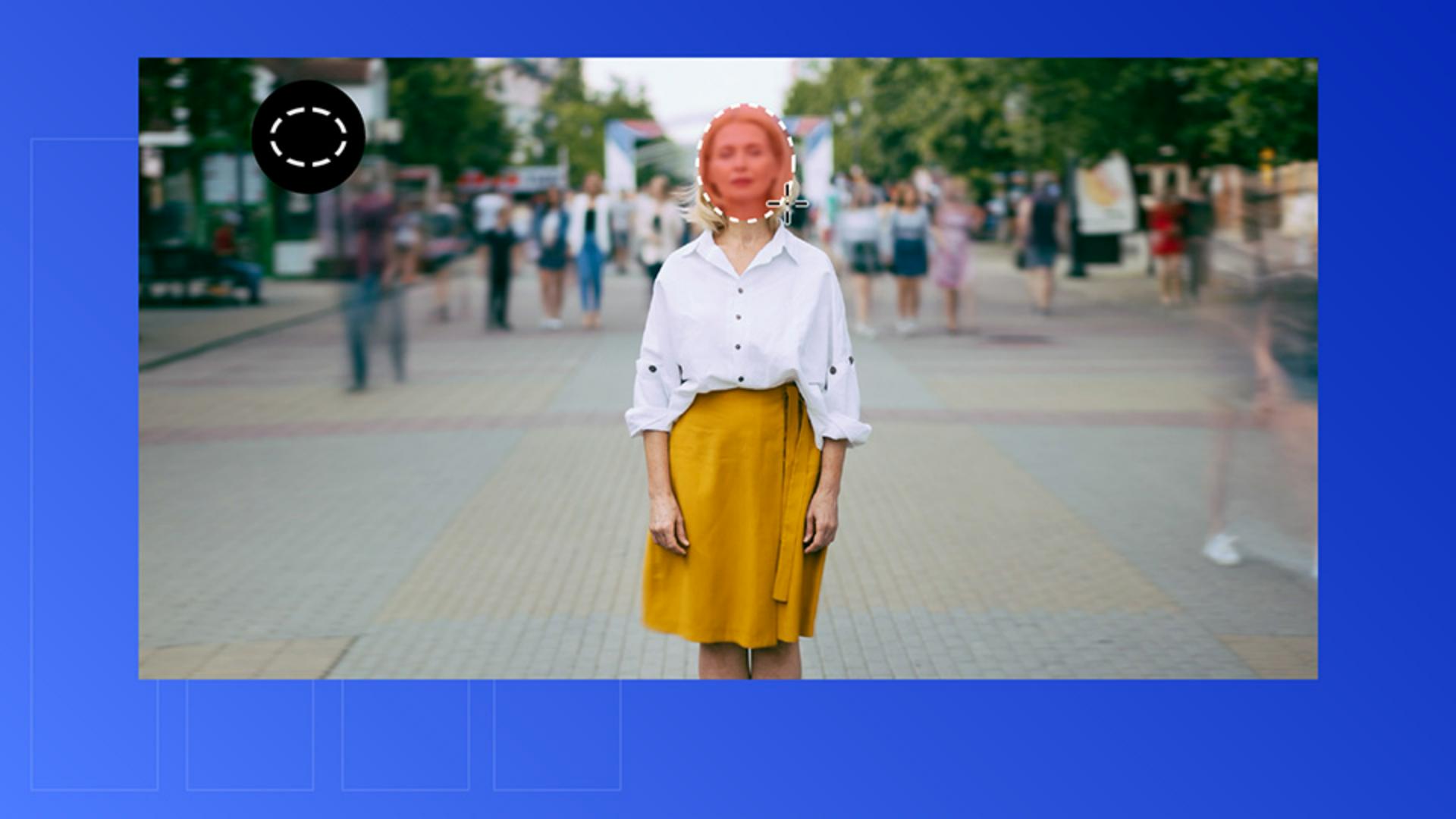
Today, I'm going to show you how to track a face blurred out using the Object Masking tool.
So, let's get started.
Open the project file called Blur_Face.
Create a mask over your subject
In your Project panel, you'll see the video clip we'll be working with.
Let's drag that onto your Timeline.
As you scrub through the Timeline, you'll see it's a time-lapse shot of a woman standing in a busy walkway with a subtle camera move.
Our goal is to track her face and apply a blur that blends naturally into the shot.
Let's go to the Toolbar and click and hold the Object Masking tool to reveal more options and select the Ellipse Mask tool.
Since her face is roughly oval-shaped, this will give us a great starting point.
Click and drag an ellipse over her face.
Let's just mask to cover her face completely.
Then grab the Feather controls - the little black dot above the mask - and drag it outward to soften the edges.
Feather it out to the edge of her hair so the blur blends smoothly into the surrounding image.
And once the mask looks good, we'll need to track it.
With the clip selected, go to the Effect Controls panel
Track the mask across the clip
and locate your Ellipse Mask.
You'll see several tracking options there - frame by frame, forward only, backward only, or both directions.
We want to track the entire clip, so let's click the middle button here - Track selected mask forward and backward.
Watch how quickly Premier's AI analyzes the footage and locks the mask onto her face.
Let's scrub through the Timeline, and you'll see how solid this mask tracking is.
Now let's add the blur.
Apply and adjust blur effects
With the Object Mask selected, open the Effects panel.
If you can't find it, go to Window, Effects, search for Gaussian Blur and double-click it.
Because the mask is selected, Premiere automatically nests it under the blur effect.
Let's bump that blur level to about 10.0.
Now we'll animate the reveal of the woman's face.
Animate blur for added control
Move the frame to where you want the blur to begin fading out, and set a keyframe for blur amount; scrub forward a few seconds, we'll set another keyframe and reduce the blur to 0.0.
Now we're ready to play it back.
Just remember to deselect the mask.
Otherwise, your blur is going to be red.
The face starts blurred, then smoothly reveals; the mask is nicely tracked automatically using AI.
And just like that, you've mask-tracked an animated a blur - clean, effortless, and entirely inside of Premiere.
Imagine all the ways you could use this technique to track and blur not just faces, but things like license plates, or to redact parts of documents or sensitive material.
Hope this adds to your growing skillset, and I'll catch you on the next one.
Note: Stock assets provided are for practice purposes only. See terms.
What you’ll learn
Create a mask over your subject
Use the ellipse mask tool to cover the subject you want to blur. Adjust the shape and feathering so the mask blends smoothly into the surrounding image.
Track the mask across the clip
Use the tracking controls to follow your subject forward and backward through the shot, keeping it aligned automatically.
Apply and adjust blur effects
Add a blur effect directly to the masked area and adjust the intensity as needed. Fine-tune the feathering so it blends into the scene.
Animate blur for added control
Use keyframes to gradually reduce or remove the blur over time. This allows you to reveal your subject while keeping the transition smooth and intentional.
You can control how Adobe websites use cookies and similar technologies by making choices below. But note that if you disable cookies and similar technologies entirely, Adobe websites may not function properly.
Cookies are small text files stored by your web browser when you use websites. There are also other technologies that can be used for similar purposes like HTML5 Local Storage and local shared objects, web beacons, and embedded scripts. These technologies help us do things like remembering you and your preferences when you return to our sites, measure how you use the website, conduct market research, and gather information about the ads you see and interact with.
You can make choices in the menu below about what cookies and other technologies you want us to use on Adobe sites when you visit them from this browser. You can always change those choices later by clicking on the Cookie Preferences link at the bottom of the page.
If enabled:
We can improve your experience by tailoring the site and the content to things we think might be of interest
We can better keep track of your preferences — like what language you prefer to use
We will better understand your likely interests so we can provide you more relevant Adobe ads and content on non-Adobe websites and in non-Adobe apps
It will help us improve the performance of our website and those of our partners who use the Adobe Experience Cloud
If disabled:
We won’t be able to remember you from session to session so the experience may not be tailored to your interests
You’ll still have access to the content of the site but certain features that depend on cookies may not function
You’ll still see ads, they just may not be as relevant to you
General information
You can control how Adobe websites use cookies and similar technologies by making choices below. But note that if you disable cookies and similar technologies entirely, Adobe websites may not function properly.
Cookies are small text files stored by your web browser when you use websites. There are also other technologies that can be used for similar purposes like HTML5 Local Storage, web beacons, and embedded scripts. These technologies help us do things like remembering you and your preferences when you return to our sites, measure how you use the website, conduct market research, and gather information about the ads you see and interact with.
You can make choices in the menu below about what cookies and other technologies you want us to use on Adobe sites when you visit them from this browser. You can always change those choices later by clicking on the Cookie Preferences link at the bottom of the page.
If enabled:
We can improve your experience by tailoring the site and the content to things we think might be of interest
We can better keep track of your preferences — like what language you prefer to use
We will better understand your likely interests so we can provide you more relevant Adobe ads and content on non-Adobe websites and in non-Adobe apps
It will help us improve the performance of our website and those of our partners who use the Adobe Experience Cloud
If disabled:
We won’t be able to remember you from session to session so the experience may not be tailored to your interests
We’ll still count your use of our site and services
You’ll still have access to the content of the site but certain features that depend on cookies may not function
You’ll still see ads, they just may not be as relevant to you
Operate the site and core servicesOperate site and measure engagement
Always active
These cookies are required, and they are used to enable the site and related services core functionality. Without them the site could not operate, so they cannot be disabled.
These cookies enable the site and related services’ core functionality and collect statistics about user engagement, such as counting active use to help us understand trends. These cookies cannot be disabled.
Measure performance
These cookies are used to analyze site usage to measure and improve performance. Without them Adobe cannot know what content is most valued and how often unique visitors return to the site, making it hard to improve information we offer to you.
These cookies are used to analyze site usage to measure and improve performance. Without them Adobe cannot know what content is most valued, making it hard to improve information we offer to you.
Extend functionality
These cookies are used to enhance the functionality of Adobe sites such as remembering your settings and preferences to deliver a personalized experience; for example, your username, your repeated visits, preferred language, your country, or any other saved preference.
Personalize advertising
These cookies are used to enable Adobe and our partners to serve ads more relevant to your interests. Without them you will still see ads, but they might not be as relevant to you.
Personalize advertising
These cookies are used to enable Adobe and our partners to serve ads more relevant to your interests. Without them you will still see ads, but they might not be as relevant to you.