
Are you a business? Call us for a consultation: 900 816 182
Empowering artists with new features in Painter 11.0
Improve detailing with filled 3D paths and enhanced control of 3D path creation and manipulation.
Discover the foundations of Substance 3D Painter.
Jump-start your creativity with foundational video tutorials.
Meet the industry’s standard texturing software.
Painter is the go-to texturing app for 3D professionals everywhere.
Find creative freedom.
Painter can help no matter what 3D style you’re aiming for, from photorealism to stylized art.
Enhance artistry with smart tools.
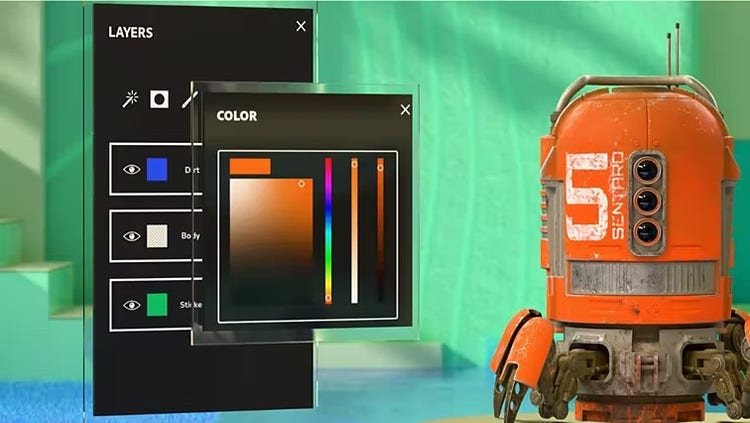
Parametric brushes and tools allow you to paint the perfect look for any asset.
See exactly what you get.
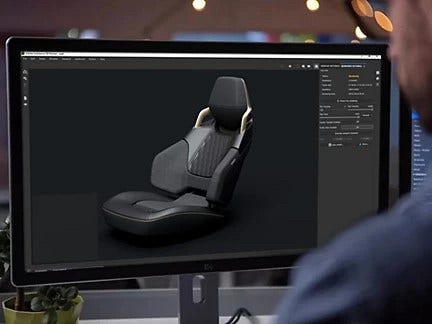
Painter’s state-of-the-art viewport lets you view your work in real time, with effects like lighting and shadows.
style
XL spacing
Painter is non-destructive.
Every action and stroke is recorded and can be recomputed at any time. Modify paint strokes or even change resolution at any time without ever losing any work.
Power and usability provides an excellent painting experience.
Powerful paint engine
Paint with dynamic brushes, projection tools, particles, including Photoshop brush presets.
Smart masks and materials
Apply realistic surface details, from subtle dusting to extreme wear and tear, and more.

Advanced material creation
Mimic real-world material behaviors such as sheen, anisotropy, clear-coat, subsurface scattering, and more.
Easy exports
Export to any renderer or game engine easily. Create custom export presets to fit Painter into your 3D design pipeline.

Icon- Automatic UVs
Imported models don't need any special preparation to get them ready for texturing.

VFX support
Painter supports multi-tile painting (UDIMS), Alembic, camera import, and Python scripting and is compliant with the VFX Reference Platform.
Generally, the first step in the 3D process is to create a model, or what is usually referred to as a mesh. By default, most meshes are a slate gray color, or can be viewed as a wireframe. 3D modeling software is used to create these objects. The next important step in the process is to add textures and materials to the object to create the visual appearance on its surface with a 3D painting software. While many programs can do both of these tasks in the same application, Substance 3D Painter is the industry leader in texture painting, allowing you to texture a model in real-time.
Among all the Substance 3D texturing-related apps, we categorize Substance 3D Painter as medium difficulty. Painter aims to make the texturing and material creation process as streamlined as possible. Like most advanced software, Painter has many powerful features to learn and understand to maximize your output with the app.
When creating a new project and adding a mesh object, Substance 3D Painter offers several import settings you can use to extract information from the object, including textures. You can also import baked maps automatically. When your project is complete, you can export bitmap textures, or export the geometry of the model. The export window can be opened through File > Export textures. For a complete overview of the export settings available and how to use them, please refer to the Substance 3D Painter documentation.
Substance 3D Painter is a 3D painting software that allows users to texture and add materials directly to 3D meshes in real-time. In comparison, Substance 3D Designer is primarily a material authoring software that generates textures from procedural patterns inside node-based graphs. So, Designer is an alternative to creating textures and materials, which you can apply to models inside Painter.
Substance 3D Painter is compatible with most major and standard 3D file formats. You can import mesh files into Painter to texture. Supported mesh file types include .fbx, .obj, .abc, .dae, .ply, .gltf, .glb, .usd, .usda, .usdc, and .usdz. You can also export to these file formats as well. Substance 3D Painter will prepare the proper files, materials, and textures required on export, or you can use the export settings to customize this output to your needs. For more information, see the documentation.
style
Static links, l spacing
Deliver designs that pop with Substance 3D and Illustrator.
You can control how Adobe websites use cookies and similar technologies by making choices below. But note that if you disable cookies and similar technologies entirely, Adobe websites may not function properly.
Cookies are small text files stored by your web browser when you use websites. There are also other technologies that can be used for similar purposes like HTML5 Local Storage and local shared objects, web beacons, and embedded scripts. These technologies help us do things like remembering you and your preferences when you return to our sites, measure how you use the website, conduct market research, and gather information about the ads you see and interact with.
You can make choices in the menu below about what cookies and other technologies you want us to use on Adobe sites when you visit them from this browser. You can always change those choices later by clicking on the Cookie Preferences link at the bottom of the page.
If enabled:
We can improve your experience by tailoring the site and the content to things we think might be of interest
We can better keep track of your preferences — like what language you prefer to use
We will better understand your likely interests so we can provide you more relevant Adobe ads and content on non-Adobe websites and in non-Adobe apps
It will help us improve the performance of our website and those of our partners who use the Adobe Experience Cloud
If disabled:
We won’t be able to remember you from session to session so the experience may not be tailored to your interests
You’ll still have access to the content of the site but certain features that depend on cookies may not function
You’ll still see ads, they just may not be as relevant to you
General information
You can control how Adobe websites use cookies and similar technologies by making choices below. But note that if you disable cookies and similar technologies entirely, Adobe websites may not function properly.
Cookies are small text files stored by your web browser when you use websites. There are also other technologies that can be used for similar purposes like HTML5 Local Storage, web beacons, and embedded scripts. These technologies help us do things like remembering you and your preferences when you return to our sites, measure how you use the website, conduct market research, and gather information about the ads you see and interact with.
You can make choices in the menu below about what cookies and other technologies you want us to use on Adobe sites when you visit them from this browser. You can always change those choices later by clicking on the Cookie Preferences link at the bottom of the page.
If enabled:
We can improve your experience by tailoring the site and the content to things we think might be of interest
We can better keep track of your preferences — like what language you prefer to use
We will better understand your likely interests so we can provide you more relevant Adobe ads and content on non-Adobe websites and in non-Adobe apps
It will help us improve the performance of our website and those of our partners who use the Adobe Experience Cloud
If disabled:
We won’t be able to remember you from session to session so the experience may not be tailored to your interests
We’ll still count your use of our site and services
You’ll still have access to the content of the site but certain features that depend on cookies may not function
You’ll still see ads, they just may not be as relevant to you
Operate the site and core servicesOperate site and measure engagement
Always active
These cookies are required, and they are used to enable the site and related services core functionality. Without them the site could not operate, so they cannot be disabled.
These cookies enable the site and related services’ core functionality and collect statistics about user engagement, such as counting active use to help us understand trends. These cookies cannot be disabled.
Measure performance
These cookies are used to analyze site usage to measure and improve performance. Without them Adobe cannot know what content is most valued and how often unique visitors return to the site, making it hard to improve information we offer to you.
These cookies are used to analyze site usage to measure and improve performance. Without them Adobe cannot know what content is most valued, making it hard to improve information we offer to you.
Extend functionality
These cookies are used to enhance the functionality of Adobe sites such as remembering your settings and preferences to deliver a personalized experience; for example, your username, your repeated visits, preferred language, your country, or any other saved preference.
Personalize advertising
These cookies are used to enable Adobe and our partners to serve ads more relevant to your interests. Without them you will still see ads, but they might not be as relevant to you.