Are you a business? Call us for a consultation: 800‑915‑9425
Sculpt 3D with digital clay.
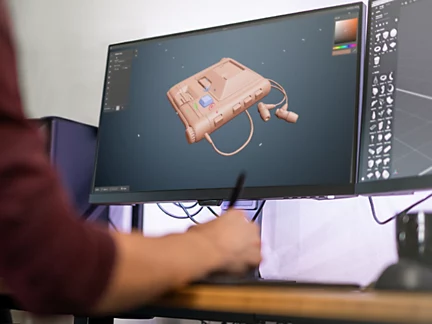
Substance 3D Modeler makes modeling in 3D as gestural and natural as drawing. Encourage your creative flow in this flexible and powerful 3D sculpting software.
Liberate 3D modeling from technical constraints.
Modeler handles more tedious and technical aspects of modeling, like UV management, so you can better focus on the creative process.
Experience powerful flexibility that scales.
Whether you’re sculpting something simple or complex, a single object or an entire scene — Modeler has everything you need to create original 3D models.
Switch seamlessly between desktop and VR.
Modeler works seamlessly between both modes, so you can create with the tools that best empower your workflow and meet the needs of every project.
style
XL spacing
Substance 3D Modeler's features let you interact naturally with your art.
Desktop and VR support
Switch seamlessly between modes to adapt your preferences, or to meet the needs of a specific 3D modeling project.
Symmetry and repetition tools
Work efficiently and accurately with these built-in tools to assemble complex objects or craft with incredible detail.

Organic sculpting
Build, smooth, and shape organically with digital 3D sculpting tools inspired by real-world clay.

Hard surface sculpting
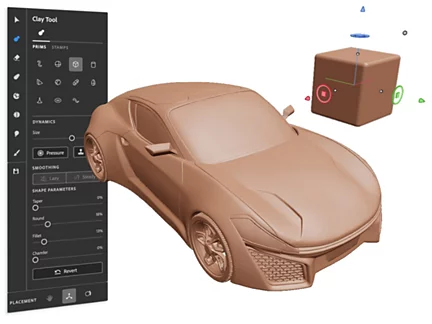
Create clear, decisive forms using parametric shapes. Easily add and cut primitives to form complex models.
style
four-up, l spacing
style
S spacing
Available on the Meta Quest 2 and Quest Pro. See what’s possible in VR with Meta Quest
3D modeling software allows you to create digital representations of three-dimensional objects. Software uses mathematical calculations to mimic depth, lighting, textures, and more, creating the appearance of true 3D. These models can be used for a number of applications across many industries.
Currently, Substance 3D Modeler is not available for macOS. A full list of technical requirements is available in the documentation.
Modeler supports most standard 3D file types, including OBJ, FBX, USD, and glTF. A full list of supported file formats can be found in the documentation.
Beginners may find Modeler suitable for learning because it doesn’t require technical concerns about polygons and topology to start shaping objects. Modeler aims to make 3D modeling feel as gestural and natural as sculpting real world clay.
To import a mesh into Modeler, use the File > Import Mesh option in the menu, or the shortcut ctrl + shift + m. Modeler supports most standard file types, including OBJ, FBX, USD, and glTF. You can also import any Modeler scene which is saved as an SMOD file.
style
Static links, l spacing
Deliver designs that pop with Substance 3D and Illustrator.

You can control how Adobe websites use cookies and similar technologies by making choices below. But note that if you disable cookies and similar technologies entirely, Adobe websites may not function properly.
Cookies are small text files stored by your web browser when you use websites. There are also other technologies that can be used for similar purposes like HTML5 Local Storage and local shared objects, web beacons, and embedded scripts. These technologies help us do things like remembering you and your preferences when you return to our sites, measure how you use the website, conduct market research, and gather information about the ads you see and interact with.
You can make choices in the menu below about what cookies and other technologies you want us to use on Adobe sites when you visit them from this browser. You can always change those choices later by clicking on the Cookie Preferences link at the bottom of the page.
If enabled:
We can improve your experience by tailoring the site and the content to things we think might be of interest
We can better keep track of your preferences — like what language you prefer to use
We will better understand your likely interests so we can provide you more relevant Adobe ads and content on non-Adobe websites and in non-Adobe apps
It will help us improve the performance of our website and those of our partners who use the Adobe Experience Cloud
If disabled:
We won’t be able to remember you from session to session so the experience may not be tailored to your interests
You’ll still have access to the content of the site but certain features that depend on cookies may not function
You’ll still see ads, they just may not be as relevant to you
General information
You can control how Adobe websites use cookies and similar technologies by making choices below. But note that if you disable cookies and similar technologies entirely, Adobe websites may not function properly.
Cookies are small text files stored by your web browser when you use websites. There are also other technologies that can be used for similar purposes like HTML5 Local Storage, web beacons, and embedded scripts. These technologies help us do things like remembering you and your preferences when you return to our sites, measure how you use the website, conduct market research, and gather information about the ads you see and interact with.
You can make choices in the menu below about what cookies and other technologies you want us to use on Adobe sites when you visit them from this browser. You can always change those choices later by clicking on the Cookie Preferences link at the bottom of the page.
If enabled:
We can improve your experience by tailoring the site and the content to things we think might be of interest
We can better keep track of your preferences — like what language you prefer to use
We will better understand your likely interests so we can provide you more relevant Adobe ads and content on non-Adobe websites and in non-Adobe apps
It will help us improve the performance of our website and those of our partners who use the Adobe Experience Cloud
If disabled:
We won’t be able to remember you from session to session so the experience may not be tailored to your interests
We’ll still count your use of our site and services
You’ll still have access to the content of the site but certain features that depend on cookies may not function
You’ll still see ads, they just may not be as relevant to you
Operate the site and core servicesOperate site and measure engagement
Always active
These cookies are required, and they are used to enable the site and related services core functionality. Without them the site could not operate, so they cannot be disabled.
These cookies enable the site and related services’ core functionality and collect statistics about user engagement, such as counting active use to help us understand trends. These cookies cannot be disabled.
Measure performance
These cookies are used to analyze site usage to measure and improve performance. Without them Adobe cannot know what content is most valued and how often unique visitors return to the site, making it hard to improve information we offer to you.
These cookies are used to analyze site usage to measure and improve performance. Without them Adobe cannot know what content is most valued, making it hard to improve information we offer to you.
Extend functionality
These cookies are used to enhance the functionality of Adobe sites such as remembering your settings and preferences to deliver a personalized experience; for example, your username, your repeated visits, preferred language, your country, or any other saved preference.
Personalize advertising
These cookies are used to enable Adobe and our partners to serve ads more relevant to your interests. Without them you will still see ads, but they might not be as relevant to you.