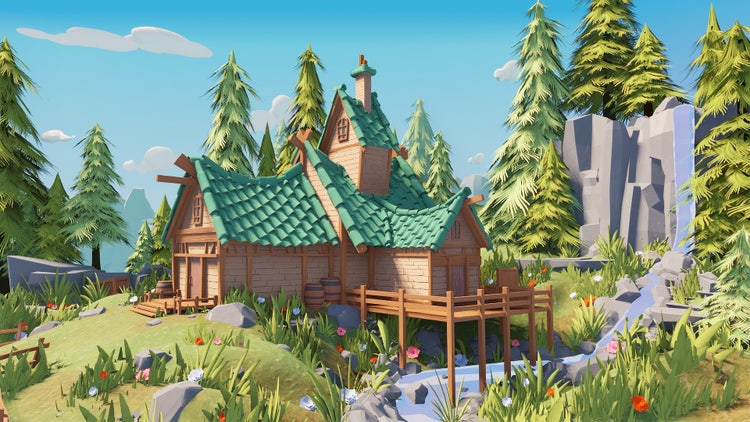
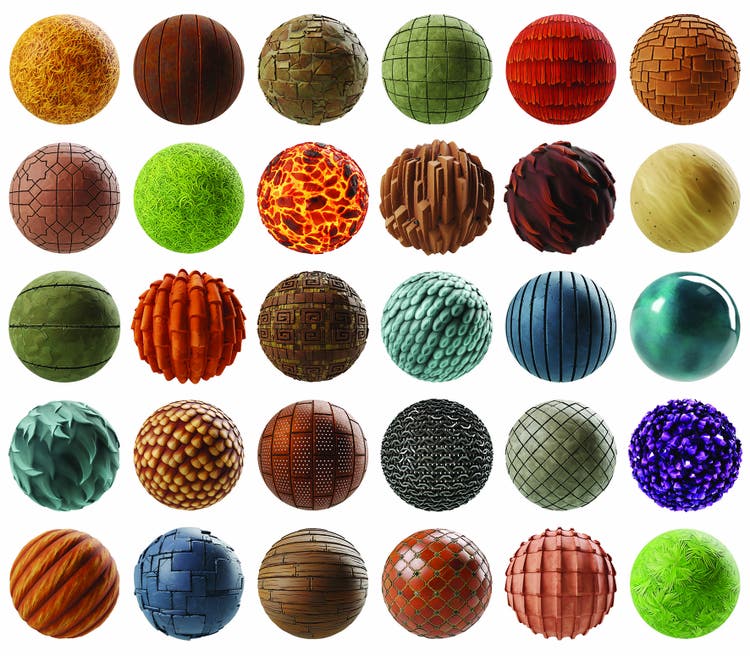
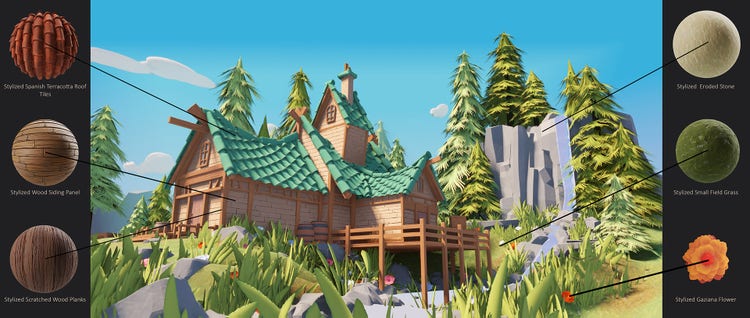
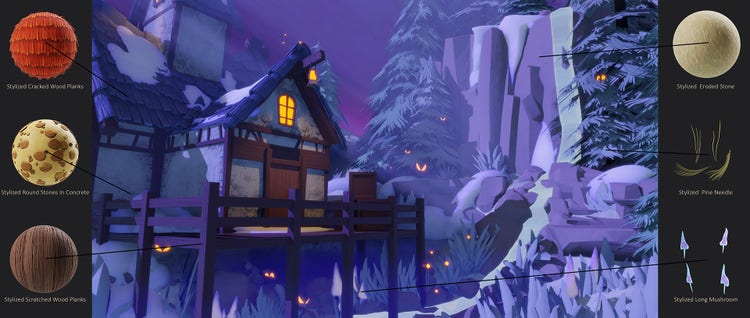
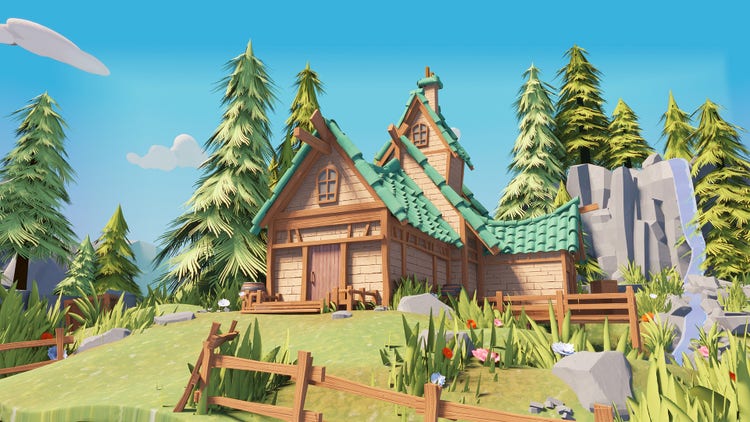
The Substance 3D Assets team just added 100 new materials in the collection! Dedicated to stylized art, this starter kit covers all your basic needs for the creation of mobile game art - or more.
A world built from stylized materials is not quite like the everyday world we see around us. It’s just a little larger than life; it pops out just a little more. Such projects aren’t intended to be a picture-perfect representation of the real world; rather, these stylized worlds present an exaggerated perspective of reality. Large details tend to be somewhat emphasized; small details are treated with a lighter touch. The ensemble can be remarkably striking.
style
L spacing
background
#e8e8e8
This style has notably proven popular with mobile games, which impose their own set of technical constraints. Such specific needs require specific materials – and so the Substance Source team are today releasing a collection of 100 parametric materials aimed at creating stylized projects, and mobile games in particular.
Yet we understand that, just as no two games are precisely alike, no two specific stylized looks are completely identical. For this reason, we’ve ensured that these assets are highly customizable; their style is somewhat generic, and designed in a modular way, in order to better offer new creative possibilities while respecting artists’ workflows. All materials are parametric, and available as usual in SBS and SBSAR format.
The creation of materials to dress stylized universes differs radically from the research of photorealism. A stylized form implies a certain direction and artistic standpoint in the representation of surfaces, which requires specific choices in terms of a texturing workflow – and which imposes specific constraints.
This, then, was the starting point of this project: to find a solution to the challenge of offering stylistic flexibility, while respecting the technical constraints imposed by targeting mobile devices.
Our goal: to increase productivity and to offer extra creative freedom to artists with materials dedicated to texturing games for mobile devices.
style
Three up, xs spacing
The first point of consideration is the aesthetics involved: moving away from strict photorealism introduces endless stylistic possibilities. The addition of a stroke effect, for instance, or the use of a color gradation approach can radically influence the perception of volumes and surfaces. Our entire material library could essentially be reproduced in stylistic form – dozens of times over, even, if we were to do so for each specific style we might consider. Of course, in practical terms this would take a few years.
(But, y’know… That’s something we’re actually thinking about… It’d be, like, pretty tricky… But keep your eyes open, just in case.)
For now, our approach is that it’s more efficient to make our stylistic materials customizable, to allow artists to personalize their look as required.
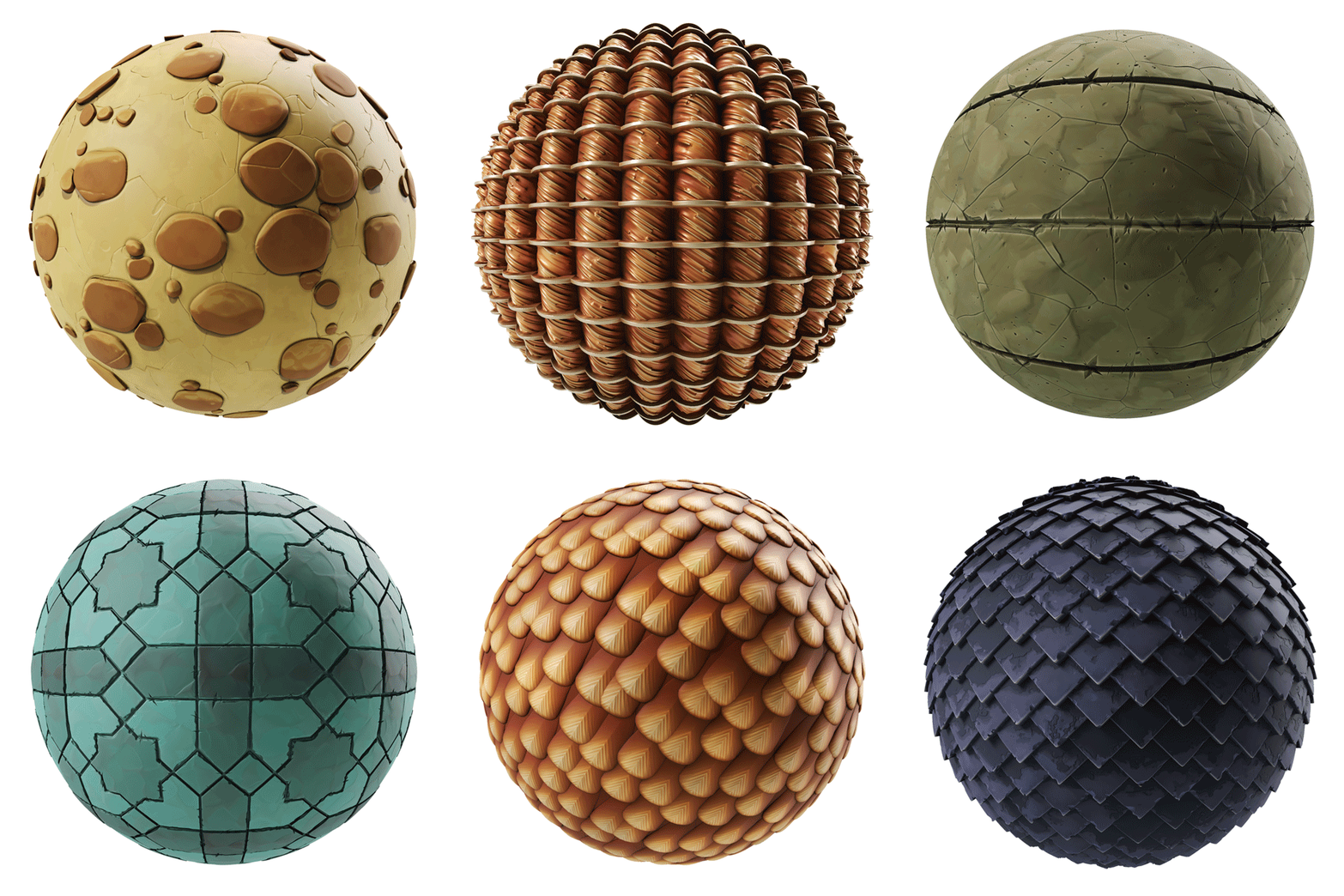
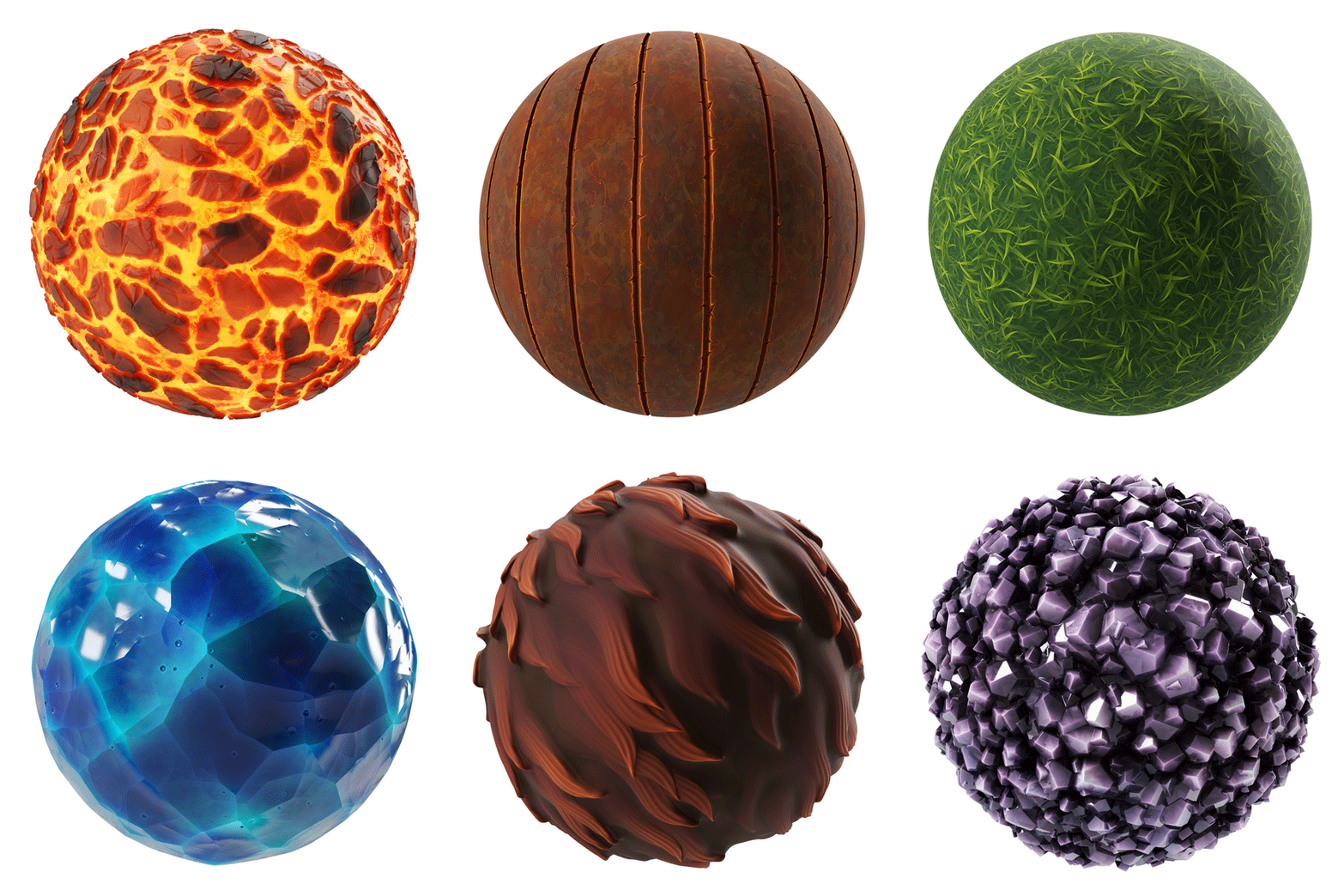
To kick things off, Substance Source is providing a starter selection of stylistic materials, with a wide range of assets in each category. This selection includes atlases to create natural, manufactured, and fantasy-style surfaces.
And – excellent news – we’ve been working on ways to help with this, by defining sets of parameters allowing generation of heaps of variations in a single click, to provide detail on surfaces whether at the pattern level or in terms of depth of color.
Each stylized game can boast its own distinctive graphic universe, and so each one should be able to use Substance materials without altering its stylistic approach.
The materials were conceived as modular bricks allowing alteration of parameters in terms of color, surface aging, patterns, and many other factors – but each brick is also designed to be combined with every other brick.
Whether materials or atlases, all our stylized assets remain Substance materials – that is, each one is completely parametric. Each parameter can produce an inexhaustible wellspring of variation; this tremendous flexibility is invaluable when bringing diversity to otherwise homogenous surfaces.
The random seed functionality makes each individual asset a mini-library of stylized material. It’s no longer necessary to make dozens of versions of the same material manually, depending on factors such as level of damage or time of year. As long as you have a single SBSAR file, you’re good to go.
And if, by any chance, you can’t find a parameter that you need, you can insert it directly in the graph yourself. Like most of the assets in the library, each item is available in .sbs format, granting you access to its entire node graph. This allows you to avoid starting out on the material creation process from scratch – moreover, it’s an invitation to go further searching for your individual style by adding your own noodles to the figurative dish.
As mentioned previously, when creating this collection of materials, we envisaged that they would ultimately be used in the creation of games for mobile devices. This imposed significant technical constraints. While console video games can rely on comfortable resources in terms of computing capacity, the mobile gaming world is constantly battling to optimize the few resources available from your phone or tablet.
Optimized to offer an optimal visual result from 256 to 8K, the collection of stylized PBR materials available on Substance Source has been modeled to make the most of resources.
Where multiple maps are required to achieve a satisfying photorealistic result we’ve deliberately combined additional surface information in the color map.
This color-based approach provides much more detailed color PBR maps that include details from the normal and height maps, potentially reducing the number of maps needed to achieve certain stylistic effects.
In addition, we’ve added extra functionality to each Substance material – namely, the ability to incorporate light information directly into the texture. Each material has a set of parameters dedicated to baking the light information into the texture; this allows you to control the orientation and the way the light acts on the material, and so to further optimize performance if necessary by eliminating some runtime compute.
Is this merely a technical optimization? No, it’s more than this – the ultimate goal here is the versatility of the adaptation of the assets, so that they can slot into the workflow of artists within the domain of stylized art.
Our ambition is to allow quick testing and retouchin g, as well as faster iteration on creative projects.
Our goal is to smoothly insert these tools into the existing artist pipeline by allowing a fast back and forth process between different tools. Rapidly paint your materials on your 3D blocking in Substance Painter and then ‘paint over’ the result in Adobe Photoshop in any order you like.
As always this is just the beginning. Stay safe, and keep washing your hands; we’ll be back soon!
Share this page
ContentType
Article
CardImage
CardImageAltText
Stylized Art: Materials Starter Kit
Details
Mar. 24 2020
Title
Stylized Art: Materials Starter Kit
Description
Get started with Stylized Art! Our Starter Kit offers 100 high-quality materials for your artistic needs.
Cookie Settings
General information
You can control how Adobe websites use cookies and similar technologies by making choices below. But note that if you disable cookies and similar technologies entirely, Adobe websites may not function properly.
Cookies are small text files stored by your web browser when you use websites. There are also other technologies that can be used for similar purposes like HTML5 Local Storage and local shared objects, web beacons, and embedded scripts. These technologies help us do things like remembering you and your preferences when you return to our sites, measure how you use the website, conduct market research, and gather information about the ads you see and interact with.
You can make choices in the menu below about what cookies and other technologies you want us to use on Adobe sites when you visit them from this browser. You can always change those choices later by clicking on the Cookie Preferences link at the bottom of the page.
If enabled:
We can improve your experience by tailoring the site and the content to things we think might be of interest
We can better keep track of your preferences — like what language you prefer to use
We will better understand your likely interests so we can provide you more relevant Adobe ads and content on non-Adobe websites and in non-Adobe apps
It will help us improve the performance of our website and those of our partners who use the Adobe Experience Cloud
If disabled:
We won’t be able to remember you from session to session so the experience may not be tailored to your interests
You’ll still have access to the content of the site but certain features that depend on cookies may not function
You’ll still see ads, they just may not be as relevant to you
General information
You can control how Adobe websites use cookies and similar technologies by making choices below. But note that if you disable cookies and similar technologies entirely, Adobe websites may not function properly.
Cookies are small text files stored by your web browser when you use websites. There are also other technologies that can be used for similar purposes like HTML5 Local Storage, web beacons, and embedded scripts. These technologies help us do things like remembering you and your preferences when you return to our sites, measure how you use the website, conduct market research, and gather information about the ads you see and interact with.
You can make choices in the menu below about what cookies and other technologies you want us to use on Adobe sites when you visit them from this browser. You can always change those choices later by clicking on the Cookie Preferences link at the bottom of the page.
If enabled:
We can improve your experience by tailoring the site and the content to things we think might be of interest
We can better keep track of your preferences — like what language you prefer to use
We will better understand your likely interests so we can provide you more relevant Adobe ads and content on non-Adobe websites and in non-Adobe apps
It will help us improve the performance of our website and those of our partners who use the Adobe Experience Cloud
If disabled:
We won’t be able to remember you from session to session so the experience may not be tailored to your interests
We’ll still count your use of our site and services
You’ll still have access to the content of the site but certain features that depend on cookies may not function
You’ll still see ads, they just may not be as relevant to you
Operate the site and core servicesOperate site and measure engagement
Always active
These cookies are required, and they are used to enable the site and related services core functionality. Without them the site could not operate, so they cannot be disabled.
These cookies enable the site and related services’ core functionality and collect statistics about user engagement, such as counting active use to help us understand trends. These cookies cannot be disabled.
Measure performance
These cookies are used to analyze site usage to measure and improve performance. Without them Adobe cannot know what content is most valued and how often unique visitors return to the site, making it hard to improve information we offer to you.
These cookies are used to analyze site usage to measure and improve performance. Without them Adobe cannot know what content is most valued, making it hard to improve information we offer to you.
Extend functionality
These cookies are used to enhance the functionality of Adobe sites such as remembering your settings and preferences to deliver a personalized experience; for example, your username, your repeated visits, preferred language, your country, or any other saved preference.
Personalize advertising
These cookies are used to enable Adobe and our partners to serve ads more relevant to your interests. Without them you will still see ads, but they might not be as relevant to you.