Use presets to convert color photos to black and white
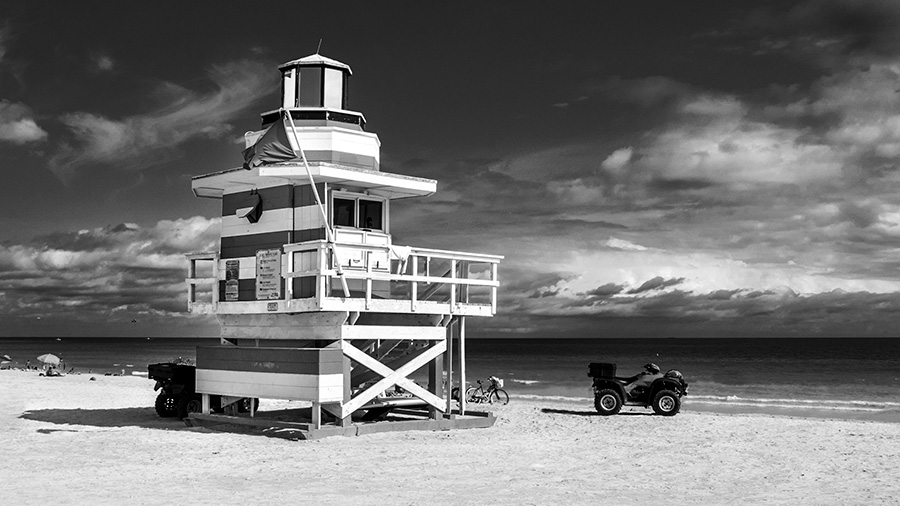
Transform your color photos into black and white images with presets, and fine-tune the look further with easy-to-use adjustment sliders in Adobe Photoshop Lightroom Classic.
These sample files are Adobe Stock assets you can use to practice what you learn in this tutorial. If you want to use the sample files beyond this tutorial, you can purchase licenses onAdobe Stock . Check out the ReadMe file in the folder for the terms that apply to your use of this sample file.
1
Choose a photo to convert to black and white
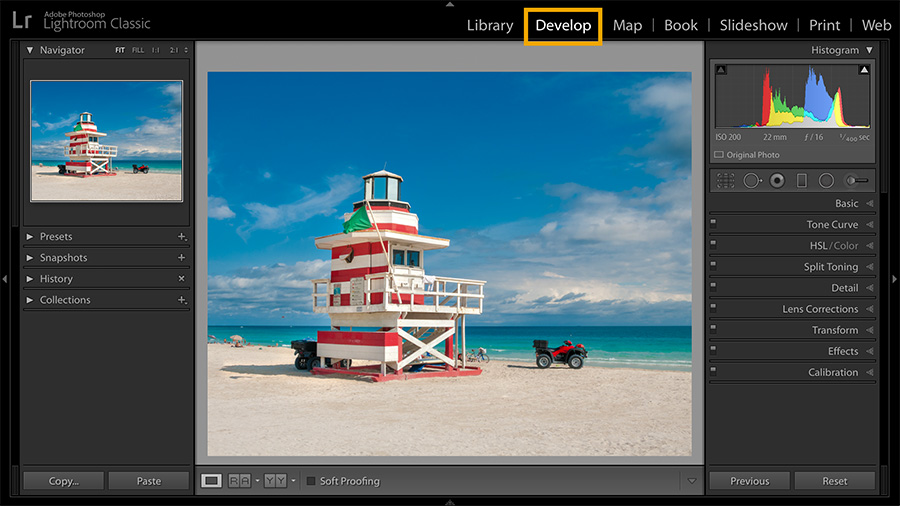
Select a color photo in the Library module grid. Click Develop in the Module Picker at the top of the screen, or press the D key, to open the selected photo in the Develop module.
Note: If you’re using the sample file provided with this tutorial, first import the sample file into your Lightroom Classic catalog.
2
Apply a black and white preset
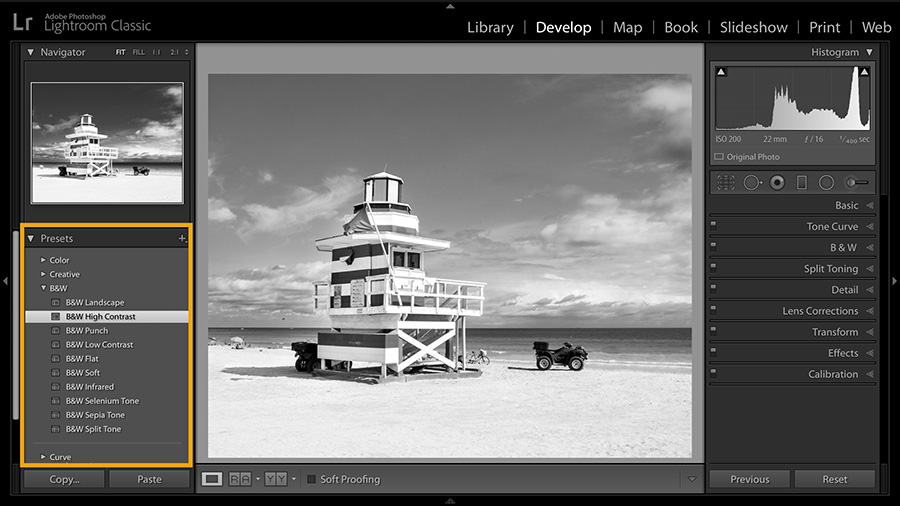
We’ll use a preset for the initial conversion to black and white, and then we’ll explore how to customize the black and white treatment. Open the Presets panel by clicking its title bar on the left side of the Develop module. Click the B&W section in the Presets panel to display a list of black and white presets.
Mouse over different presets in the B&W section to preview how each would look on your photo. Click one of the presets in this section to apply it to the photo. For this example, we chose B&W High Contrast. If you change your mind, you can apply another preset on top of this one, or press the Reset button to return to the original photo and then apply a different preset.
3
Open the Basic panel
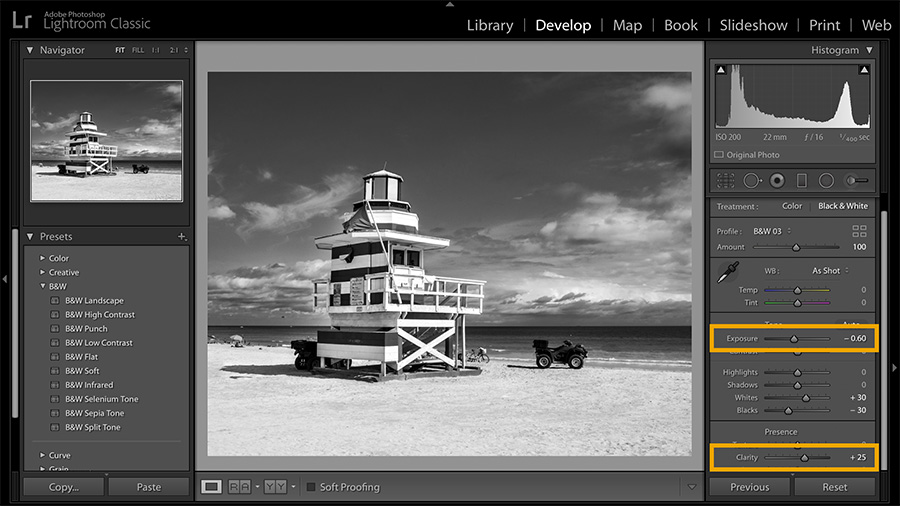
With a preset black and white effect applied, now it’s time to see how the effect can be customized for a particular image. Open the Basic adjustment panel on the right side of the Develop module. You can see that the preset we used applied a black and white profile and adjusted the Whites and Blacks sliders to boost the contrast.
4
Customize with manual adjustments
This image still seems a bit bright. Drag the Exposure slider in the Basic panel to about -0.60 to slightly darken the photo. Drag the Clarity slider to about +25 to give the photo more punch by boosting contrast in the midtones.
5
Adjust the black & white mix
Open the Black & White panel to reveal the sliders that control how the colors in the original photo are translated to black and white.
Note: In Lightroom Classic, the Black & White panel will be visible only if a photo has been converted to black and white.
This panel allows you to determine the level of grayscale brightness for different colors in the original image. Drag the Blue slider to about -20 to darken blues in the sky and the sea. Try dragging the Red slider, which will darken or lighten the dark stripes on the lifeguard tower.
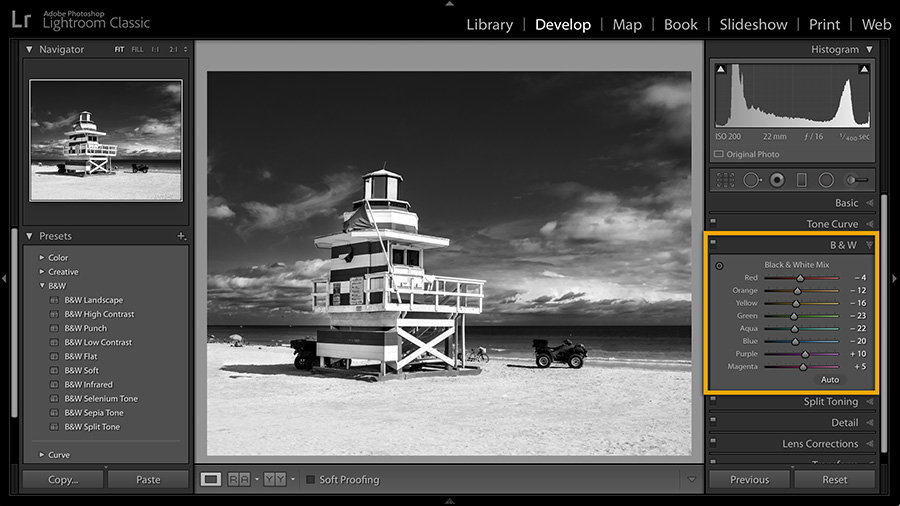
Experiment with other black and white presets and manual adjustments to get exactly the black and white look you want.
You can control how Adobe websites use cookies and similar technologies by making choices below. But note that if you disable cookies and similar technologies entirely, Adobe websites may not function properly.
Cookies are small text files stored by your web browser when you use websites. There are also other technologies that can be used for similar purposes like HTML5 Local Storage and local shared objects, web beacons, and embedded scripts. These technologies help us do things like remembering you and your preferences when you return to our sites, measure how you use the website, conduct market research, and gather information about the ads you see and interact with.
You can make choices in the menu below about what cookies and other technologies you want us to use on Adobe sites when you visit them from this browser. You can always change those choices later by clicking on the Cookie Preferences link at the bottom of the page.
If enabled:
We can improve your experience by tailoring the site and the content to things we think might be of interest
We can better keep track of your preferences — like what language you prefer to use
We will better understand your likely interests so we can provide you more relevant Adobe ads and content on non-Adobe websites and in non-Adobe apps
It will help us improve the performance of our website and those of our partners who use the Adobe Experience Cloud
If disabled:
We won’t be able to remember you from session to session so the experience may not be tailored to your interests
You’ll still have access to the content of the site but certain features that depend on cookies may not function
You’ll still see ads, they just may not be as relevant to you
General information
You can control how Adobe websites use cookies and similar technologies by making choices below. But note that if you disable cookies and similar technologies entirely, Adobe websites may not function properly.
Cookies are small text files stored by your web browser when you use websites. There are also other technologies that can be used for similar purposes like HTML5 Local Storage, web beacons, and embedded scripts. These technologies help us do things like remembering you and your preferences when you return to our sites, measure how you use the website, conduct market research, and gather information about the ads you see and interact with.
You can make choices in the menu below about what cookies and other technologies you want us to use on Adobe sites when you visit them from this browser. You can always change those choices later by clicking on the Cookie Preferences link at the bottom of the page.
If enabled:
We can improve your experience by tailoring the site and the content to things we think might be of interest
We can better keep track of your preferences — like what language you prefer to use
We will better understand your likely interests so we can provide you more relevant Adobe ads and content on non-Adobe websites and in non-Adobe apps
It will help us improve the performance of our website and those of our partners who use the Adobe Experience Cloud
If disabled:
We won’t be able to remember you from session to session so the experience may not be tailored to your interests
We’ll still count your use of our site and services
You’ll still have access to the content of the site but certain features that depend on cookies may not function
You’ll still see ads, they just may not be as relevant to you
Operate the site and core servicesOperate site and measure engagement
Always active
These cookies are required, and they are used to enable the site and related services core functionality. Without them the site could not operate, so they cannot be disabled.
These cookies enable the site and related services’ core functionality and collect statistics about user engagement, such as counting active use to help us understand trends. These cookies cannot be disabled.
Measure performance
These cookies are used to analyze site usage to measure and improve performance. Without them Adobe cannot know what content is most valued and how often unique visitors return to the site, making it hard to improve information we offer to you.
These cookies are used to analyze site usage to measure and improve performance. Without them Adobe cannot know what content is most valued, making it hard to improve information we offer to you.
Extend functionality
These cookies are used to enhance the functionality of Adobe sites such as remembering your settings and preferences to deliver a personalized experience; for example, your username, your repeated visits, preferred language, your country, or any other saved preference.
Personalize advertising
These cookies are used to enable Adobe and our partners to serve ads more relevant to your interests. Without them you will still see ads, but they might not be as relevant to you.
Personalize advertising
These cookies are used to enable Adobe and our partners to serve ads more relevant to your interests. Without them you will still see ads, but they might not be as relevant to you.
