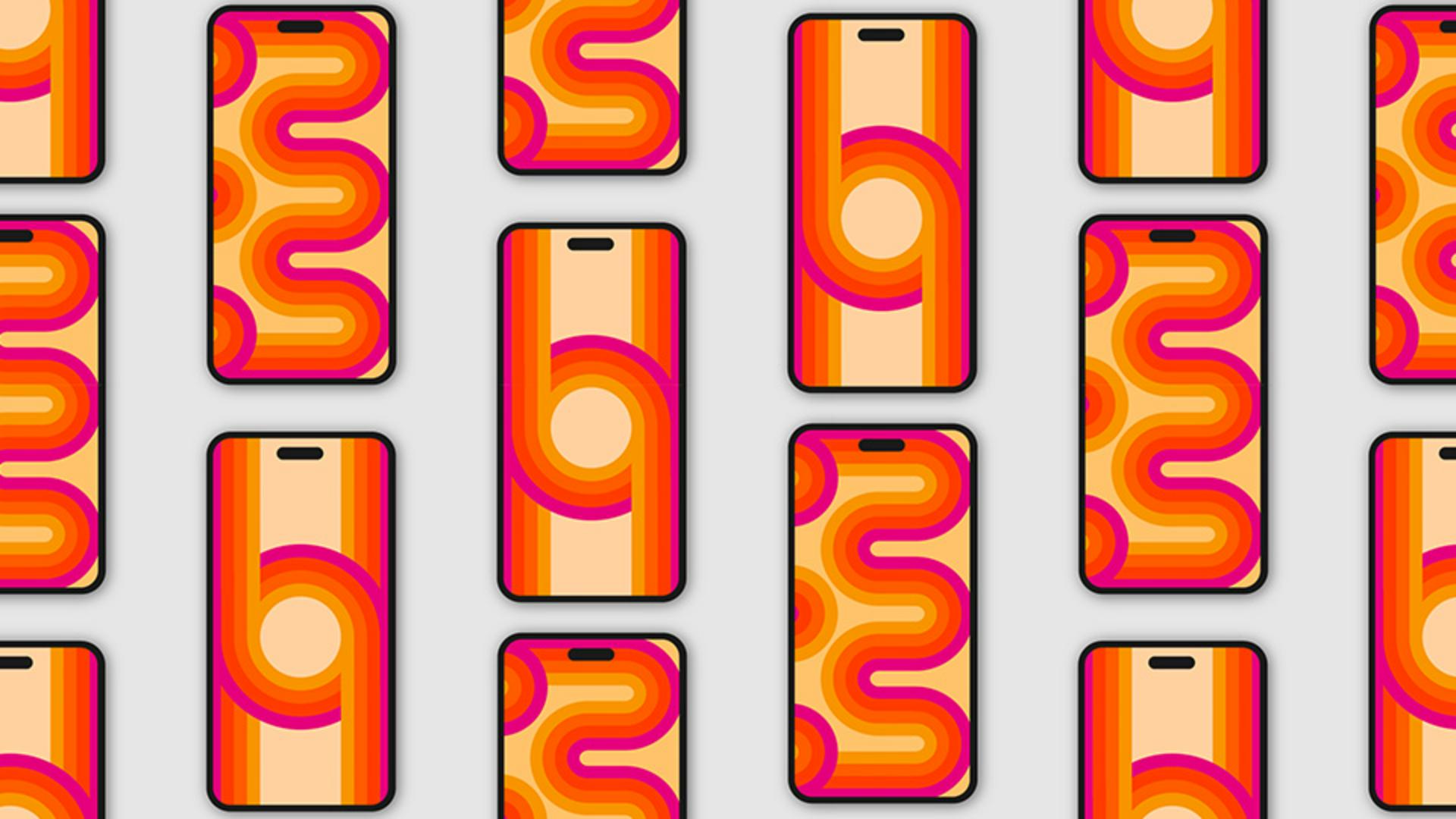
[Rob de Winter]: Always wanted to design your own beautiful retro wallpaper?
With shapes and art brushes in Illustrator you can do it quick and easy.
My name is Rob de Winter, I'm an Adobe certified Instructor, Author, and Designer from the Netherlands, and in the next few minutes, I'll show you how to create and customize your own creative brushes and how you can apply them to shapes and lines in Illustrator.
Drawing shapes for a custom art brush
Let's first start by drawing the shapes we need to create a brush.
So click the Rectangle Tool and draw a rectangle.
Now change the Fill color to yellow and make sure there's no Stroke color.
Let's now duplicate the rectangle straight down.
To do this, click the Selection Tool, move the rectangle down and then hold Shift and Alt on Windows or Shift and Option on macOS.
We need two more copies, so let's repeat this step twice.
I always press Ctrl D on Windows or Cmd D on macOS to repeat the previous transformation.
Do this two times.
Adjust the Fill colors of the three rectangles.
I already saved four retro color swatches in my Swatches panel.
When you're ready, open the Brushes panel by going to Window, Brushes.
Select the rectangles and then click the + button
Creating and configuring the art brush
in the Brushes panel to create a brush.
Select Art Brush and click OK.
First, name your brush Retro Brush.
By default, all the settings are usually set correctly.
I always like the brush to stretch in the drawing direction, so I leave Stretch to Fit Stroke Length as it is.
Furthermore, the drawing Direction is automatically set to the Right, so the brush immediately draws in the right direction in this case.
If you prefer to draw in a different direction, you can set it here.
And don't worry, you can always adjust the settings afterwards.
Now click OK.
The brush is saved in the Brushes panel and if you like, you can test your brush by drawing with your Brush Tool.
I think it's really cool.
I've also drawn a line with the Pen Tool and a few half circles.
First, let's create some rounded corners on the line.
Applying the brush to lines and shapes
To do so, select the line and click the Direct Selection Tool.
Now drag the corner widgets inwards to create rounded corners, then select all the shapes and click your newly created brush from the Brushes panel to apply the brush.
I think it looks great, but it might look even better if we flip the line direction of the top and bottom circles.
Select the top-half circle with the Selection Tool, then hold Shift and click the bottom-half circle to select them both.
Then click the Brush Options of Selected Object button in the Properties panel, check the Flip Across button and click OK.
And if you quickly want to change the overall stroke weight,
Refining stroke direction and appearance
you can adjust this easily in the Properties panel.
Now that you've seen how to create your own 70s style designs with brushes in Adobe Illustrator, you can get started creating retro wallpapers, posters, or album covers yourself.
Again, my name is Rob de Winter and I look forward to seeing you in the next video.
What you'll learn
Draw and color shapes
To start, you'll create a few rectangles and apply some throwback colors.
Make an Art Brush
Use the shapes as a foundation to create an Art Brush and save it in the Brushes panel. You can give the brush a unique name to tell it apart.
Apply your brush
Now bring your design to life! Simply draw lines with any drawing tool and choose your brush from the Brushes panel.
Adjust the settings
You can always adjust the brush options and the stroke weight to achieve the perfect look.
You can control how Adobe websites use cookies and similar technologies by making choices below. But note that if you disable cookies and similar technologies entirely, Adobe websites may not function properly.
Cookies are small text files stored by your web browser when you use websites. There are also other technologies that can be used for similar purposes like HTML5 Local Storage and local shared objects, web beacons, and embedded scripts. These technologies help us do things like remembering you and your preferences when you return to our sites, measure how you use the website, conduct market research, and gather information about the ads you see and interact with.
You can make choices in the menu below about what cookies and other technologies you want us to use on Adobe sites when you visit them from this browser. You can always change those choices later by clicking on the Cookie Preferences link at the bottom of the page.
If enabled:
We can improve your experience by tailoring the site and the content to things we think might be of interest
We can better keep track of your preferences — like what language you prefer to use
We will better understand your likely interests so we can provide you more relevant Adobe ads and content on non-Adobe websites and in non-Adobe apps
It will help us improve the performance of our website and those of our partners who use the Adobe Experience Cloud
If disabled:
We won’t be able to remember you from session to session so the experience may not be tailored to your interests
You’ll still have access to the content of the site but certain features that depend on cookies may not function
You’ll still see ads, they just may not be as relevant to you
General information
You can control how Adobe websites use cookies and similar technologies by making choices below. But note that if you disable cookies and similar technologies entirely, Adobe websites may not function properly.
Cookies are small text files stored by your web browser when you use websites. There are also other technologies that can be used for similar purposes like HTML5 Local Storage, web beacons, and embedded scripts. These technologies help us do things like remembering you and your preferences when you return to our sites, measure how you use the website, conduct market research, and gather information about the ads you see and interact with.
You can make choices in the menu below about what cookies and other technologies you want us to use on Adobe sites when you visit them from this browser. You can always change those choices later by clicking on the Cookie Preferences link at the bottom of the page.
If enabled:
We can improve your experience by tailoring the site and the content to things we think might be of interest
We can better keep track of your preferences — like what language you prefer to use
We will better understand your likely interests so we can provide you more relevant Adobe ads and content on non-Adobe websites and in non-Adobe apps
It will help us improve the performance of our website and those of our partners who use the Adobe Experience Cloud
If disabled:
We won’t be able to remember you from session to session so the experience may not be tailored to your interests
We’ll still count your use of our site and services
You’ll still have access to the content of the site but certain features that depend on cookies may not function
You’ll still see ads, they just may not be as relevant to you
Operate the site and core servicesOperate site and measure engagement
Always active
These cookies are required, and they are used to enable the site and related services core functionality. Without them the site could not operate, so they cannot be disabled.
These cookies enable the site and related services’ core functionality and collect statistics about user engagement, such as counting active use to help us understand trends. These cookies cannot be disabled.
Measure performance
These cookies are used to analyze site usage to measure and improve performance. Without them Adobe cannot know what content is most valued and how often unique visitors return to the site, making it hard to improve information we offer to you.
These cookies are used to analyze site usage to measure and improve performance. Without them Adobe cannot know what content is most valued, making it hard to improve information we offer to you.
Extend functionality
These cookies are used to enhance the functionality of Adobe sites such as remembering your settings and preferences to deliver a personalized experience; for example, your username, your repeated visits, preferred language, your country, or any other saved preference.
Personalize advertising
These cookies are used to enable Adobe and our partners to serve ads more relevant to your interests. Without them you will still see ads, but they might not be as relevant to you.
Personalize advertising
These cookies are used to enable Adobe and our partners to serve ads more relevant to your interests. Without them you will still see ads, but they might not be as relevant to you.