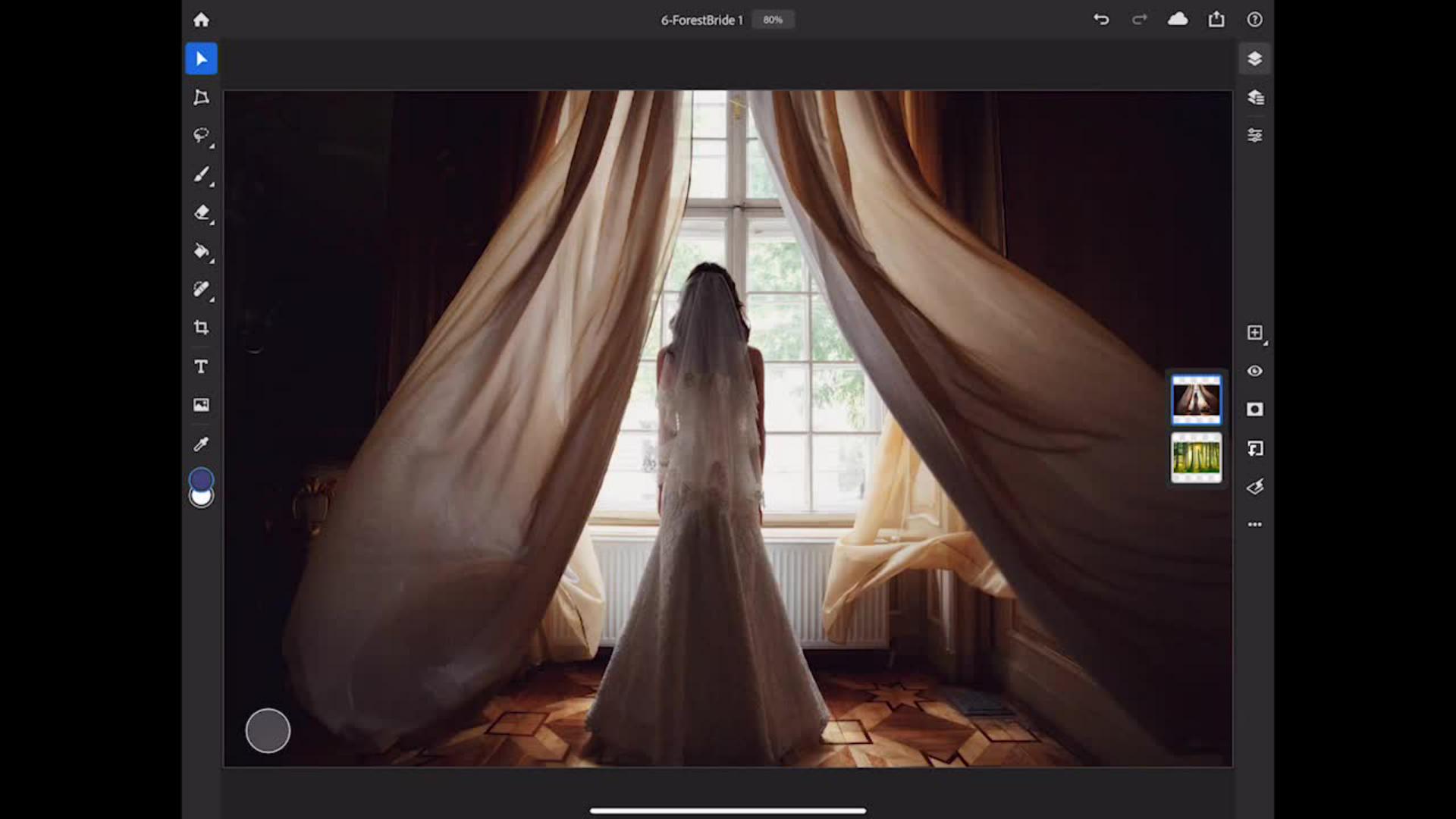
Explore how to use layer masks to combine images in Adobe Photoshop on your iPad.
Published
Introduction
Knowing how to use layer masks is an important skill if you want to make great looking composites either here in Photoshop on your iPad or in Photoshop on your computer.
And the good news is that layer masking works the same way on both of these surfaces.
It's just a matter of getting to know where the various features are.
So here in Photoshop on the iPad I'm starting with a simple document that has two layers.
It has this bride image on the top and if I make that invisible you can see that there is a forest image on the bottom of the layer stack.
What I'd like to do is hide part of the bride layer so we can see them through to some of the forest on the layer below.
So, start by making sure that the top layer is selected
Adding a layer mask to blend images
then go to the Taskbar and tap the Mask icon.
That adds a new empty layer mask to the bride layer. the white thumbnail that you see in the Layers panel is that layer mask.
Next, we're going to brush with black on the layer mask
Painting on masks for non‑destructive edits
to hide part of the bride layer.
Select the Brush Tool in the Toolbar.
In the Tool Options bar, the colour chips should be black and white because we're working on a layer mask.
With black as the foreground color, I'm going to brush and wherever I brush on the layer mask on the bride layer I'm hiding part of the bride layer so we can see down through to the forest on the layer below.
The big advantage of using a layer mask to do this as opposed to say selecting something and cutting it out is that layer masks don't make permanent changes to the image.
For example, if I brush somewhere that I didn't mean to and I hide part of the bride layer that I'd like to bring back into view, all I have to do is go to the Tool Options bar for the Brush Tool and swipe up on the color chips to make white the foreground color and then brush over part of the area of the bride that I'd hidden.
So, all the changes I make with layer masks are always editable.
Viewing and switching between mask and image
If you ever want a closer view of your layer mask just double tap the layer mask thumbnail in the Layers panel.
Now you can more clearly see the black on the mask that's hiding the corresponding part of the bride layer and the white on the mask that's showing part of the bride layer.
I'll double tap again on that layer mask thumbnail to go back to the normal view.
You always want to be aware of whether you're working on the layer mask or on the image that's on the layer so that you get the results that you want.
Here in compact view of the Layers panel you can switch from the layer mask to the actual layer by swiping side to side on the layer mask thumbnail.
To switch from the layer mask to the layer I'll swipe left to right on the layer mask thumbnail.
And to go back to the layer mask I'll swipe from right to left.
So far, we've been working in compact layers view.
If you prefer to work with layer masks in detailed layers view
Working with layer masks in detailed view
where they look more like they do in Photoshop on the computer then tap the Detailed Layer View icon in the Taskbar.
Now you can see the layer mask thumbnail on the right side of the bride layer and the layer thumbnail on the left side of the bride layer.
The blue highlight indicates which thumbnail is active.
Make sure your mask thumbnail is highlighted.
In either compact or detailed layers view you can delete a layer mask all together without harming the image itself.
To do that with the layer mask thumbnail selected tap the three-dot menu in the Taskbar and choose Delete mask.
If you're just getting started with layer masking those are the basics of layer masking in Photoshop on your iPad.
Practice these techniques a few times on different images and you'll get the hang of it.
If you already have experience using layer masks in Photoshop on the computer, here's some additional information you may appreciate about using layer masks in Photoshop on your iPad.
Creating layer masks from selections and refining results
For one thing just like in Photoshop on your computer you can create a layer mask from a selection on the iPad.
Let's switch back to Compact Layers view.
Select one of the Selection Tools and make a selection.
Here will be easiest to select over the dark corners.
So, I'll drag over those with the Quick Selection Tool.
Down at the bottom of the screen there's now the Selection Tool action's bar which appears whenever you have a selection active.
I'll invert my selection by tapping Invert in that bar and now let's make this into a layer mask by going to the Taskbar and tapping the Mask icon.
Then you can use the Brush Tool to fine tune the mask by brushing on it with black.
Another technique for experienced users is to try brushing with lowered brush opacity for a semi-transparent look like this.
So that's a look at layer masking in Photoshop on the iPad that I hope you find useful whether you're new to layer masking or whether you're used to doing it already in Photoshop on your computer.
What you learned: Add a layer mask, brush on a layer mask to hide and show parts of a layer, use a selection to create a layer mask
Layer masks are essential to creating composites in Photoshop on your iPad. They are used to combine layers by hiding and showing parts of a layer without permanently changing content.
Add a layer mask
Select a layer in the Layers panel.
Tap the Mask icon in the Task bar to add an empty, white layer mask to the selected layer.
Brush on a layer mask to hide parts of a layer
Brush on a layer mask with black to hide parts of a layer. The advantage of using a layer mask to do this is that your edits do not make direct or permanent changes to the image.
In the Toolbar, set the foreground Color chip to black. When a layer mask is active, the Color chips default to black and white. You can switch the foreground and background Color chips by swiping up or down on them.
Select the Brush tool in the Toolbar and use the Size option in the Tool Options bar to set the brush size. The brush preview in the image changes as you drag the Size slider.
Brush with black on the layer mask to hide part of the active layer.
If you want to bring some hidden areas back into view, swipe up or down on the Color chips to switch the foreground color to white. Then brush with white on the layer mask over the areas you want to reveal again.
Tips for experienced users: In Photoshop on your iPad, as in Photoshop on a computer, you can create a layer mask based on a selection, and you can brush on a layer mask with lowered brush opacity to partially hide layer content.
You can control how Adobe websites use cookies and similar technologies by making choices below. But note that if you disable cookies and similar technologies entirely, Adobe websites may not function properly.
Cookies are small text files stored by your web browser when you use websites. There are also other technologies that can be used for similar purposes like HTML5 Local Storage and local shared objects, web beacons, and embedded scripts. These technologies help us do things like remembering you and your preferences when you return to our sites, measure how you use the website, conduct market research, and gather information about the ads you see and interact with.
You can make choices in the menu below about what cookies and other technologies you want us to use on Adobe sites when you visit them from this browser. You can always change those choices later by clicking on the Cookie Preferences link at the bottom of the page.
If enabled:
We can improve your experience by tailoring the site and the content to things we think might be of interest
We can better keep track of your preferences — like what language you prefer to use
We will better understand your likely interests so we can provide you more relevant Adobe ads and content on non-Adobe websites and in non-Adobe apps
It will help us improve the performance of our website and those of our partners who use the Adobe Experience Cloud
If disabled:
We won’t be able to remember you from session to session so the experience may not be tailored to your interests
You’ll still have access to the content of the site but certain features that depend on cookies may not function
You’ll still see ads, they just may not be as relevant to you
General information
You can control how Adobe websites use cookies and similar technologies by making choices below. But note that if you disable cookies and similar technologies entirely, Adobe websites may not function properly.
Cookies are small text files stored by your web browser when you use websites. There are also other technologies that can be used for similar purposes like HTML5 Local Storage, web beacons, and embedded scripts. These technologies help us do things like remembering you and your preferences when you return to our sites, measure how you use the website, conduct market research, and gather information about the ads you see and interact with.
You can make choices in the menu below about what cookies and other technologies you want us to use on Adobe sites when you visit them from this browser. You can always change those choices later by clicking on the Cookie Preferences link at the bottom of the page.
If enabled:
We can improve your experience by tailoring the site and the content to things we think might be of interest
We can better keep track of your preferences — like what language you prefer to use
We will better understand your likely interests so we can provide you more relevant Adobe ads and content on non-Adobe websites and in non-Adobe apps
It will help us improve the performance of our website and those of our partners who use the Adobe Experience Cloud
If disabled:
We won’t be able to remember you from session to session so the experience may not be tailored to your interests
We’ll still count your use of our site and services
You’ll still have access to the content of the site but certain features that depend on cookies may not function
You’ll still see ads, they just may not be as relevant to you
Operate the site and core servicesOperate site and measure engagement
Always active
These cookies are required, and they are used to enable the site and related services core functionality. Without them the site could not operate, so they cannot be disabled.
These cookies enable the site and related services’ core functionality and collect statistics about user engagement, such as counting active use to help us understand trends. These cookies cannot be disabled.
Measure performance
These cookies are used to analyze site usage to measure and improve performance. Without them Adobe cannot know what content is most valued and how often unique visitors return to the site, making it hard to improve information we offer to you.
These cookies are used to analyze site usage to measure and improve performance. Without them Adobe cannot know what content is most valued, making it hard to improve information we offer to you.
Extend functionality
These cookies are used to enhance the functionality of Adobe sites such as remembering your settings and preferences to deliver a personalized experience; for example, your username, your repeated visits, preferred language, your country, or any other saved preference.
Personalize advertising
These cookies are used to enable Adobe and our partners to serve ads more relevant to your interests. Without them you will still see ads, but they might not be as relevant to you.
Personalize advertising
These cookies are used to enable Adobe and our partners to serve ads more relevant to your interests. Without them you will still see ads, but they might not be as relevant to you.