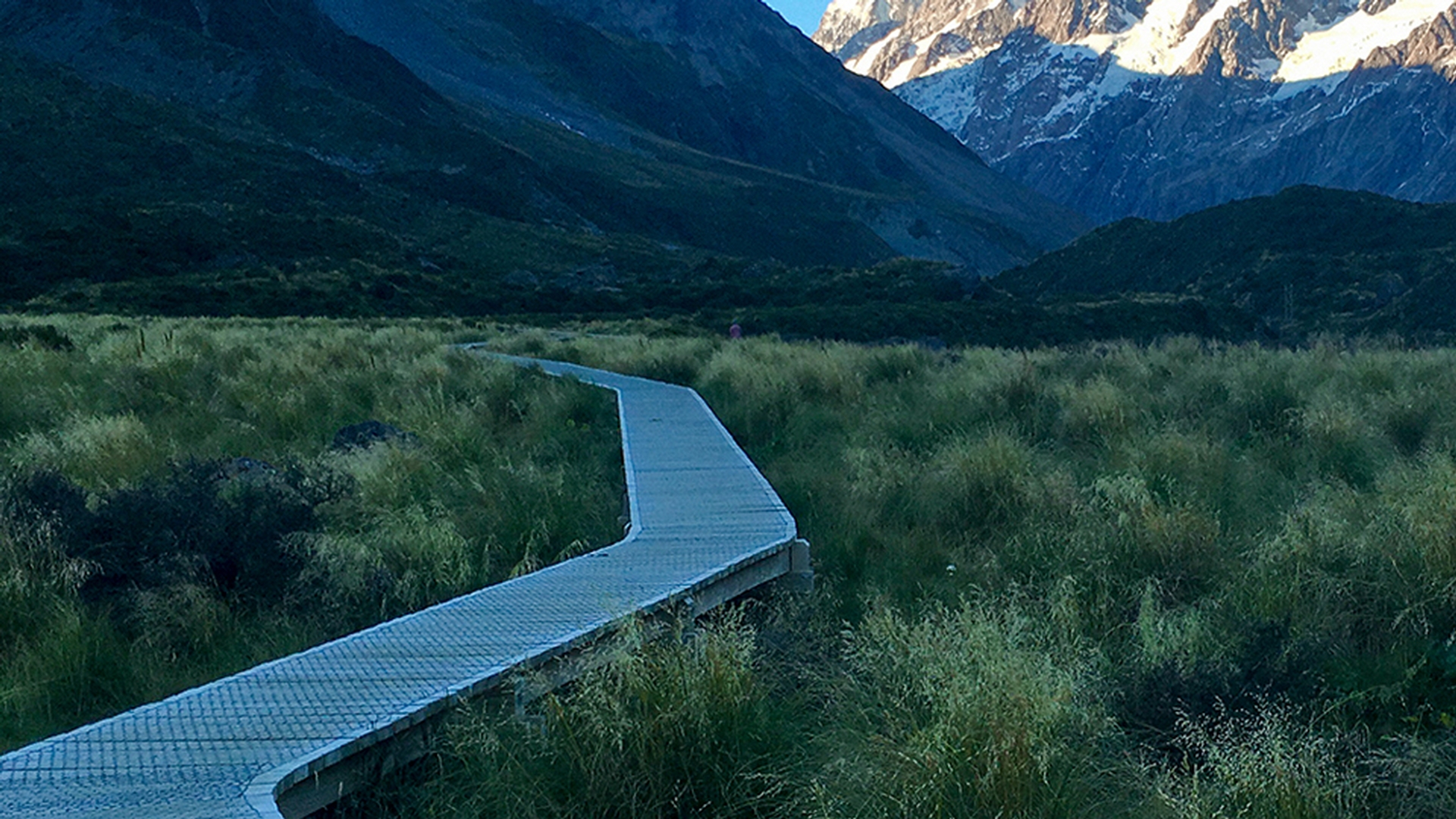
[Jan Kabili]: It's always amazing to see how Photoshop can remove a large object or sometimes even a person from an image.
One way to try removing a large object is by filling over it with a special fill command: Content-Aware Fill.
Let's try it on this image, where we can remove this large wooden walkway.
The first step is to make a rough selection
Selecting a large object for removal
around the object you want to remove.
We'll use the Lasso tool, but you could use a different selection tool of your choice, keeping in mind that your selection has to include a little of the background, as you'll see.
I'm going to click on the Lasso tool in the Tools panel and then move into the image and draw a selection outside the walkway.
Now this is important: You have to include a small bit of the surrounding area inside the selection all the way around.
Down at the bottom, I'm going to go outside the Document window, and all the way around, and back to the beginning, and then release my finger from the mouse or trackpad to complete the selection.
Removing objects with content-aware fill
Now comes the main step: Go up to the Edit menu and choose Fill..., and in the Fill dialog box, go to the Contents menu and choose Content-Aware.
Then just click OK.
In just a second the walkway is gone.
Let's deselect by going to the Select menu and choosing Deselect or using the keyboard shortcut Command + D on Mac, CTRL + D on Windows.
What Photoshop has done is to automatically take some grass from outside of the walkway, use it to cover up the walkway, and then blend the result in with the surrounding area.
It really is amazing.
Now here's a bonus tip:
Refining results with the clone stamp tool
If you see any blurry areas where the walkway was, you can try using the Clone Stamp Tool to cover that area.
To do that, go over to the Tools panel and select the Clone Stamp Tool, and then go up to its Options Bar to the Opacity slider, click there, and drag the Opacity slider to the left to lower the strength of the opacity of the Clone Stamp Tool.
And then click in a blank area to close that slider.
Move into the image and find some grass that isn't blurry.
If your brush tip is really small, press the right bracket key on the keyboard, which is near the P key on the keyboard, a couple of times to make the brush tip bigger.
Then sample some of the non-blurry grass by holding down the Option key on the Mac or the ALT key on Windows, so the cursor changes to this target symbol.
Click to sample there and then remove your finger from the Option key or the ALT key.
Now move over the area that's a little bit blurry and click and drag to add some texture back in there.
Saving the edited image
If you do like the result go up to the File menu, choose Save As..., and save your image in the Photoshop format.
You'll be surprised at how big a change you can make to an image by removing large items.
With only a few clicks you have a whole new image to display or to use as a background for a new design.
Note: Stock assets provided are for practice purposes only. See terms.
What you’ll learn
Draw a selection that includes a little of the background
Content-Aware Fill needs surrounding context to reconstruct what's underneath, so the selection has to reach slightly outside the object on all sides. Use the Lasso tool to draw loosely around the object you want to remove, making sure to include a thin border of the background all the way around. That extra context is what gives Photoshop enough to work with.
Run Fill and let Photoshop reconstruct the scene
Once you have your selection, the fill happens in just a couple of steps. Go to Edit > Fill, choose Content-Aware from the Contents menu, and click OK. Photoshop samples the surrounding area, in this case grass around a walkway, and blends it into the space the object occupied.
Use the Clone Stamp to clean up any soft or blurry areas
Content-Aware Fill occasionally leaves blurry patches near where the object was. Sample clean nearby content with the Clone Stamp, lower the opacity in the Options bar, and paint texture back into the areas where needed. Tip: If you see blurry areas after filling, press the right bracket key to size up your Clone Stamp brush and sample non-blurry texture nearby to paint texture back in.
You can control how Adobe websites use cookies and similar technologies by making choices below. But note that if you disable cookies and similar technologies entirely, Adobe websites may not function properly.
Cookies are small text files stored by your web browser when you use websites. There are also other technologies that can be used for similar purposes like HTML5 Local Storage and local shared objects, web beacons, and embedded scripts. These technologies help us do things like remembering you and your preferences when you return to our sites, measure how you use the website, conduct market research, and gather information about the ads you see and interact with.
You can make choices in the menu below about what cookies and other technologies you want us to use on Adobe sites when you visit them from this browser. You can always change those choices later by clicking on the Cookie Preferences link at the bottom of the page.
If enabled:
We can improve your experience by tailoring the site and the content to things we think might be of interest
We can better keep track of your preferences — like what language you prefer to use
We will better understand your likely interests so we can provide you more relevant Adobe ads and content on non-Adobe websites and in non-Adobe apps
It will help us improve the performance of our website and those of our partners who use the Adobe Experience Cloud
If disabled:
We won’t be able to remember you from session to session so the experience may not be tailored to your interests
You’ll still have access to the content of the site but certain features that depend on cookies may not function
You’ll still see ads, they just may not be as relevant to you
General information
You can control how Adobe websites use cookies and similar technologies by making choices below. But note that if you disable cookies and similar technologies entirely, Adobe websites may not function properly.
Cookies are small text files stored by your web browser when you use websites. There are also other technologies that can be used for similar purposes like HTML5 Local Storage, web beacons, and embedded scripts. These technologies help us do things like remembering you and your preferences when you return to our sites, measure how you use the website, conduct market research, and gather information about the ads you see and interact with.
You can make choices in the menu below about what cookies and other technologies you want us to use on Adobe sites when you visit them from this browser. You can always change those choices later by clicking on the Cookie Preferences link at the bottom of the page.
If enabled:
We can improve your experience by tailoring the site and the content to things we think might be of interest
We can better keep track of your preferences — like what language you prefer to use
We will better understand your likely interests so we can provide you more relevant Adobe ads and content on non-Adobe websites and in non-Adobe apps
It will help us improve the performance of our website and those of our partners who use the Adobe Experience Cloud
If disabled:
We won’t be able to remember you from session to session so the experience may not be tailored to your interests
We’ll still count your use of our site and services
You’ll still have access to the content of the site but certain features that depend on cookies may not function
You’ll still see ads, they just may not be as relevant to you
Operate the site and core servicesOperate site and measure engagement
Always active
These cookies are required, and they are used to enable the site and related services core functionality. Without them the site could not operate, so they cannot be disabled.
These cookies enable the site and related services’ core functionality and collect statistics about user engagement, such as counting active use to help us understand trends. These cookies cannot be disabled.
Measure performance
These cookies are used to analyze site usage to measure and improve performance. Without them Adobe cannot know what content is most valued and how often unique visitors return to the site, making it hard to improve information we offer to you.
These cookies are used to analyze site usage to measure and improve performance. Without them Adobe cannot know what content is most valued, making it hard to improve information we offer to you.
Extend functionality
These cookies are used to enhance the functionality of Adobe sites such as remembering your settings and preferences to deliver a personalized experience; for example, your username, your repeated visits, preferred language, your country, or any other saved preference.
Personalize advertising
These cookies are used to enable Adobe and our partners to serve ads more relevant to your interests. Without them you will still see ads, but they might not be as relevant to you.
Personalize advertising
These cookies are used to enable Adobe and our partners to serve ads more relevant to your interests. Without them you will still see ads, but they might not be as relevant to you.