Welcome back, I am Hallease, a filmmaker and storyteller.
In the previous video, I showed you how to create a new project and import your footage.
Assembling a rough cut in the Timeline
Now it's time to assemble your clips into a rough version of the story you want to tell.
This is often called a rough cut.
The main goal is getting your clips onto the Timeline and in the right order, so that your story flows from beginning through the middle and finishes at the end.
One easy way to check the order of your clips
Checking clip order using the playhead and thumbnails
is to drag the Playhead along the Time Ruler at the top of the Timeline panel.
This way you can see if the clips are in the right order.
Another way to get a glimpse of what's in a clip is to adjust the height of the video tracks in the Timeline panel.
This will show thumbnails for each clip, and you can easily see if any are out of order.
To adjust the height, grab the handle of the scroll bars on the right-hand side of the Timeline.
Now that we can see all the thumbnails, I think we're missing a clip of dripping espresso.
Because we'll only need a few seconds of the espresso dripping, we can add it to our sequence by using in and out points.
Selecting clip sections with in and out points
Let's walk through it together.
First, double click on the clip in the Project panel, so it opens in the Source monitor.
Then use the Playhead to scrub through the clip until you find where you want the clip to start, and press I on your keyboard.
Then move the Playhead again until you find where you want the clip to end and press O.
Now if you look at the Source monitor Time Ruler, you'll see the section is highlighted between two blue brackets.
Now you can drag the clip from the middle of the Source monitor and drop it into the Timeline.
If I just drop the clip where I want it to go, watch what happens.
By default, the new clip will replace or overwrite
Inserting versus overwriting clips in a sequence
whatever content is under it.
This might be what you want, especially if you're trying different camera angles and takes.
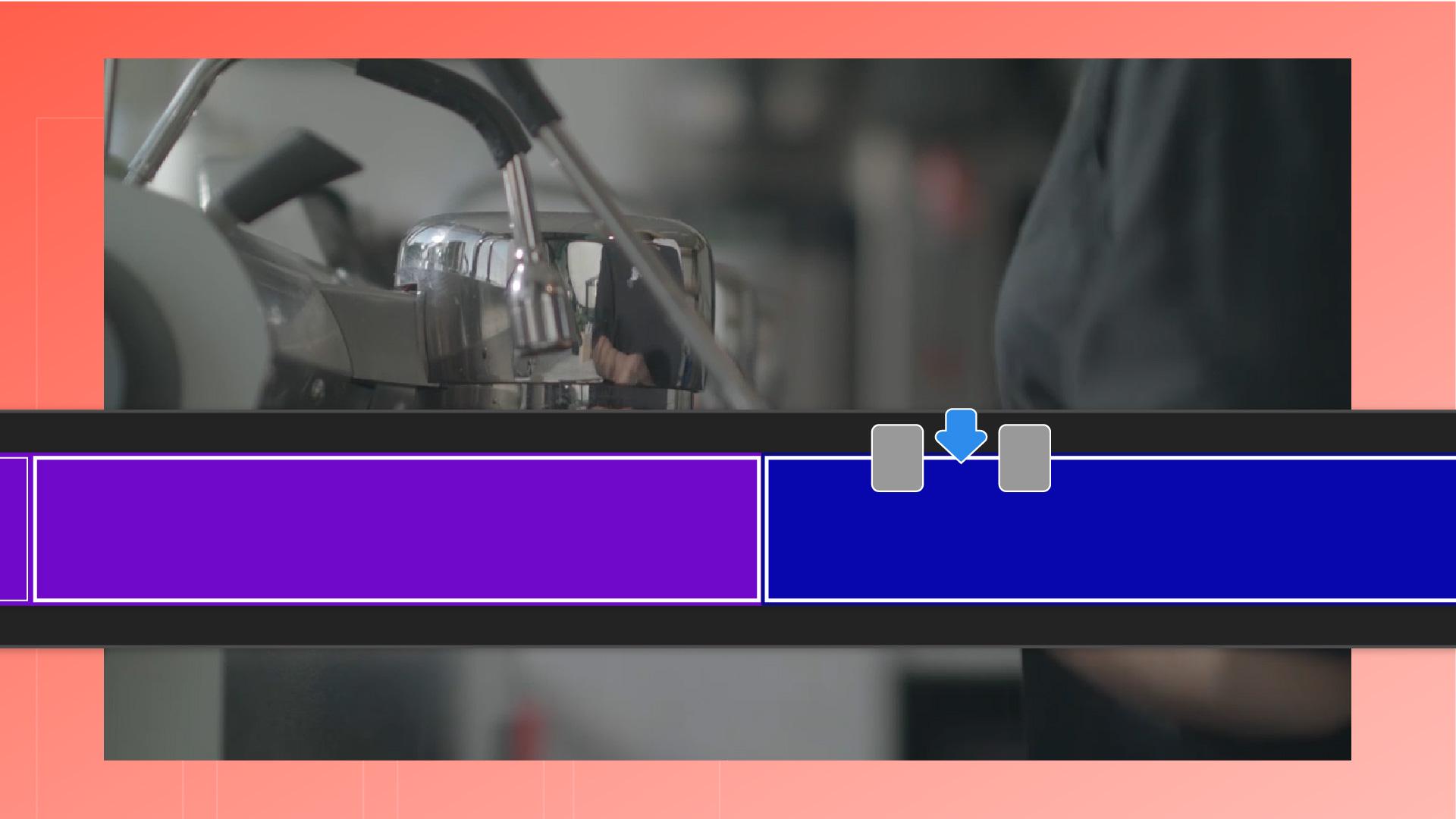
But let's say I want to insert this clip between two clips in my sequence.
To do that, I can drag the clip into the sequence while holding down the Command key on a Mac or the Ctrl key on Windows to perform the insert edit.
The new clip will push all the other clips down the Timeline and add the new clip where I drop it.
So let's review.
You can verify your clips are in the right order by moving the Playhead through the sequence, or by increasing the height of the clips to see the thumbnails.
Adding in and out points allows you to select and add only the parts of a clip you want to include in your sequence.
And dropping a clip into the middle of your sequence will overwrite any footage that is already there.
But holding down Command or Control while dragging will allow you to add the clip, moving the footage that follows down the Timeline.
In the next video, I'm going to walk you through fine tuning your rough cut.
I'll see you over there and happy editing!
Note: Stock assets provided are for practice purposes only. See terms.
What you'll learn
Preview your draft
Preview your video by adjusting the track height or by dragging the playhead through the sequence and watching it in the Program Monitor.
Use in and out points
Add only part of a clip to your sequence double-clicking it to open it in the source monitor. Then use I and O on your keyboard to set in and out points. Finally, drag the clip into the timeline.
Overwrite footage or insert footage
If you want to replace the frames in the timeline, drop the new clip right on top. If you want to insert a clip between two clips already present, hold Command on Mac or Control on Windows before dropping the clip onto the timeline.
You can control how Adobe websites use cookies and similar technologies by making choices below. But note that if you disable cookies and similar technologies entirely, Adobe websites may not function properly.
Cookies are small text files stored by your web browser when you use websites. There are also other technologies that can be used for similar purposes like HTML5 Local Storage and local shared objects, web beacons, and embedded scripts. These technologies help us do things like remembering you and your preferences when you return to our sites, measure how you use the website, conduct market research, and gather information about the ads you see and interact with.
You can make choices in the menu below about what cookies and other technologies you want us to use on Adobe sites when you visit them from this browser. You can always change those choices later by clicking on the Cookie Preferences link at the bottom of the page.
If enabled:
We can improve your experience by tailoring the site and the content to things we think might be of interest
We can better keep track of your preferences — like what language you prefer to use
We will better understand your likely interests so we can provide you more relevant Adobe ads and content on non-Adobe websites and in non-Adobe apps
It will help us improve the performance of our website and those of our partners who use the Adobe Experience Cloud
If disabled:
We won’t be able to remember you from session to session so the experience may not be tailored to your interests
You’ll still have access to the content of the site but certain features that depend on cookies may not function
You’ll still see ads, they just may not be as relevant to you
General information
You can control how Adobe websites use cookies and similar technologies by making choices below. But note that if you disable cookies and similar technologies entirely, Adobe websites may not function properly.
Cookies are small text files stored by your web browser when you use websites. There are also other technologies that can be used for similar purposes like HTML5 Local Storage, web beacons, and embedded scripts. These technologies help us do things like remembering you and your preferences when you return to our sites, measure how you use the website, conduct market research, and gather information about the ads you see and interact with.
You can make choices in the menu below about what cookies and other technologies you want us to use on Adobe sites when you visit them from this browser. You can always change those choices later by clicking on the Cookie Preferences link at the bottom of the page.
If enabled:
We can improve your experience by tailoring the site and the content to things we think might be of interest
We can better keep track of your preferences — like what language you prefer to use
We will better understand your likely interests so we can provide you more relevant Adobe ads and content on non-Adobe websites and in non-Adobe apps
It will help us improve the performance of our website and those of our partners who use the Adobe Experience Cloud
If disabled:
We won’t be able to remember you from session to session so the experience may not be tailored to your interests
We’ll still count your use of our site and services
You’ll still have access to the content of the site but certain features that depend on cookies may not function
You’ll still see ads, they just may not be as relevant to you
Operate the site and core servicesOperate site and measure engagement
Always active
These cookies are required, and they are used to enable the site and related services core functionality. Without them the site could not operate, so they cannot be disabled.
These cookies enable the site and related services’ core functionality and collect statistics about user engagement, such as counting active use to help us understand trends. These cookies cannot be disabled.
Measure performance
These cookies are used to analyze site usage to measure and improve performance. Without them Adobe cannot know what content is most valued and how often unique visitors return to the site, making it hard to improve information we offer to you.
These cookies are used to analyze site usage to measure and improve performance. Without them Adobe cannot know what content is most valued, making it hard to improve information we offer to you.
Extend functionality
These cookies are used to enhance the functionality of Adobe sites such as remembering your settings and preferences to deliver a personalized experience; for example, your username, your repeated visits, preferred language, your country, or any other saved preference.
Personalize advertising
These cookies are used to enable Adobe and our partners to serve ads more relevant to your interests. Without them you will still see ads, but they might not be as relevant to you.
Personalize advertising
These cookies are used to enable Adobe and our partners to serve ads more relevant to your interests. Without them you will still see ads, but they might not be as relevant to you.