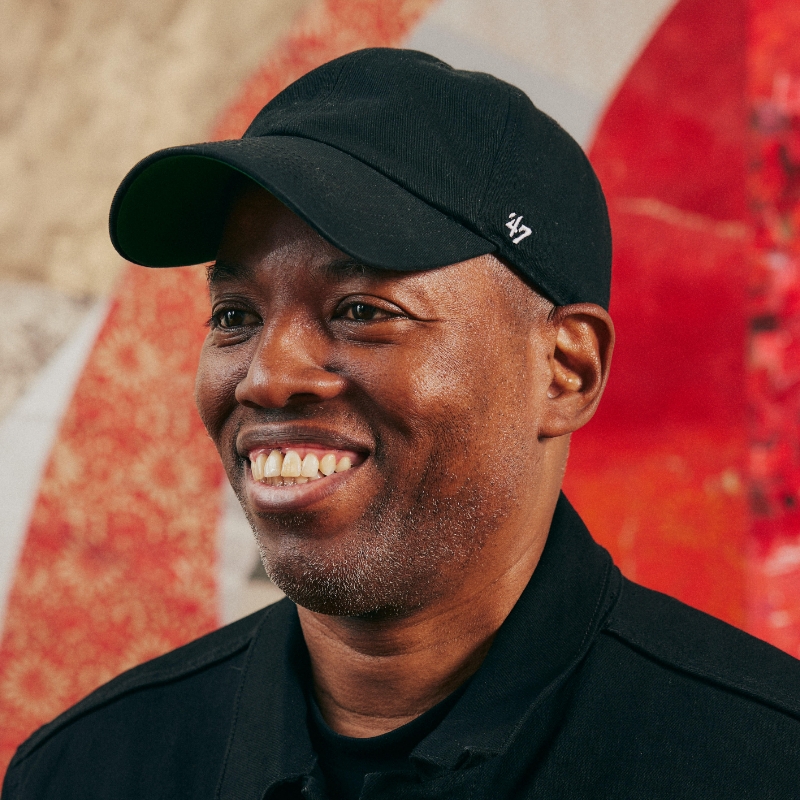
40 Years of Art and Design: Graffiti, Hip-Hop, and Fine Art

[Music] [Cey Adams] Hello, everyone. They literally just signaled me to go, and I'm just standing here looking around.

My name is Cey Adams, and I come from New York City. And today, we're going to talk about my career which spans more than 40 years. And I cannot tell you how excited I am. And I just want to thank everyone at Adobe for having me because I'm a literal lifelong user of Adobe products. So thank you.

Wow, that was it? No applause or anything? Wow, a tough crowd.

So like I said I come from New York City, and my career starts as a teenage graffiti artist. And these are a couple of photographs from even really before my career started with my family, and I thought it was important to show that because like a lot of my friends, I did not have a roadmap to get to where I was going. A lot of my work is rooted in illustration and graphic design, but it's all informed by graffiti. And so when I was starting out, I used to do black book sketches and I would take those things to the subway yards and then I would use that as the basis for my paintings.

So this is one of the pieces that I did in, I think, 1981, and like a lot of people, I would do all of this stuff in the middle of the night and try to get back home before the sun came up and my parents went to work. And back then in New York City, it was a much tougher place than it is now. And it's really fascinating to me when I look back at all of the things that I've done in my career, but nothing makes me more proud than some of this subway work.

So this is taken by my friend Martha Cooper, and it's from 1981. And so at the time, I think I'm 19, and this was a gallery called Graffiti Above Ground. And what they did was they took inner city youth and they gave us an opportunity to learn how to become professional artists. And myself, Crash, Daze, Lady Pink, Futura, Lee Quiñones, and a bunch of others used to sell at this gallery. And it was, like I said before, really, really the early days of the graffiti movement that later became the street art movement. And for me, when I think about this time, what I enjoy the most is that I had no management or talent beyond what I taught myself. And it was just a really, really amazing time and I just miss those days so much.

So one of the first bands that I ever met was Beastie Boys in 1983 and when I met them, they commissioned me to make this logo. And they were always fans of wild style lettering and things that were really sort of difficult to read. And so when they asked me to design this logo, they were clear that they wanted something that was really relatable as far as kids on the street. And so I made this and like the woman that designed the Nike swoosh, I got about $35 to do this, and that wasn't bad enough. It was paid in installments. So I look at it now and I think, "Wow, these guys are still using this logo right now." And so needless to say, I think they got their money's worth.

So around that same time, I met Rick Rubin and Russell Simmons when they were forming Def Jam. And without really having a full understanding of what it meant to be a graphic designer, I started learning how to design records with no formal training, and they basically just sort of threw me in there and gave me this opportunity, and I just tried to make the most of it. And for the record, I did not design this logo. Rick Rubin designed this logo, and I have to mention that because oftentimes I get credit for it, and I just want to say that.

So one of the first artists that I worked with was LL Cool J, and I've known him since he was 16 years old. And over the years, we've designed many albums together and I wanted to just show a few of them because they're just way too many to talk about all at once. The photograph on the left was taken by a photographer named Jesse Frohman, and the photo on the right was by Albert Watson. And the albums that you're looking at are three of my favorites, and the one in particular that I love the most is Mama Said Knock You Out, which is on the top.

So these are some images from the Public Enemy, Fear of a Black Planet album cover. Well, really, it's one image, and it was done by an illustrator named B. E. Johnson, and at the time, he was doing illustrations for NASA. And so back then, you used to have to have an illustrator's annual. And I imagine that there are maybe some illustrators in the house, but I don't think there are many people that remember when you used to have this big brick of a book, and you would thumb through that, and that's how you would find illustrators and photographers, and you'd call up and you'd talk to their rep, and that's how we found B. E. Johnson. And what was interesting at the time was that he had no knowledge of who Public Enemy was, but he agreed to take on this project and we took this thing and we really did something that I was very proud of. And the reason I have these both on screen is because you can see the limitations in terms of what printing was like in the '80s versus what the actual artwork looked like. And there was all this detail in the planet that was lost in the printing process. And so, I decided when I was doing this, I really wanted people to be able to see the detail because his painting was so beautiful.

So this is DMX. And at the time, DMX was a really, really rebellious and interesting guy. And when he approached us with the idea of doing this album cover, he said, "I wanted it to be a literal bloodbath." And so, the photographer Jonathan Mannion that took all of these photographs for each one of his albums had to figure out a way to create this blood. And so what we did was we mixed a bunch of gelatin and food coloring in a bath, and we experimented and played around with it. And at the time that we were making this, this is when the PMRC was coming down heavy on hip hop acts, and they really did not want to release this, but Def Jam fought and fought until they got their way. And looking back now, it's just, like, I still can't believe we were able to pull this off because when you see the photograph and you see it in this scale with all this detail, it just really is just something that's really beautiful. And DMX was such a courageous guy for doing something like this because in hip hop at the time, people were just sort of mugging in front of brick walls with a mean ice grill, and he really wasn't afraid to be creative.

And so Jay Z was a very similar type of artist. He was adventurous and we would have these conversations about creativity, and you have to understand that this is all in the same calendar year. These artists would come to Def Jam and they had their own little independent labels that were distributed by us. But in most cases, this was the first time they'd worked with a creative director. So a lot of them didn't really understand the concept of doing a full photoshoot and using props and things like that, like this $300,000 Bentley that we had to rent and have security next to it so nothing would happen to it, because at the time the record company would have been liable. And again, when I think back to this time, one of the things that was really cool was that I had no idea that these guys were going to become so important, but they were both really great collaborators. And I really want to say that out loud because everybody knows who Jay Z is now, but at the time, this is a really, really big deal that we were able to do this kind of work.

So this is a young man named Keithroy Yearwood, and he is the baby that was on the cover of the Notorious B.I.G.'s Ready to Die album cover. And it was taken by a photographer named Butch Belair. And oftentimes people ask, even though it doesn't seem like it makes a lot of sense, but people still ask, "Is that what B.I.G. looked like as a baby?" Granted, it does look a lot like him, but this was Sean Diddy Combs had a hair and makeup person and this was her child, and so she ended up using him as a model at the time. But one of the things that was really cool to me was that when we started to work on these records, Puff was a guy who gave you a lot of creative space. He would just say, "This is the title and you guys figure it out." B.I.G. wasn't even a part of the equation. He literally like, for whatever reason, was not a part of the creative process. He just showed up, he hit his mark, he took his photographs, and he went home and did whatever it is he does. And that gave us a lot more room to be creative and have fun, so it was really great to be able to have that freedom.

So I had a graphic design company that was founded in 1986 called Drawing Board Graphic Design. And it started out with myself and my partner Steve Carr. And little by little, we added on more and more designers and more and more illustrators. And over the years, we ended up doing hundreds of album covers, not just for Def Jam and Bad Boy but for a lot of the other major labels as well. And so when I look at this photograph, I think about Mary J. Blige in particular and A Tribe Called Quest because both of them are getting inducted into the Rock & Roll Hall of Fame this year.

So logos have always been something that has been really, really important to me and I believe it sort of ties back to my graffiti roots. And so whenever we would design an album, I would usually take on the task of designing the logo myself, and I don't know how many folks here are familiar with the radio station HOT 97 in New York City, but-- One person, great.

This logo is something that I've seen duplicated many, many times in other cities. There's always a hot something or other, no matter where you go in the country, and oftentimes I see people copying this design and it just makes me really proud that I've seen so many people sort of knock this off and like I said flattery is the best form of acknowledgement and I'm proud that I got a chance to create that and people have copied it so much.

So since we're in Miami, one of the things that I do want to acknowledge is that there's a institution here called the Museum of Graffiti and it is a museum that is created for us, by us, and-- By that what I mean is that there are folks that are from the graffiti community that have created this institution as a place where we can show our work and we don't have to rely on the major museums for acknowledgement. And so, when they approached me to design their logo, I felt like it was a real full circle moment because these are people that understand where I come from and so I decided I wanted to include this when I spoke because we are in Miami and it's something that I find really near and dear to my heart because I would have never imagined us having our own place and I'll talk a little bit more about that later on.

So a few years back, I was approached by the folks at Adidas to create a collection for Muhammad Ali and these are a few of those pieces. And at the time, what was really great was Muhammad Ali was alive and he was very active in everything that was going on in his career at that point, and he hand selected a handful of artists to create these little capsule collections, and I was one of them. And it was something that was a lot of fun because I would have never imagined Muhammad Ali even knowing that the work that I do even made sense for something that he was being a part of.

So Dave Chappelle. Wow. Thank you.

In 2001, Dave Chappelle approached me about designing a logo for his sketch comedy show called Chappelle's Show, and so at the time I did not really think much of it. Dave gave me a VHS tape with a couple of skits on it and I looked at it and I thought to myself, "Wow, this is really radical stuff." So I was going to make a logo that, in my mind, was revolutionary and so I decided to do a red, black, and green letter C, just sort of speaking back to this idea of being radical. And all these years later, he's turned this into one of the most important things that I've ever done. And so last year when he was doing a residency at Madison Square Garden in New York City, he brought me up on stage in the middle of his show and he gestured from the back and somebody came out with a box, and they came out with this diamond pendant, and he put this thing around my neck, and I could not believe it. I haven't had a piece of jewelry since the '80s.

It was a really nice thing to do because I work with some really amazing people, but very rarely do you get acknowledged and get credit for doing something like that. And so I had to say that because it was just a beautiful gesture. And so this is one of the designs that I did for some of the tour merch that we did for that show, and what Dave wanted was an homage to classic New York. And so if any of you are old enough to remember, this is what our old subway tokens used to look like. And so I wanted to do a little tribute to that and he got it immediately and we were off to the races.

So in 2012, my friend Adam Yauch from the Beastie Boys passed away, from lung cancer-- throat cancer. I should be clear about that.

And I wanted to make an homage to him because, like I mentioned earlier, Yauch and the rest of the guys loved wild style graffiti, so I made a couple of paintings in his honor using bright colors because I know that was something that he always liked and it just made me happy to be able to, sort of, reconnect because we've been all over the place for many, many, many years. And the Beastie Boys are some of my favorite people in the whole world.

So after doing graffiti and graphic design, and package design, and a bunch of other things, I decided that I wanted to take a break from all of those other kinds of things and move to traditional art making and really sort of take it back to where I came from. And I stumbled upon doing graphic design style collage making, mostly as a way of getting my hands dirty again because I spent many, many years sitting in front of computers. And these are a couple of the pieces that I made. These are all handmade collages with glue and, X-ACTO knives and paper and vintage ephemera and a little bit of acrylic. And both these pieces are 20x20.

So around that time, I decided that I was going to make a body of work that sort of speaks to things that I loved as a kid growing up. And so I came up with this concept called Trusted Brands, and the name, sort of, is tongue-in-cheek, but it speaks to logo design, which is something that's always been near and dear to my heart. And so I started making these pieces as a way of, sort of, connecting with my love of graphic design. And the thing that I wanted to do was to make sure that it was all done with paper. There's no paint. Everything you see there was cut and paste with glue and collage and vintage ephemera that I've sourced from all over the country and in some cases all over the world.

So when I started making these pieces, I thought that this was the perfect vehicle to not only speak about my journey as an artist but to basically celebrate all of the artists that I loved. People like my friend Keith Haring, my friend Jean-Michel Basquiat. I've always loved Ellsworth Kelly. I'm a hardcore New Yorker, so I love the New York Knicks, and I really wanted to showcase all of those things, all while being able to acknowledge some of these brands that I loved as a kid growing up. And a funny thing happened when I started doing this work. I had my first show in 2014, and the show was an immediate success. Everybody that was around my age instantly got it. It was a nod to my love of pop art, but it was also a celebration of everything that I had learned up to that point.

And so when I started doing that, one of the things that I realized was I wanted to celebrate, in my mind, what was the number one brand in America. And I have to say that this is pre-election, but I decided that the American flag was a great vehicle to tell stories. Everything that I wanted to accomplish, in a piece, I could do in that real estate. And again, this was one of those things where once I started doing this, people got it and everybody started to celebrate the work and then I decided to scale it up. And this was a piece that I made at Art Basel back in 2017, and it was so much fun to do it because, like I said, I got to celebrate everybody that I loved, collectors got it, and it was something that I did not really try to make a political statement, but what I found was there was room for everybody to participate.

And so after doing graffiti and graphic design and product design and fine art, I decided I wanted to get back outside and start working again in the street. And this is really the beginnings of the street art movement. My friend Shepard Fairey was out doing these colossal murals, all of my graffiti friends were out painting murals, and so I decided that I wanted to do something similar, but instead of painting my name again, I decided that I wanted to create a message that even had a larger and more universal appeal, and so I decided that I was going to start spreading the message of love. And most of the time when I make these pieces, I don't sign my name, I just go, I paint it and I leave, and people can find me however they find me. But one of the things that was really cool when I started doing this was I started seeing things on Instagram where people were posting things with their dog and their favorite loved one. Oftentimes-- I can't believe I just said favorite loved one.

They would celebrate beautiful moments in their life, and I realized, "Man, I hit a nerve." And the thing that was so great about it was this word doesn't belong to anybody, so I didn't have to worry about all of the issues of copyright and all of these other things that we, as creatives, have to deal with all the time. But the other thing that I really wanted to do was if I'm in front of a room of creative people, I wanted to make sure that when people looked at this work, it was razor sharp for the graphic design fans, and people really understood that this was not something that was slapped together in a few minutes. These pieces take a lot of time. And I love making them and getting comments from people that truly appreciate how long it takes to make something beautiful. And again, I've just seen so many creative ways for people to acknowledge the things that they care about, whether it's a pet or a family member or sometimes people held memorial services in front of these pieces.

So a few years ago, during the pandemic, I got a call to assist in painting a Black Lives Matter mural in New York. And this was not the very first one, I think that was in DC, but this was the first one in New York City. And I went with a couple of my friends, and it was one of the most moving things that I've ever done in my life to be able to paint the names of people that died at the hands of racial violence. And so it's everybody from Martin Luther King to Trayvon Martin and that is a lot of names and it is a literal living memorial to all of these people and it was a beautiful thing to be a part of, but, man, it was a really, really difficult task because as you can see in the photograph, it is a lot of ground to cover.

And my volunteers took off, fell on me after one day and so I was on my own after that.

So this is a mural that I painted for a nonprofit called City Harvest. And again, once I started doing this kind of work, I really wanted to emphasize scale, because I think that there's something about painting a large beautiful mural that just makes people feel great. And for me, I'm always trying to challenge myself and test my chops to see if I've gotten any better over the years. And so when I got an opportunity to do this, I jumped at it, but I really wanted to just utilize every single thing that I had learned up to this point.

This is a mural that's three stories that I did for the folks at Foot Locker and this was to celebrate their 30th anniversary. And so, again, I had to learn a whole bunch about the history of the organization, and they gave me a bunch of pointers and notes and things that they wanted to include in the piece. But the number one requirement was that they wanted something that was quintessentially New York, and I'm a native New Yorker and that was a big part of why they commissioned me to do this piece.

So a few short years ago, slightly before the pandemic, I got a call from Google, and they wanted me to make a Google Doodle and at the time I did not know what a Google Doodle was.

And so I did my research and this was to celebrate, at the time, the 44th anniversary of hip hop. And as most of you probably know, last year was the 50th anniversary. So this is a couple of years old, but what was really great about it was it was completely interactive and the thing that was so great was that they went back to the old neighborhoods in New York City and they tapped all of the cultural pioneers, and they made sure that everybody got a little piece of this campaign, and they gave checks to people that don't normally get the call. And that was something that I had never seen before, and I thought it was really beautiful that they acknowledge the culture in that way, and they did this beautiful campaign. And even right now, if you get a chance, when you get back to your hotel, Google Cey Adams hip hop 44 or hip hop's birthday and put my name in there and this Google Doodle will come up and it's really cool. It's interactive. You can learn how to DJ and all these other things and it's just so much fun.

So this is a mural that I made for my friends at Levi's. And I say friends at Levi's because these folks have been clients of mine for the last however many years, and Levi's is a wonderful company to work with. They give me so much freedom and so much space to just do my thing, and they don't micromanage. And I've been around a long time, and I've worked with a lot of clients, and it's really important for people to see you. And that's why if I'm in a room full of creatives, I have to say this because there's nothing more wonderful than somebody that understands your skill and they are going to give you all the tools that you need to create something that you can be proud of and they're going to pay you. And that's the definition of what it is we do. We just want to be acknowledged.

And Mattel is another one of those companies.

We made this campaign last year and they came to me and they said, "What do you want to do?" And I said, "I don't know. I want to make things." And I've always loved Hot Wheels as a kid, always. And so imagine your adult self having an opportunity to connect with your eight-year-old self and to create a dream project and just... the sky's the limit, like, whatever you decide to dream, they're going to make it a reality. They're not going to get into talking about budgets and limitations, they're just like, "Let's play." And that's what they did. And this is-- "We want to make something. What do you want to make?" I said, "I want to make my version of the Mystery Machine as an homage to Scooby Doo and the gang." And they said, "Let's do it." And so we made this little car or truck. And when this thing dropped last year, man, this thing sold so fast it made my head spin.

They gave me a half dozen of them. I gave them out to my family and friends thinking I could just go back and get more. Man, those things were gone.

And I learned a valuable lesson, save some for the archives.

But the other thing I got to do was to make this beautiful sculpture and they went into their archives from the '60s and '70s, and they gave me boxes of all this ephemera. And I got to make something that really connected the dots from where I was as a kid to where I am right now as an adult. And those things do not happen all the time, and so I'm very grateful to the folks at Mattel Creations for allowing me to play in that way.

So this is my friend, Chef Marcus Samuelson. He is a bona fide rockstar in the culinary world, but he's also a wonderful human being. And he approached me about doing this project with Bombay Bramble. And behind us is this giant billboard on 125th Street that is right above Magic Johnson Theaters. And I walked by that thing year after year after year dreaming of what it would be like to see my artwork on that billboard. And when Marcus called me about this project, I literally lost my mind because I knew how beautiful the real estate was. And so this is a piece that I got to make for that campaign and the other thing that was really wonderful is that Marcus made all this great food and we just had the most wonderful time.

So this is, yeah, I guess, last year, Hip Hop 50. So I was approached by the Grammy Foundation to make an installation celebrating the 50th anniversary. And we did this with a couple of my friends and we got to acknowledge a lot of the folks that I came up with in the past and a lot of the folks that are making work today. But what was really great for me was that I got an opportunity to make these installations and really just acknowledge some of the pioneers that I've come up with that people don't know. And so when I got to tag this wall, I got to include the names of so many people that a lot of folks might have forgotten.

So this is the Smithsonian Anthology of Hip-Hop and Rap. This is a 9-CD box set and a 300-page coffee table book that covers the history of hip hop from soup to nuts. And so it's from the Sugar Hill Gang to Drake and everybody in between. And it's not just recording artists, it's graphic designers, it's graffiti artists, it's everybody that I came up with. And to be able to make something like this, with no art direction, no micromanaging, no budget constraints, the only thing that was a little difficult was that this happened during the pandemic, and this book came out right in the heart of the pandemic and so we couldn't go on the road and do a traditional book tour and we couldn't celebrate it. And that was a little sad. But it is a beautiful, beautiful book. And I urge anybody, that is a big fan of hip hop, to go to the Smithsonian's website and check it out. And by now the thing is probably discounted, so you can really get a good deal.

So right now, I have an exhibition traveling around the country called Cey Adams, Departure 40 years of Art & Design. And I am proud to say that, in December, it's coming to the Museum of Graffiti's Art of Hip Hop gallery.

I know that most of you probably are from out of town, but if you find yourself here for Art Basel, please come and check out this exhibition because, man, it is so beautiful. I was lucky enough to be able to have friends that went into their personal collections and loan me things that they had bought of mine or they got them, however they got them, but they loaned them to us for the exhibition. In addition to every single thing that's in my archive. And it's such a beautiful show and I urge you to come and check it out if you get a chance because it is something I'm really, really proud of. I spent many years working on this during the pandemic, and it's just exciting to see this thing traveling around the country and getting a chance to really meet with folks and talk about the journey. And we're really going to try to blow it out for Art Basel, so please come through.

And that is the end of my presentation, and I want to thank you for listening to me.

But I also want to say, if anybody's got any questions, I'm happy to take a few minutes to talk to you. You just have to walk up to the mics, and I don't know how they do that, but we'll take some questions. And thank you so much for listening to me. I really appreciate it.

[Music]

Luminary Session

40 Years of Art and Design: Graffiti, Hip-Hop, and Fine Art - S6001

Sign in
ON DEMAND

Closed captions in English can be accessed in the video player.

Share this page

Speakers

Session Resources

No resources available for this session

About the Session

Join visual artist Cey Adams as he discusses his artistic career spanning over four decades, from teen graffiti artist in New York City to founding creative director at Def Jam Recordings. He co-founded The Drawing Board, the label’s in-house design firm, that “defined the visual culture of Hip-Hop” and created some of the most iconic album covers and logos including Run-DMC, Beastie Boys, LL Cool J, Public Enemy, The Notorious B.I.G., Jay-Z, and Mary J. Blige. Today Adams creates fine art, drawing inspiration from 1960s pop art, vintage sign painting, and comics. His work focuses on themes including pop culture, brand identity, and cultural and community issues.

As Cey shares insights from his creative journey, you’ll learn about:

  • Creating your own blueprint by harnessing your passion, creativity, and drive
  • The importance of relationships and community — from collaboration to inspiration
  • Giving back — using art as activism to inspire and promote change through community engagement

Technical Level: General Audience

Category: Inspiration

Track: Graphic Design and Illustration

Audience: Art/Creative Director, Educator, Graphic Designer, Print Designer, Illustrator

This content is copyrighted by Adobe Inc. Any recording and posting of this content is strictly prohibited.


By accessing resources linked on this page ("Session Resources"), you agree that 1. Resources are Sample Files per our Terms of Use and 2. you will use Session Resources solely as directed by the applicable speaker.

Not sure which apps are best for you?

Take a minute. We’ll help you figure it out.