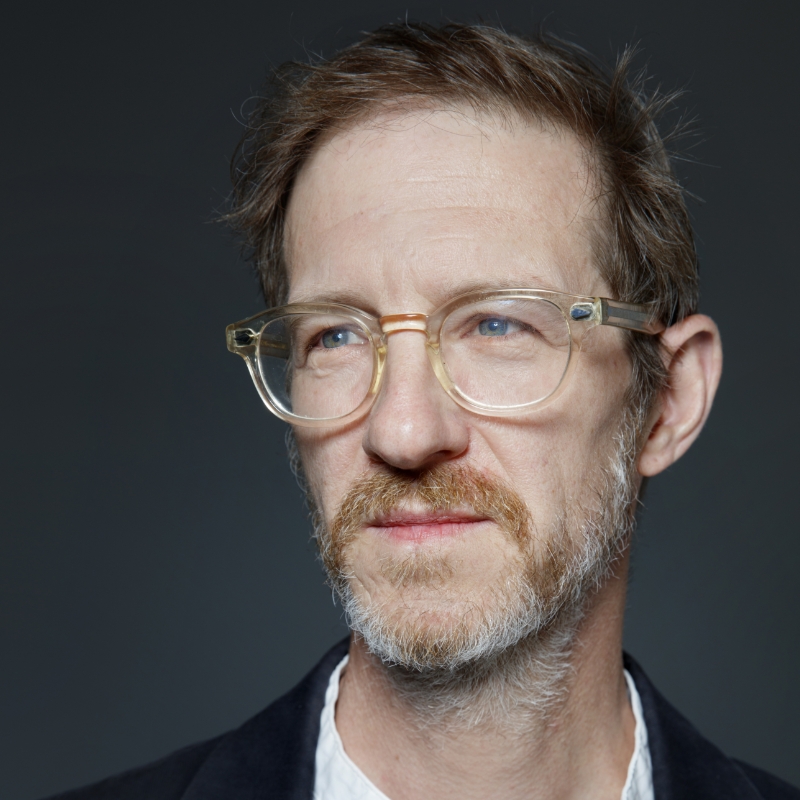
[Music] [Nicholas Blechman] My name is Nicholas Blechman. Thank you all for coming. I'm here to talk about one of my favorite topics, which is collaboration. But before I get started, I'm just going to give you a little bit of background as to who I am.
So I grew up in-- My father is a cartoonist, a very famous illustrator. His name is R.O. Blechman, and this is a photo of him, and that's me back in 19, must have been 70, and this is a photograph that's taken by Garry Winogrand.
And his drawing style is very iconic. He draws in this wiggly, shaky, it's been described as a very nervous line. And even though the line is very nervous, his ideas are very confident. He's very witty, he's very wonderful thinker. And he drew many covers for the New Yorker and worked for just about every ad agency in New York City, entering the '60s and '70s. His work was everywhere. So I grew up always being exposed to the New Yorker magazine, and I was always surrounded by art and design and a lot of his friends were also designers and illustrators.
But that's not how I learned about graphic design. I really came to graphic design much later after college when I started to do my own fanzine called No Zone. Everything in this magazine I did myself. So I did the layout, I did the editing, I did the printing, I did the distribution. This was like a laboratory for design for me. And it was a space where I could experiment and I could also voice my rage at the political system. So it was like a cri de cœur, and every issue had a different format and size. I made lots of mistakes, and I would always try to vary and shake it up and reinvent myself with each issue. And I also changed theme from issue to issue. The Empire issue came out right after September 11th, and it was my reaction to the Gulf War and the invasion in Afghanistan. As I was doing this magazine, I was reaching out to many different illustrators and cartoonists and designers, asking them to contribute. So I had complete freedom. I existed at the fringe of mainstream publishing. The problem with this model is that, because I had no advertising, because I've had a circulation of 1,000, it was a self-defeating proposition, and I could not sustain it for very long.
But as I was reaching out to these different people, I was building a design community. And I was art directing before I even knew what the term art directing was. So even though I made a lot of mistakes in the process of making this, I think that that was the point, a place where I could have complete freedom.
The last few issues were then picked up by Princeton Architectural Press. So at some point, I realized there's no way I could continue doing all the shipping and selling it to all the different stores myself.
And I had this tradition, at the end of every issue, the first very first issue I got, I would always send to Steven Heller. Steven Heller at the time was the Art Director for the New York Times book review, and he was also an educator and a design writer. And to me, he was like some sort of a design god. And he published just about every single book on graphic design was published by Steven Heller. So I would take the first issue and I would send it to him and, eventually, Steven Heller asked me to come and work at the New York Times Op-Ed page. And this was to me like a dream come true.
I first started just replacing the Art Director that was there when she was sick or when she was on vacation, and then eventually I was given the job.
So overnight, basically, I went from the fringe to working in the mainstream. And with this more powerful platform, it allowed me to reach out to much bigger designers. So this is an illustration that Paul Rand did, an illustration by Brian Cronin and Barbara Kruger.
Because it's a daily and I was publishing always on deadline, after a couple of years, I burnt out. And then I had my own design studio. And then at some point, that was also a burnout situation. And then I was asked to return to the New York Times and I was, art directing the week in review section, which is now called the Sunday Opinion. And these are some of the pages that we designed. Even though it came out with the Sunday edition, it was always put together at the last minute on Fridays, and I would get home at around 3 o'clock in the morning, totally wiped out. So, yeah, that was a very intense design experience.
I then graduated to the book review section, replacing Steve Heller as the Art Director for the book review. And this was the second dream coming true, was being able to art direct the book review. And I think, as you can see, I just had tremendous freedom to work with different illustrators and designers and to do whatever I want on the cover. The only limitation is that the article itself, the review of whatever book was being described had to be somewhere on the cover. Now if you look at the book review covers, it's just a piece of art and a headline.
So I often get this question, "Well, how do you become Creative Director of the New Yorker?" So that's, in essence, that's-- Now you know. It's by following your passion and following your instincts and by not having a plan, and it allowed me to go from a scrappy little magazine to one of the most prestigious magazines.
So...
Now I'm going to talk about my favorite subject cooperation, collaboration. And I want to make a distinction between cooperation versus collaboration. So this idea of cooperation.
First of all, there's this myth of, like, you can do it by yourself, you can totally go solo, and you can, but you run into all sorts of problems. And you rely on tech support and things go wrong, and it's difficult, and we cannot work in complete isolation. There is this myth that the romantic era gave us of this genius charting, his or her own course, and I think the reality is much closer to this anxiety when it senses of how to fill that empty space, that blank sheet of paper. So this is a drawing that Christoph Niemann did, and he's also one of my partners that I collaborate with most frequently, so you'll hear his name quite a bit. But this solitude, this fear of failing, of not being able to come up with a brilliant idea is something that I think that all creative experience at some point, and it's a fear that was so strong in me that I always sought out collaborations. I always wanted to work with other people, to foster some exchange of ideas.
Yuval Noah Harari writes that, "Sapiens were in the middle of the food chain." There was nothing exceptional or unique about humans. We were just one animal of many. But at some point, things shifted and humans were able to cooperate in large groups flexibly with others. And, yes, there are lots of other animals that can cooperate. So wolves cooperate really well together, bears, apes do, but the difference with humans according to Harari is that we can collaborate or cooperate with complete total strangers, and that's a bit of a gamechanger for us.
And what allowed-- That put us at the top of the food chain as a predator rather than the middle. Flash forward to 100,000 years, I get a lot of emails each week asking to collaborate with me too. Let's collaborate. I have a collaboration offer. And I just want-- It's always like one of my pet peeves. I just want to be clear. This is not a collaboration. This is somebody saying, "Let's work together," which is very different.
So when I mean the difference between collaboration and working together, if we're working together, there's more of a hierarchy. In other words, I'm setting the parameters under which we will work together, but the actual heavy lifting is going to be done by you. You're going to be the one that's actually doing illustration and doing the artwork. I'm just there to guide you along and to point you in the right direction.
Partnership versus collaboration.
So collaboration has become a buzzword in the industry in the past, I don't know, a couple of years. Everybody is talking about collaborating, and it's more of a-- I see it as a marketing trend. So, for example, Carhartt will collaborate with APC or J Crew will collaborate with Engineered Garments. In the subways of New York, you see people wearing baseball caps and it says MoMA or it says the New York Yankees on the front and then it says MoMA on the side. And these kinds of collaborations always baffle me because it's like MoMA's somehow very much into sports, or the Yankees, do they have an art collection that I wasn't aware of? So sometimes it feels like some sort of logo narcissism and it creates these weird hybrids that I don't really see as being-- It's more repackaging versus creating a new product.
So I think if it's done right, if two brands can come together, to create something new, that's when it becomes interesting. So it's at that intersection between these two different groups where I think something exciting can happen. So it's the sum of the parts become more than the individual thing. So at the New Yorker, we've been fortunate enough to collaborate with some special brands, with Sleepy Jones, with Schumacher, paying homage to our covers and to our cartoonists.
We're doing a collaboration with Timex. I'm very excited about that, which will be released next year. Next year is the 100th anniversary for the New Yorkers. So we're in full anniversary mode, in anticipation of that. We also have a capsule of New Yorker branded sweaters and shirts with J. Crew.
La Colombe, each of their coffee packages is designed by a different illustrator. So they came to us and said, "Well, why don't we do a set of New Yorker coffee packages using New Yorker artists?" So these are collaborations that make sense, but I think there has to be some criteria for how these different companies come together. So the first thing that we want is for the partnership to somehow elevate the New Yorker. It can't just be good for that brand that wants to work with us. It also has to be good for us.
So we have to-- It can't be just like a random company, they have to share the same values as us. They have to be as obsessed with high quality as we are. The New Yorker, I consider to be a legacy brand. So in theory, we'd be also partnering with someone similar. So the Schumacher, for example, they've been around for over 100 years. And then lastly, I always like it to be some connection to New York City.
It has to make money, to be honest. There has to be a minimum guaranteed royalty so that we are generating a certain amount of money. And then it has to be fun. There has to be some pleasure that comes from this, something unexpected. It can't just be, "Here are typefaces, here's our archive, here are logos, go do something." It's more like, "Let's get the art department, your art department and our art department together. Let's brainstorm. Let's try to come up with ideas and come up with something new." And it's really hard to do that successfully. Some of the things that have come out from that are these Sleepy Jones pajamas with cartoons by Charles Barsotti. And this needlepoint pillow that was done with Schumacher. So with Schumacher, we did a bunch of wallpaper, which I'll show you in a second, but we also did this needlepoint pillow in which every little needlepoint stitch corresponds to a pixel. So we could have complete control over the needlepoint when we drew this, at the right resolution.
So these are fun. These are like, I never thought in a million years that I would be doing pajamas when I went to the New Yorker.
This is the sample of the wallpaper that we did with Schumacher. The illustrator is Ed Steed, who's done a number of covers, a number of illustrations, cartoons inside the magazine. And even though these colors are beautiful and it's all flowers, if you look closely, I think there's something quite creepy with these little creatures, just because maybe I know Ed Steed.
And Joanna Aviles did this wonderful, just vignettes and scenes of New York. So this is a great opportunity not only for us but also for cartoonists to not only to do work outside of the confines of the magazine and to work with other brands.
So putting out a magazine every single week is inherently collaborative because we're working with so many different departments and editors. And I've noticed that the more ambitious the project is at the New Yorker, then inevitably, the more collaborative it's going to be. But I just want-- There's a small misconception, I think, between collaboration which we're all working together as a team to get something done and collaboration where everyone is actually a creative director. Everyone is actually as-- Everyone has a say as to how the project is going to unfurl. So I think of that as what we do at The New Yorker on my team is more of a vertical collaboration because it's top down. So somebody is telling us, "These are the articles you're going to be working with. This is what the art's going to be," whereas a more horizontal type of collaboration is in which everyone is calling the shots and everyone has equal say. And those types of collaborations I find much more difficult to manage.
So the core-- I just want to talk a little bit about my work at the New Yorker. So the core responsibility of what we do as a team is just to create images, to create beautiful images, and the way we work is always very independent from each other. So in other words, I will be commissioning one piece and then someone else in my team will be commissioning something else, and we all check-in with each other, but we all work independently and autonomously. So in that sense, it's the opposite of collaboration. We're not working together, and the less we collaborate together, maybe the better it is because too many cooks also can mess things up.
So the goal is to work with the best illustrators and best designers and to find solutions that are as complex and to find visual solutions that are as complex and subtle as the writing itself. And I think that's one of the pleasures of working at the New Yorkers that the articles themselves are so beautifully written. So it's a great inspiration to us to try to find solutions. And the themes vary greatly from politics to social issues. This is a beautiful drawing by Sophy Hollington, for an article by Elizabeth Colbert on whales and how they communicate with each other.
So this piece is itself on penis enlargement, is itself a collaboration between ProPublica and The New Yorker. So that's a partnership between these two different media firms. So it will launch in the New Yorker, on the same day that it'll go live online at ProPublica. And the art for this was done by Maurizio Cattelan and his team. And he's an artist, but somehow the photography department always handled or worked with Maurizio Cattelan because, ultimately, he shoots their photo illustrations. So this was also a collaboration between the photo department and the illustration department where we are both coming together talking to Maurizio trying to find a solution for this challenging problem-- of the challenging problem of penis enlargement Trying to find a convincing illustration for these kinds of topics, I think, is difficult.
So our roles are increasingly overlapping and interrelated as we produce stories that exist in different places. So, for example, the New Yorker for many, many years was just a print magazine. And so many of our readers didn't even know that the New Yorker even existed online. And now we have a really robust website and digital offering. But the art, the translation of that art, trying to get the art to work in many different places is always very difficult. So this is our redesigned website that we relaunched, I think, earlier this year. And the top of the homepage is just a single story. For years, it had been multiple stories and you can click on whichever one you want. And that's how the Atlantic is and that's how the New York Times is, but we decided that we would shift our focus, instead have just one lead story that we're recommending that'll be up all day long, and we say that this is a story that you're supposed to read. So there's this new emphasis on art and the way art looks on the homepage when we're featuring it this big.
When I started at the New Yorker 10 years ago, we had, I think, one of our print designers was every now and then commissioning a little piece that would go online, maybe two or three pieces that would go online, and we had maybe one or two digital photo editors. Now we have like five or six digital photo editors and we have three art directors working full time on the website.
And one of them, Nicholas Conrad, who did this beautiful illustration for an article by Zadie Smith, he's our secret weapon. He's our in-house illustrator. So he actually does-- I have this rule in the art department, nobody's allowed to do any kind of illustration. We're not illustrators, we're art directors, with the exception of Nicholas Conrad who is able to, on very short turnaround, do some illustrations.
So this is a photograph by Thea Traff of Sofia Coppola. This was in the print magazine and then this is how it looks on the homepage. And so then the question is, okay, well, how does the image translate from print to web? How does this still look like the New Yorker? And, yeah, maybe it does or maybe it doesn't. Obviously, it's a beautifully composed photograph, but making it black and white, it has a classic quality that makes it feel like something that the New Yorker would do. The first photographer for the New Yorker, staff photographer was Richard Avedon, who did these gorgeous black and white photographs and so we always keep that in mind with many of our assignments.
A variety of stories, a variety of different styles, always trying to keep it as mixed up as possible. This is the talk of the town section in the magazine, and this is what it looks like online. So this is in the front of the book where we have these short little vignettes, these short pieces that are usually like little witty written pieces about different characters in the city, and we illustrate them with these black and white drawings. So, again, figuring out how this is going to look. They look great in the magazine, but does this really make sense in a digital context? And then lately we've been doing digital-only issues. So these are issues that are online-only. And this was the interviews issue. We have issues that come out that are double issues. And then, so for the down week in which we're not publishing an issue, we offer a digital-only issue.
And this is a cover. So this is a digital cover, which is like super confusing because it looks like a print cover, but it's actually never existed in print.
And this is an animation by Cari Vander Yacht, and it's one of my favorite illustrations from this past year.
So this is interesting because all the covers are done by Françoise Mouly, she's the covers' editor. And in the art department, we do all the interior illustration and then the web does the digital illustration. And now for this, for the digital issues, we started doing some of the digital covers. So I think things are opening up and departments are collaborating, working with other departments in ways that they hadn't before.
Online, we can get away with murder. I feel this is our food issue and I feel like a number of different rules are being broken here in terms of all tracked out, all caps neutraface. That's something we would never do. This insane blue background, putting the logo in the yellow circle is also a big no-no.
But I love to give the web team, and this is Nicholas Konrad and Aviva Michaelov and Aurora. They do this and I feel it's their mandate to try to push it as far as possible in terms of like shaking things up. But it's this-- Coming out with an online issue is very much new territory for us.
I can't give a talk about The New Yorker without talking about our iconic tote bags. So many people think that actually The New Yorker is a tote bag company that happens to put out a magazine each week rather than the other way around. The tote bags-- In order to get a tote bag, you have to have a subscription to The New Yorker. So that's been the model for us to sell subscriptions was to create this iconic tote bag. So the tote bag that's the large type on white, that's called the control bag that you see quite-- I haven't seen any in Miami yet, but you see them all over in the subway of New York. And then the green one and then the Ed Steed one are just variations on that control bag, and then we've tried various other totes by different illustrators. The pigeon is by Luci Gutiérrez, and the yellow one, which is my favorite, is by Tim Lahan.
The New Yorker Festival is another area in which we, like, in the art department, we go outside and we start collaborating with yet another team, the events team, this has been going on for now in our 25th year, so we're about to launch our 25th New Yorker Festival. And each year, we have to come up with a completely different identity for how that particular festival looks.
And the festival is a very special moment for The New Yorker in which all the different writers from Jennifer Egan to Gary Shteyngart, Seth Meyers, Jonathan Franzen, at the next one, Julie Mehretu, the artist, will also be speaking, come on stage. And for that, just before people come on stage, we do a short animation that kicks it off as people walk up. And this to me is the-- It culminates, the design that we do, whatever the identity and work we do throughout the year for the festival, it culminates in this little animation. So I'm just going to play this one for you.
So the illustrator for that is Tomi Um.
And this year we have-- This is the identity for the 25th New Yorker Festival. So this is the one that's going to start at the end of this week. And the illustrations are done by Liana Finck. And I've got to say, everyone who looks at this is aghast by the pink. They're, like, "Wow, that's really intense." And I have to say it's very Miami.
And this was fun for us because in the world of cartooning and illustration, there's a hard line between those who are doing illustration and those who are doing cartoons and those who are typographers and designers. And Liana Finck, I put in the category of cartoonist as opposed to illustration. So it was really fun for us to go outside and to work with a cartoonist.
We also have podcasts. So podcasts are a huge area of growth for The New Yorker. And so, in this case, we work with the audio team to develop an identity for each of our podcasts. So we have our premier podcast, which is the Radio Hour, and then we just recently launched the Critics at Large and also the Political Scene are fairly new podcasts. So each one of these needs a look. It needs to look like The New Yorker, but it has to have its own identity. It has to work really small on your phone, obviously.
So these are all design challenges outside of the magazine that make us collaborate with different teams.
One of the most significant podcasts, so I just want to go back and say that the-- In the Dark Team, which is an investigative journalist podcast recently joined The New Yorker, and they just released their new season which talks about a high profile war crimes, how high profile war crimes prosecutions in the US have failed to deliver justice in the sense they have not prosecuted anybody. So this is an entire podcast about crimes that took place in Iraq, around 2005, 2006, specifically in Haditha, and massacres, allegedly, that were done by the marines, that were then investigated but actually no one was actually punished. So for this, we had the podcast, of course, but we decided to do an immersive interactive visual documentary to go with it.
So what's unique about this besides leveraging all sorts of technology that we've never used before and also leveraging and working with all sorts of data In The Dark team came up with and trying to find taking all these points of data and then giving them to an illustrator, in this case, Emiliano Ponzi, and trying to recreate what it was like to be there at that time. And what is particularly ambitious about this is not only is it from the point of-- It's not one point of view, we actually try to show it from different points of view of different people. So from an Iraqi boy who was there at the time, or from the point of view of a marine who was there, or from the point of view of an Iraqi soldier who is working alongside the US marines.
And then this also comes with a huge database of all the war crimes. So it's hugely ambitious and hugely enterprising, and if you haven't seen this, I can't recommend it strongly enough. It's really quite something. And I also will say that if this represents the pinnacle or the future of what we can do as a news organization in terms of like visual storytelling, then I would have to say that the future is so collaborative.
This involved work, yes, with the interactive team, also with the podcast team, with our web designers. It was just a huge amount of work. And I also am very pleased with the fact that illustration was used to tell the story, that it was not done in some photo collage way, that it was really-- I think it's a testament to the power of illustration that this story was, when there's a bed, for example, in a room and we try to show that bed in this 3D environment, we actually measure the bed, we give all this information to the illustrator, and we actually try to tell it. And it has a very visceral effect, and I think the drawings without that being actual portraits of the soldiers is an anonymity in the style that it's done, complimented well.
Okay. So now I want you to forget everything I've said about collaboration, and I want to start all over, and I want to talk about collaboration by necessity, and how I came to be a collaborator. So that's the work side.
So The New York Times Magazine has this one special issue they come out every year called the Year in Ideas. And they had this idea that there would be a huge blackboard drawing of all the different inventions and ideas of the year and that we would do a drawing of it. So they asked a friend of mine, Brian Ray, to do the illustrations. And he had about a week. And he was anxious about covering such a long, large surface at such quick turnaround. So he asked me if I would help him, and then I saw how large the space was and how many drawings we had to translate on to this blackboard, and I became nervous, and then I had to ask Christoph Niemann if he would join us. And so one night we went to a studio, and the three of us in a couple of hours just drew this crazy drawing which came together really nicely, and we thought that was the end of it, and then about a month later, Society of Publication Designers has their annual and they said, "Oh, we'd love for you to do that chalkboard drawing again." And this time it was like, "Oh, my God, it's even larger now." Because there's the back side also, the back page, as well as the cover.
And the idea, of course, taking all the winning entrance and somehow translating that into the drawing. And as you know, one thing that drives illustrators completely nuts is when you do a drawing and it's successful and someone comes and asks you to do that same drawing again. It's like an insult to our creativity somehow. So we're like, "Okay. It's the SPD. It's a good cause. Let's do it." And so this came from it. But I swear, every couple of months after that, we would get a call from some agency or some magazine saying, "Can you please do a big blackboard drawing?" And this led to other larger projects. So this is yet another one. This is in San Francisco for VMworld. Brian, Ray, and I did this.
So that's me on a scissor lift and the man next to me is Doug. I think there was some requirement at the convention center that there had to be a union member on the scissor lift at all times. So he was there. He would just stare and watch me doodle. But by the end of the three days, that's how long it took us to complete this, he was there with the chalk doing some of the drawings with us. So that was a great collaboration. And just to show you that I don't always work with chalk, this was done for the Art Directors Club. Also with Brian Ray, we used black tape.
And we just covered the surface... All we had as an idea was, let's just draw a city and we'll put faces on the buildings. And then from that simple idea came this elaborate drawing, that we did with a bunch of students for a workshop.
And if you come to New York City and you come to my office on the 38th floor, you'll see I take a Sharpie and I do little doodles on the walls of The New Yorker, and I do these also with Christoph Niemann. So when Christoph Niemann comes to New York, he lives in Berlin, I always give him a Sharpie and he does a little doodle. These are all very mysterious drawings about the inner workings of The New Yorker that a lot of the references I myself can't even explain to you.
Okay. So now, creative collaborations. So this is when I think of collaboration, this is-- I feel like the heart of what I have to say is that, with Christoph Niemann, we decided to form a group called 100%. And the idea was we would do a bunch of books, artist books, one off artist books together. Each book would be a different percentage point and so there'd be like 20% and 30%, then add it all up and then at the end of the project, we'd have 100%, and that would be the complete library and we'd finish publishing. That was the concept at least.
The idea was that each one would have a theme. So Christoph and I would have these incredible fights over coming up with what would be a good theme for one of these books. And, of course, whatever the theme was, we would have to end up drawing and working on it for the next couple of months. So it was like a real commitment. I remember at one point I was obsessed with the idea of noses, probably because I have a big nose. And I was like, let's do 100% noses. So many jokes in The New Yorker are on people with big noses. And he just thought that's the stupidest idea I've ever heard. And to prove it, he did a little book of noses and gave it to me and said, "Look, here's 100% nose. It's done. Let's move on." So of all these different ideas, we ended up on 100% evil, and this was done quite a few years ago. We shared a graphic design studio in lower Manhattan, and it was not too far. It was in Chinatown. It was not too far from the World Trade Center. September 11th happened, and then the following wars in Afghanistan and then Iraq, and we just thought, "Okay, evil. That's going to be our theme." And this is the book that came from that collaboration.
And I want to go through some of these pages to explain how we work together. It was really-- I do a drawing, then he would do a drawing that would not be a response to it, but he would just do a bunch of drawings on the theme of evil. I would do a bunch of drawings on the theme of evil. Half of my drawings, he would say, "No, these are bad," and toss them out, and then drawings that he would do, I would pick the ones that I thought were better than others, and we just go back and forth between us.
So the thing about this is-- So there'd be these-- He didn't draw this in response to my having drawn a laptop with teeth. He would have had drawn this, and then we would-- It was in the editing that we'd find these nice pairings, and we'd put these together.
But I think the important thing here is that just working in black and white, the important thing, well, we have several important things. First of all is we've had very clear rules. This has to be black and white and then we'll use just one color, one spot color on top of that.
So those were the rules that we had to set up. And I feel like if you're going to be in a collaboration with someone else, there has to be clear guardrails as to how that collaboration is going to happen.
And to this day, there are some drawings here and I don't know if Christoph did the drawing or if I did the drawing.
Actually, that's not true. I know who did these drawings.
The thicker brush stroke is Christophe and the more thin line is me.
But then we thought, "Okay, what's the worst thing you can do? What's the most evil thing you can possibly come up with?" And I'm like, "War. War is terrible. War is like that's beyond." So we decided to have a war. And this reminds me of when you're a little kid in class and you do a little drawing, and then you pass it to a friend, and they do a little doodle, and then they send it back. So I decided to send my brick army soldiers to attack Christoph, and then Christoph from the other side of the book would send his ninja air force.
And then I would send all the kitchen utensils truly weaponized, then he would send these kung fu skeletons. And then in the middle, there'd be like a big mash up of these different forces in which was the complete war. I just realized there's Florida there, and that's-- I love Florida. That's because of the hanging chad during the election, I think we threw in Florida. That was referenced to. But this is really-- I really felt, okay, we're in high school and we're just not listening to the teacher and we're just drawing back and forth and it was so much fun to do. So this is a definition of collaboration is if it's successful, it's a piece of art that you create that you could not have created by yourself. I could not have come up with this. It could only come, something like this would only exist through this conversation that I had with Christoph.
And once you started doing this, once you started putting out that you're doing these collaborations, people start approaching you for that kind of work. It's like the chalkboard. People see that you do chalkboards, okay, let's do that as a solution. So Metropolis Magazine and Architecture Magazine asked Christoph and I to do a city, not a city, to draw significant architectural landmarks. And not landmarks but new skyscrapers of significance. And we decided that we would just draw purely vector, purely CMYK, and he did half the buildings and I did the other half of the buildings and then we put it together.
I think then Christoph had this master/genius idea of putting all these old buildings at the bottom in yellow that brought everything together. So it wasn't just like a grouping of buildings. But I love this. This is so much fun to do, and, again, this could only come from a collaboration, and it was great.
Then one more project that I just want to finish off with this project is an exhibit at the Metropolitan Museum of Art, a couple of years ago called Talking Pictures, Camera-Phone Conversations between artists. So they asked Christoph and then Christoph asked me and the idea is really simple. We would have a conversation and they asked, I don't know, a dozen different artists. But the conversation can only take place through your phone and cannot include words. So you would have to send images to each other. So I would take in a photograph of you, and I would send it to him, and then he would take a photograph of a lecture that he's at with his interview. It's like back and forth. But being that we're illustrators, we started drawing.
So that was the process.
And this was the cover.
And the rule was that we had established for this partnership was that I would only draw in black, and he would only draw in blue.
This is his office, his studio in Berlin, and this is where I'm working in New York.
And so he would take this as an example. He did this. He would send it to me, and then that would be my answer.
So I took a picture of lower Manhattan. I sent it to him, and then his response was, which I absolutely love.
This is the view from the kitchen on the 38th floor of One World Trade Center on a very foggy morning.
And that was his response.
So we're doing two kinds of things. We're doing photographs, a photograph that's answered with another photograph, but then sometimes we'll do a photograph and it would answer the photograph with a drawing or sometimes-- So in this case, for example, these, a crosswalk, and then Christoph's response was also a crosswalk. But what I love about Christoph's crosswalk is, it's so badly photographed, his crosswalk with the little pieces of paper cut out, which he didn't even try to conceal it. And I think the more in this kind of a situation, the worse the photograph it is the better because it looks handmade. So trying not to be good if we are not photographers. This photograph of this little toy, I don't know why, I would try to take photographs that I would send to him as provocations through little prompts. Like, "Here, take this," and then he would say, "Okay. Here, take that." And he'd do a drawing back of something that he had done of his response to it. So in and of themselves, I would never normally take this kind of a photograph. He took a photograph. He took this, and I replied with that.
And then at first, we started doing this, which is just purely drawings. So you do one drawing, I do another drawing.
That's my living room.
Christoph's head, my head.
I love how abstract these are, and I love there's a certain freedom that came from doing these that we're not trying to illustrate anything per se. It was just like a visual response to something he had done, but we still go through that process of, I would do a drawing, and then he would look at it and say, no, I don't like that. Do another one, and vice versa. So we were constantly in check, and even though we were competing with each other trying to show, look how clever I am, there was that too. And that's another great aspect of a collaboration, is that you're always trying, there's this process of one-upmanship, you're trying to impress the other person you're working with. It also drove us, I feel like it lifted both of our standards in a way. Burnt toast, my toaster, then for some reason, he was skiing, I guess, which led to that. So with each drawing, we'd have to find an answer to the drawing that allowed for there to be an opening for another drawing to respond to it. So then the pencils became a thing.
A visual pun just on the shape. I love these bagels, smoked bagels coming out of the-- And this is like a subway where I live in Brooklyn, and I just thought great, I just absolutely love, and I just knew Christoph would have fun doing something with it.
And this is towards the end of the collaboration where things are just getting really weird and really abstract.
And then we started doing drawings on top of drawings. So instead of rather a response, he would do a drawing in blue and then I would just do like some other random drawing in black on top of it and that became a different method. So as soon as the rules became boring, we'd figured out different methods of working in order to shake things up.
And then each book we stamped with a little print. So I had a black rubber stamp, and he had a blue rubber stamp with a blue ink pad. And each book, if you bought a book, we produced a book for the exhibits, would come with one of these little cards. I show this just because I think it's just a wonderful metaphor for collaboration. It's like back and forth.
Family. So my father, I mentioned, is an illustrator, and I was asked then to do a presentation with him, in which we would talk about our work. So we decided to talk about our differences as illustrators that that would be the subject of the talk itself. So this is a double portrait. So I'll just read this to you. "He never taught me to draw. Throughout my childhood, I never saw him draw." "How can I teach him when I'm still learning?" "Hey, shouldn't you use a thinner pen? Your line looks way too thick." "Thick lines look best in a newspaper." "This isn't a newspaper. It's a magazine." "My good friend." Click.
So "Eyewear, black designer glasses." "My eyeglasses are small like my writing." "Typography, trade gothic condensed," my favorite typeface. "I like to hand letter my type. This is Dido." "I do most of my reading underground. Now I'm reading memoirs. Gary Shteyngart, Edmund de Waal, and Roz Chast." "The Leaning Tower of Pisa. I mostly read at night. At the moment, I'm rereading Mikhail Bulgakov's Master and Margarita." He's always reading some crazy Russian novel. "Fashion, he provides me with great hand-me-downs." "That's my jacket, but take it. It doesn't fit me anymore." "Obsessions. I love Japanese transformer robots from the '70s." "I collect the books of Virginia Woolf." "This is how I draw a line." "This is how I draw a line." "This is how I draw a hand. Sometimes, I forget a finger." "This is how I draw a hand." "This is how I draw a nose. Big like my own." "This is how I draw a nose except for women and children." "This is how I draw shoes." "And this is how I draw shoes, unisex." So Manifesto.
So just a few points.
I think the most important thing in doing any kind of a collaborative project is to find the right partner.
I think that's really the hardest thing, to find someone who totally shares your vision, your way of seeing the world.
And I think there has to be some sort of symbiosis between the way that you work and you have to-- Finding the right person with the right chemistry is a really hard thing to do.
There are lots of risks that are involved. So often people come to me and they say, "Hey, Nicholas Blechman, hey, Christoph Niemann." I'm like, "No, no, no. I'm not Christoph. I'm actually Nicholas." It's this mixed identity starts to happen. And sometimes, I recently bumped into Christoph, maybe it was, I don't know, a few years ago, we were asked to talk together on collaboration. And he said, "No, no, no. I don't do collaborations anymore. I stopped doing collaborations. And I was really struck by that. I was like, "My god." I was heartbroken. I was like, "Great stuff." But there is something now that in which I don't do as many collaborations and it's great to-- You don't want to lose yourself in them. You don't want it to become a crutch. There's something wonderful about just being on your own and calling your own shots and not working with someone else. The other important thing is trust. To completely let go and to forget that you're even collaborating with someone else. For the work itself to be the source that's fueling and driving you, and you're just not even aware of your own ego anymore. It's just about what you create. I think it takes with every project that I do with Christoph, with those books, the first month is just super self-conscious. We're just so aware of what it is that we're doing. It takes a while to actually for the work to take over and for your egos and personalities to dissolve.
But the great thing about a collaboration, and which is why I encourage you all to do it, is that completely unexpected things can happen, and you can come up with pieces of art that you would normally not be able to create. And I think that's really what it's about is leaving your own comfort zone and working with someone else and just seeing where that will take you. And I think that's the hardest thing for us to do because we all have our habits and our creative habits and it's really hard to mix things up. And if you're used to using a fine point black pen, then to go from that to be using a new computer software, for example, is really tricky. But when you do this and it's successful, I feel you are able to create something that's transcendent. I know transcendent is a really big word, but I do feel you rise above and create some beautiful work that you normally wouldn't have been able to do. So without further ado, I'd like to thank all the people that I've collaborated with, both at work, Aviva Michaelov, Alexandra, my father, Brian, Paul Saher.
[Music]