[Music] [Kerry Squires] Hello. [Spike Spondike] It's really nice to see everybody. It's a nice full house, which is great...
Almost.
Great. Well, thanks for coming and joining us. And as Bill mentioned, we're here to talk to you about type. And that's pretty much it. That's all we do.
And yeah, we're those annoying people who just, yeah. - We are very annoying-- - Obsessed. And mainly we're here to help you navigate your way through the typographic universe, this vast universe of type. And as you can see here, we even struggled in finding a font to use for the cover of the presentation. So we thought we'd try a few out and see what was going to work. So this is a common problem for all of us, really.
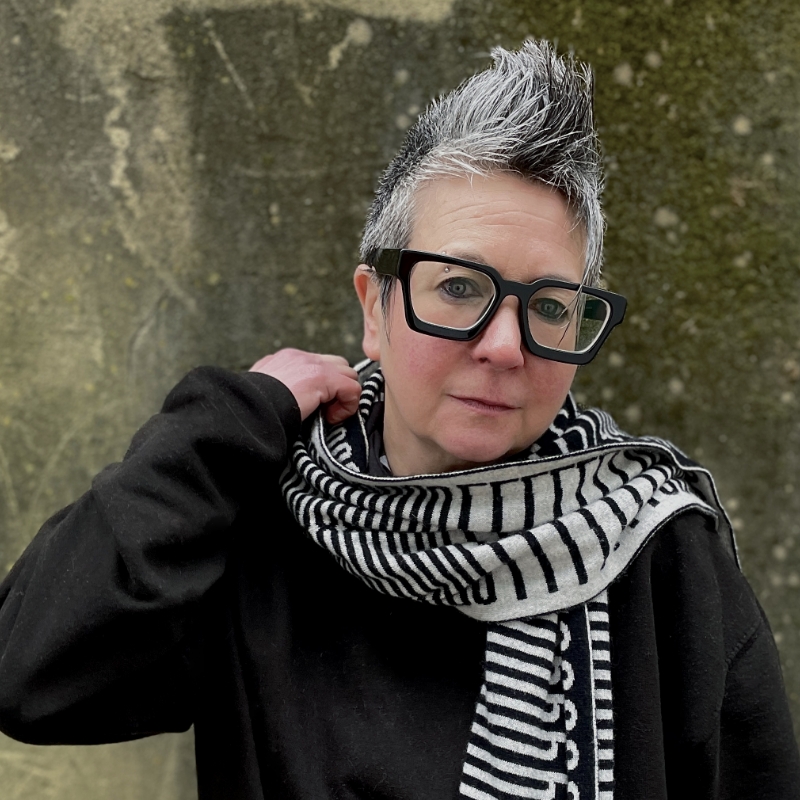
So yeah, I am Spike and I'm an Aries Sun, a Gemini Moon and a Gemini Rising.
This means I'm curious and adaptable. And growing up, I always thought I'd be a musician or maybe a baseball player. I was a bit of a tomboy growing up, as you can see, was into the Pittsburgh Pirates even though I grew up in Cleveland. So that was a bit of a problem growing up. But I loved the pirate logo. I just thought that was really cool and rebellious, and I think that helped me, just start to gain confidence in rebellion and being a bit different and pushing boundaries. And I think that's always been a superpower of mine.
Also, being an Aries, I like to be number one at everything.
But I didn't go the music route and I went into design, and basically I make type. That's it. So as Bill mentioned, I've worked for Dalton Maag, I've worked for Colophon Foundry. Monotype was acquired just at the beginning of this year by Colophon. And so now I'm here making typefaces with them, working with these amazing people. I've designed some bespoke typefaces for some big brands. You may have heard of them, Lego, Facebook, Instagram.
Anyway, so anybody in the audience want to share with me any of their favorite typefaces? - Shout something out. - I had Comic Sans. You had Comic Sans. That's a really good one. Anybody else? [Woman] Cooper Black. Cooper Black. Wingdings. There you go. I mean, Cooper Black, I know it's lame, but it was my favorite typeface growing up and even now. And I think for me, it's nostalgia, and I think that's a really important thing to think about when you're looking at typefaces and the emotions that fonts evoke. And for me, yeah, the nostalgia and the versatility, like, Cooper Black is amazing because it can be, the logo for a children's candy, but also be on the poster for X-rated adult movies back in the '70s.
If I could design a typeface as versatile as that, I could quit my job. I'd be happy. I could retire.
But, I think, yeah, again, that's something to think about is, can typefaces evoke that, do they trigger any nostalgia in memories? Kerry? Oh, is it my turn now? Yes, I will take it from back of the stage. Hi, Adobe MAX. I'm really excited to be here today. This is me, very cool sandals, I'm sure you'll agree. I'm a Cancer Sun, a Libra Moon and a Leo Rising. Being a Leo Rising is actually my superpower, as well as being left-handed. Have we got any left-handers here? Yes, we've got loads. - Okay, it's a safe space. - They're left-handed as well, yep.
So I grew up in the '90s where I was surrounded by loads of cool pop bands, and I really, really wanted to be a singer when I was growing up. I also really wanted to be an astronaut and I really wanted to be an artist. I managed to do one of those things, and I'm going to be an astronaut really soon.
So as an Art Director, I use type. I bring it to life, and I've worked for many different companies such as Apple and Condé Nast, where I've designed things like record covers, created branding for big campaigns, and also done something like fun editorial illustration. Using type is crucial when you're working with brands and telling a story, and today we're going to help you with that.
So Spike made one of these. I completely copied. I was like, "That's really, really cool." My favorite typeface changes all the time, to be honest, but one that I particularly love is Eurostile...
Mainly 'cause I was a massive Star Trek nerd when I was younger, and it appears in, loads of cool sci-fi films, and it's also the Casio typeface. So sure you've all heard of that.
Okay, let's go.
Right. So did you know there's over, what, half a million fonts in our typographic universe? And I don't know, there's, what, over 100 billion stars in our Milky Way? So we can easily navigate through half a million fonts. And we'll do this together, right? - Yes. - Okay. So let's say we're your personal spirit guides. And this is Fonti, and she's going to help us on this exciting journey. - Fonti is our manager, by the way. - Yeah. So best behavior. I mean, she's the annoying paperclip, but not as annoying as the paperclip from Microsoft. - Clippy. - Clippy, yeah, yeah. I love Clippy. - No Clippy badgings. - Sorry, we won't do that.
Okay, so here's the scene. Does this look familiar to anyone? It's choice paralysis. There's so many options and you're just scrolling. We're essentially doom scrolling type at this point.
This is not what we want to be doing. We're relying on the software a bit too much. So let's think about using our minds a little bit more, not just the software.
Since I was studying design, I've come across so many rules within typography. There's always this big idea that there's a wrong typeface and a right typeface, and I always felt quite boxed in and intimidated by that. But it's not as clear cut as it sounds. So how do I know if I'm choosing the right typeface? Is it trendy enough? Is there even a right typeface? Who knows? Okay, so how many people here have thought of it, like, in your career, have you felt any of these things? I mean, I felt one. Still, even to this day.
But it's really common. And the most common one is Imposter Syndrome. And this encounters about 90% of creatives along our careers, and just this feeling of self-doubt.
But it's also worse for people who are in any minority group as well. So there's that extra level of Imposter Syndrome.
But really, the biggest question or the biggest thing to think about is, are you even having fun? And why are you designing stuff in the first place? Okay, so let's just zoom out for a second. This is you.
You are a small dot in the universe absolutely freaking out about choosing the right typeface. You're probably also crying in the shower before work.
So yeah, but you're a really important dot in the universe. And there are so many ways that you can start your journey and really start to connect those dots. You should feel empowered to take these steps and build your confidence when creating.
So we're just going to breathe for a second here...
Have a sip of coffee or matcha, whatever you're drinking...
Just relax because we are now entering the creative process.
Right. Now that we've taken a step back, we're going to offer some tips to help you feel not so overwhelmed when you're navigating through the universe. And we want you to tune in with your gut, tune into your intuition, and just go with that. And first thing is really to just start to play to take off that initial pressure. Just play.
Okay. So one way that you can start to do this is to disconnect from your computer. I know that feels like you're going against everything that you're told, but just start to remind yourself of how you created artwork before you would use a computer. So be tactile, go out for a walk, just observe everything around you. And through doing that, you will naturally start to connect with your inner child.
We're so conditioned as we get older to not do this anymore, and connecting with your inner child really allows you to be authentic in your creative work. There's some famous quote somewhere that says, "Play is the highest form of research." - Who's that by? - Is that Einstein? - Is that it? Einstein? - Some old bloke, that's it. - But it's pretty true. - Yeah. So this is me connecting with my inner child. It's something that I drew when I was growing up in the '90s, in primary school. I always used to draw type like this when I was in really boring subjects, like science or geography or whatever, but I just found it like the funnest thing ever.
And I was thinking the other day, why don't I do this anymore, just create with that naivety and freedom? How about you, Spike? Well, we'll go back just a little bit further, showing my age, about 1984, and my parents came home with an Apple computer and a dot matrix printer. And I was introduced to fonts, and that whole world of fonts. And my favorite was San Francisco by Susan Kare, and just the playfulness of it. And she must have been digging into her inner child as well when she was developing this. And, I don't know, just she wasn't afraid. She was quite bold and courageous to release something like this.
Also for me, I loved handwriting and I was always really proud, and clearly my teacher was quite proud as well. But I think I was about nine years old. And it was amazing because I was talking to a colleague at work the other day and he was saying he never writes anything down and all of his notes are on a computer. And it just blew my mind 'cause it's just like, "I've still got my paper diary and everything." I don't put anything digitally. But you start to get your dendrites sparking if you actually take a pen to paper. And I think that's something that we need to remind ourselves, just doing that and just being in the analog world and getting out of the whole digital world. And it just seems like a silly thing to say, but I think it's really important and we all need a reminder for that.
Yeah, it's so important. And again, just the idea of creating with freedom and no pressure, these are some things I dug out the other day from when I was studying at art college a bit later on, and I always used to cut up type for magazines and collage and really look at the color and the composition and how all of the elements play together on the page.
And yeah, I just didn't have that pressure that you feel when you're working on a live client facing brief, and I really had to remind myself how that feels. I was creating all of this for fun and to just explore...
And that's when you get your best inspiration. And obviously, it's really, really helpful when you're looking to choose typeface. The angsty Z. Oh, my God, I was so angsty as a teenager.
Yeah, and for me, this was just even recently, I was just playing around and took some bits off of my synthesizer table, and I just started writing out the word "Amplifier." And it was a really pleasant, happy surprise because I broke down, just a really simple letter form, but it was broken down into all these little repetitive segments and I thought that was really cool for electronic music and the repetition in electronic music. And so you could take this as inspiration for either selecting a typeface, maybe it's for an album cover or something, or either selecting a typeface or designing a typeface. Just, yeah, I was really pleased with this, so-- I love this so much, it's so cool.
So another way to start connecting with your inner child is literally by going outside for a walk. You might not have thought of that already, I don't know. You can spot type in the world, everywhere you go, and again, just try to do this without any pressure, just relax, and quite often the inspiration will find you. This is some examples from where I live in South London. I literally found these last week, just really quickly, but I love them all. Just looking at composition and color and, yeah, all of the different shapes is really helpful.
I'm the same. Basically, when I go on holiday, this is what my holiday photos look like, and maybe a lot of you are like that as well. But yeah, there's a few pictures of friends and family, but it's usually just typefaces everywhere. And I think it's really important to just usually what you're looking for is right in front of your face. You don't have to reinvent the wheel. It's just there already. And I still refer back to these photos when I'm working on projects and just like, "Oh, yeah, I need to design something soft and bubbly," and you saw it and you can take your inspiration from there.
Right. So we're going to breathe again. We're in our next phase of stage two of our creative process. I'm going to have a sip of water maybe, in my raspy voice.
So we're back in the room. And now that we've had time to away from the computer, it's time to get back into the computer. And how do we start to navigate into our world of digital fonts, either selecting them, designing them? And most people, they're just going to go back to the usual suspects, aren't they? It's like-- Right. I'm scrolling through top of the list in my fonts. Okay, Avenir. Okay. Yeah. That's a good standby.
I am scrolling through even further. Futura. - Seen it so many times. - Yeah. Okay. And scrolling down further, Helvetica. That's a good standby. But funny enough, Monotype uses Helvetica for our brand typeface. And there's a reason for it though because we've got, what, over 150,000 fonts in our Monotype's platform and we design custom. And Helvetica is just a great neutral font to let everything else shine. So there was a reason for it. There's a context. And if you just start thinking about context, that's one way to just start to narrow things down already.
Okay. So what if we didn't go for a safe option and what if we found something much more unexpected in the library? So let's do this. With your offline experiments in your head, let's start to explore the digital type library. So which fonts resonate with what you've already been thinking about in your research? I'm going to have a look here. So I know that I want a display, and then looking through the filters, comic book, yeah, that'll be fun.
Retro, yeah, I'm always talking about the '90s.
Youthful, yes, please. So I nearly chose sausage, but I went for one called Gliker, so I synced that to my library. Let's have a little bit of a closer look.
So this is really fun. It's got a really retro feel to it. It's by a studio called Sun Studio, and apparently this font is inspired by the '60s, by cartoons, and has this real hippie feel to it. And interestingly, there's themes in there that I feel like relate to my inner child, which is really nice how that connected together there.
So I already started having a little initial play with this as well. Did I mention that I'm a Leo Rising? Not sure, but the brand is all about being a Leo Rising. It's called Roar and it's about being a leader while also being a bit silly and childlike, but I've really done this to just see how the font looks in situ. I think that's really, really helpful and I love how it's looking so far. It's looking good. Spike, how are you getting on? Definitely. Yeah, I like it. Well, of course, being in Aries, I'm always thinking about myself. So I started with my typeface Kibitz and it's a serif, so I wanted to find a sans serif to pair with it.
So I went into the Monotype, font pairing. And so you can just click on this button and you magically get a whole selection of sans serifs. And I just started to scroll through. You can select, I select a Kibitz Black and just scroll through looking to see what might have the right feeling. I didn't want anything too boring. I wanted something that had a connection.
Maybe there's a nice angularity to something that can match the Kibitz. And I did find one that I really liked. And what you can do is go in and you just sync that font.
And this is what I came up with. So it was HK Guise Regular, and I really wouldn't have just found this right away. It was just through this font pairing magic system that it just works. I think it's a great combination. And I did a mock-up as well. So just made up some media company and the M and the W look really cool with that flatness of the R and just the angularity of the serifs. And also just thought I'd mock-up a gin bottle as well, which I would be really happy to have on the show. Yeah. I want that gin. Watch this space. So now that you're armed, hopefully, we've some fun choices, we've had a look at the type library, we want you to start experimenting further visually. We're deep within the creative process now.
So we're giving you full permission to make mistakes and also look at other people, other designers who are happy to make mistakes and experiment. And Kerry and I just put together a couple of projects that we think are pretty cool and represent that. Yeah, so I'm really excited to show you this one. I love it so much. It's the Pardon typeface by PFA Studios, who I believe are based in Berlin.
But I was talking earlier about feeling really boxed in by all those rules. This, I feel like, totally goes against those rules, which I love. It's really courageous, but it's also quite naive and childlike.
And apparently, it was intentionally a failure. And the name is a joke in itself, since Pardon would never be sorry, it would like to be taken as it is.
Right. So this one was designed for the Royal Television Society for a campaign called Too Much to Watch. And to express that, they took the bubbly letters and squeezed it and squished it into this space. And the algorithms, I'm not sure how they did it technically, but it was all based on physics. But what it ended up with was all these really bonkers shapes. And I think that's what was so beautiful about it is everything was quite unexpected and you got what you got and that's what just made it so amazing. It's so fun.
So the next one I want to show you is really, really beautiful. This is by House of Gül, and the design of this is inspired by the joy and abundance of love felt during Ramadan. It uses custom Arabic calligraphy, and I just find the freedom and playfulness is so beautiful. It feels reassuringly human in the best way.
This guy was definitely full of experimentation and it was for Morton Salt and they were doing a anti-food waste campaign. And all of the letters were made from actual compost taken out of a bin and stamped to make these letters happen. And it just expresses the whole idea of food waste in just visually, just within a typeface. There's not even any graphics. So I think that's where you can really start to think again about experimenting and context of the design.
Yeah, so this one is using a whole different way of font pairing.
It's such a great example of experimentation, but in a really balanced way. This is the Happy Fuel branding by Wonderland, and each letter represents an emotion such as confused, heavy, or clumsy. And just to show you a bit closer, the visual branding captures the real, raw emotions that people bring to the table. You can see it working in situ here, which, again, is really, really lovely.
And, yeah, you can really see how the type is portraying all sorts of emotions. Definitely wish I worked on that project. - Me too. - It's amazing. And, of course, this is an old classic. And this was from the early '90s, and it was David Carson for Ray Gun magazine. And this was an article written on Bryan Ferry. And so he was finding the right typeface for the article, and apparently, he just thought the article was incredibly boring. He hated it. So the story is, he started at the top, just scrolling down, doom scrolling, doom scrolling, got to Z and used Zapf Dingbats. And he just thought, that's the best typeface for this article. And, I mean, it's ballsy. It's great. - I just think, I don't know-- - It went really well. - Yeah. - Like, it was perfect. Perfect. But it's classic. And, yeah, there was a podcast that he just did with-- Who did do-- Was it Carl? - No. - With Graham. - With Graham. With Graham. - Yes. - Monotype. - Monotype. Yeah, represent Monotype Podcast. Yeah, yeah, yeah, a little drop, but, yeah, it was a really great podcast, I just listened to that.
And then if you guys were here with us a couple of years ago, we talked about emotion and type. And we worked with the neuroscience company Neurons and really started to dig deeper into how brands and consumers can use typefaces to express emotions and connect with their audience. And just really looking into like, why do fonts make us feel? What connection is it that they have with us? Fonti here is-- - Feeling all the feels. - Yeah, feeling everything. I don't know. What are you feeling right now? I'm feeling excited, joyful, ecstatic, maybe? How are you feeling? I think I'm not as anxious as I thought I was going to be. Oh, that's good. So I think excited and joyful, I think that's where I'm at the moment.
So getting back to emotion and also getting back to the sun, moon and rising, we aren't just talking about that because we're obsessed with astrology. We do talk about astrology quite a lot. Yeah. But we just wanted to mention that because at our booth this year, we aren't scanning brains, but we're doing palm readings. And we've also-- If you come to the booth and you've got your sun, moon and rising, we will create your font's constellation that goes with your star signs.
Yeah, I'm not going to lie, guys, it's really, really fun, you should definitely check it out. It's called the Cosmic Ascender and, yeah, the machine provides a personalized type analysis based on your birth chart, so you need to know your three signs before you get there, but you'll get your very own custom constellation graphic using glyphs from our library.
Anyway, we want to show you how it works, so let's get someone up on stage to demonstrate this. - Universe, send us a human. - Can we have a human, please? Here she is. Round of applause, please. Our volunteer.
- Hello. - [Cuddly] Hello. Hey, Cuddly. - Hi. - Thank you for joining us. Happy to be here. Yeah? Feeling good? - Feeling good. - Okay. We want your big three signs. Do you know them already? I do. I'm an Aries Sun, Scorpio Moon, and a Virgo Rising. - Oh, spicy. - Yeah.
Okay. Cool. Let's do it. So...
We're putting in Aries Sun...
Scorpio Moon.
Moody. And Virgo Rising. - Okay, let's go. - Let's go, all right. We should have put some music in here or something. - Yeah. - Yeah. - Can anyone beatbox? - Beatbox? - Or sing? - No. No? Okay.
Oh, okay. Cuddly, you are the Meticulous Wanderer with Bold Vision. How do you feel about that? Feel good, yeah. Did some good wandering this morning, so-- Oh, yeah? - I was wandering. - Oh, that's pretty strong. - Yes. - Okay. Aries. - Strong. - Yeah, Aries, strong. Definitely. Okay, and the system has also offered you three different fonts that resonate with your personality. So we have here Good Times, Parliament, and Grenette. Cool. Very nice. Okay, let's look a bit closer at these. All right, so we've got Good Times. The name alone sounds about like you probably like to have a good time. - I do like to have a good time. - All right. - And-- - She definitely does. It looks quite bold and courageous, friendly. Yeah, so I don't know. Would you think this is an interesting place to start? - Yes. - Okay, cool. And then we've got Parliament.
I don't know, Parliament's pretty badass. I love Parliament. More badass than I am. Okay. Right. No. What do you mean? So I wouldn't mess with Parliament. And Grenette. And I don't know, I'm getting a retro, bit soft. Chic. But still, means a little bit of business with the serifs.
So yeah, so that's what we've come up with for you, and it's just some place to start exploring maybe some typefaces you never would have really thought about in the first place.
- Thanks. - Cool. Thanks, Cuddly. Thank you.
Right. So go explore your universe. You got this, Cuddly. Trust us.
Okay, so now it's your turn to go and find your type within the universe and uncover creative possibilities. You have the power within you, trust us, Fonti is always with you all of the way.
You might want to take a photo of this or write it down, but we just really wanted to summarize what we've spoken about today. They're Fonti's top tips.
Cool. Okay. So yeah, if you would like to, please go visit our booth today. We will be there to hang out and chat if you want to chat further. But also, if you want to find us, here's our details. And Spike's got a really cool Mixcloud-- I didn't put anything up. I didn't put anything font like up, but if you want to follow me on Mixcloud with my DJ mixes, that's fine as well. But also on Insta. So yeah.
[Music]