Navigating Creative Waters: Princess’s Production Journey

[Music] [Scott David Martin] All right. Good morning, everybody.

Welcome to day two of Adobe MAX.

How you guys feeling? Feeling good? I think we got some hungry creatives in here. Mad respect for the people that are in here at 8 o'clock in the morning. Right? The amount of text messages I was getting last night to come out and like go to the parties, I was like, "Oh, I don't trust myself. "I don't trust myself." So I love that you guys are all here and I'm incredibly grateful to be on this stage today, right, and I hope you guys get some takeaways. So this is for you. So as I'm speaking, we have a Q&A at the end, but this is a vibe, right? You got something to say. The mics are right there. Let's stop the presentation and get your questions answered. And if you have other questions, let's get them answered right outside the doors. Okay. Just to make sure we're in the right place, this is Navigating Creative Waters, Princess's Production Journey. So if this is not where you wanna be, now's the time to go.

Okay. So this is what you'll see today, our itinerary introduction, overview to the Princess Production team, right? Number two, the Frame.io Adoption and Journey. So our journey to be world-class collaborators runs in parallel with Frame.io, right? Number three, the changes that we made to our culture, our technology stack, and our process. Number four, the Alaska Production Results, probably the most exciting part of the presentation, right? Building a clear approach to postproduction versus figuring it out when you get there, right? Number five, what did we learn in the process? How did V4 transform the way that we work? And what are our top five tips that you guys can use today if you're using Frame.io V4? And what's next? This is the fun part, right? Being on stage and revealing the mistakes you made, that's fun. So stick around for that 'cause that's how we influence the future. Okay? So that's our itinerary today. That's where we're sailing. Time for embarkation. Introduction. Princess is the original Love Boat. Since 1965, love has been the compass. Right? And if you work for Princess, you love it because we love seeing people go out, making meaningful connections, going to wonderful destinations. Right? It's about love at Princess.

You always feel welcome here, right, because we love the guests that we serve and that's what Princess is all about.

Core creative competencies. so if you guys are in the agency world, you're in the in house world, this is probably very familiar to you. Right? Creative strategy and direction, creative operations, account management, project management, tech management, asset management, and then creative services, right? The fun stuff, graphic design, illustration, copywriting, email design and development, and then photo-video production.

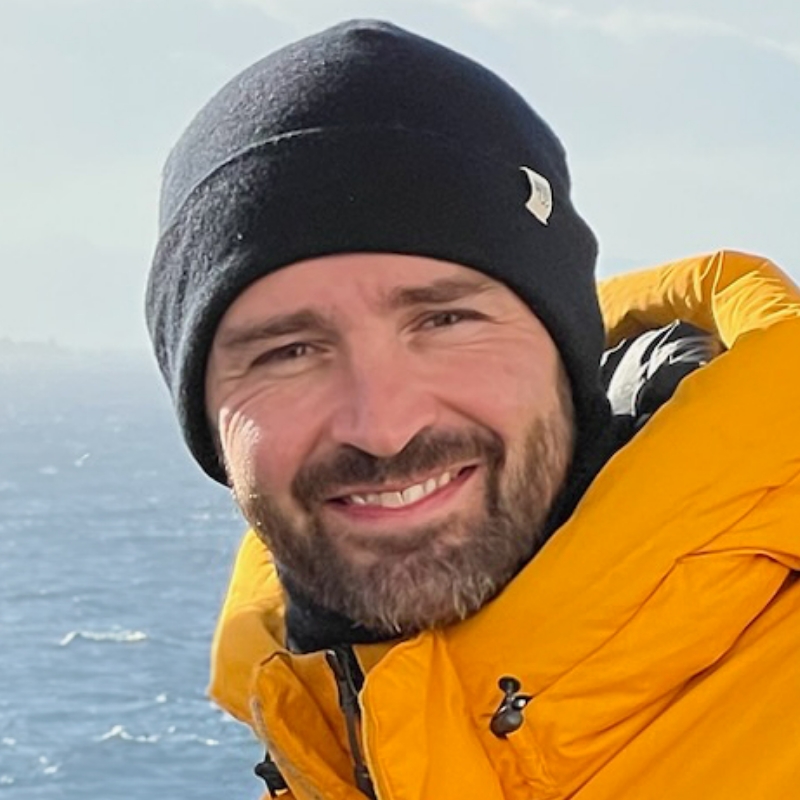
So who am I? My parents thought it would be a great idea to give me three first names, so I'm owning that. My name's Scott David Martin, I'm the manager of the in-house operation at Princess and I'm very grateful and honored to be the executive producer and director of the largest production that Princess has ever had this summer in Alaska. I'd say one of my side gigs is photography, so you see some of the photography in the magazines there. I love doing that as well. And this is the director's reel, so you can see some of my work. [Man] Jack London once said that the proper function of man is to live, not to exist-- And that I shall not prolong my days trying to.

I shall use my time.

Those words shouldn't need definition. The proper function of man is to live, not to just merely exist. And he's not going to waste the days of his life to trying to prolong that.

He's not going to waste his time. He's going to live. [Man] 180, Roger. Copy: radio activated. Roger, thank you.

All righty, there we go, thank you.

Who wants to go travel? Let's live a little bit together, right? All right. So let's talk about the creative workflows in Princess, right? Princess brings the world closer to you, 330 cruise destinations, a 100 plus countries and 7 continents, really. It's truly a global organization, right? We have a global destination portfolio, 13 key itineraries, 4,000 plus shore excursion offerings. I've been on about half of them. They're pretty epic, guys. Check them out. And what comes with that is production and asset management challenges. Right? We have clients that are based globally and post teams. Right? I used to spend my days getting up right now very early in the morning to focus on the UK team, and then during the day, I would focus on the North American team, and then at night I would stay up late to talk to my Australian team. That's all changing with Frame.io. Here's the client list, right? Pretty standard, marketing, guest experience, people team. I also have some partnerships and websites to work on, right? So the travel business really trades on three things, word-of-mouth, relationships with travel agency partners, and captivating storytelling. That's where we come in, the production team. We play a crucial role in empowering brand storytelling across all channels globally, internal and external collaborators, and it's a part of a creative service team in marketing. On a good year, we're generating 165 million views, 200 million impressions, and we like to double that year over year, right? We're ambitious.

So really, this is what gets us up in the morning, bring captivating content to life. What makes the brand different, better, or special? Here's the deliverables, brand identity, photo and video, advertising, copy, retail, environmental and experiential, out of home, and miscellaneous. Our collaborators, you folks probably collaborate with some of these people, internal operators, departments, external agencies, contract editors, colorists, or your internal production team. So an agency, they have certain deliverables that they need, so their business need might be a marketing campaign, right, delivering that 4K RAW Original Camera File asset because their distribution is for broadcast television. The social team is going to be looking for highly compressed video, 4x5, 9x16, totally different need.

Our brand team, they might have a business need of NFL game advertising, right? So the deliverables of banner in SoFi Stadium. The web team, completely different needs. Why design B-roll, right, with negative space? They need their product and offerings. Our editors, completely different needs, right? The business need might be an open for sale edit for Alaska and the request is, "Hey, I want the entire asset library from 2014 to 2024." I need the b-roll Selects, I need the graphics package, I need the music because they're going to digital and social.

Here's an example. Right now, coming out of Alaska, we're working on the Pursuits Series, Navigate, Fly, Ride, Seek, Stay, and Connect. Each editor has different needs. They want those assets. They're not worried about the other ones. So let's take a look at Princess Voyage with Frame.io starting with the background and adoption.

So our aspiration is to be world-class teammates run in parallel with Frame.io, like I said at the beginning. We communicate our workflow in PF and AF. It's Pre-frame Adoption and After Frame Adoption. And today we share our team's progress and journey, and yes, there's much to be proud of, right? But the best leaders are always obsessed with the question of what's next. What is next? And that's really the beginning of our story 'cause that's what I was asking a very long time ago is what's next for us? But to properly answer that question, we need to take a hard look at ourselves. Our creative culture, are we using world class tools? Are we using the best practices in the industry? So let's take a look at that. What are we doing now? Our creative culture, how do we manage various types of projects and empower collaboration? That is the key part, right? What tools will help keep your creative team on track and productive? And then process what processes are going to take you and your leadership to the next level? So key learnings, Pre-Frame.io, we went through a SWOT, right? Strengths, weaknesses, opportunities and threats. Bless you in the front row. Strengths, right? We had a depth of library, we had a lot of assets, and we had organizational aspirations. We really wanted it, guys, we really wanted it. Our weaknesses, repetitive asset audits, no organizational standards, staff bandwidth was not meeting the requests we needed, no broadcast-ready editing capabilities, and talent rights were a nightmare. Opportunities standardize that search, centralize that asset library, self-serve structure for folks so they can truly create at the speed of their imagination, improve visibility and access, decrease costs and vendor reliance. Threats, storing local mentality. That was something we had to get over. Operating silos, the Ringelmann effect, which we'll talk about later, and licensing and external fees. But this is what it came down to, speed to market, having enough creative resources and volume of demand for content, right? A lot of folks are dealing with this. And this at the bottom, a TBD increase in annual creative workload because we didn't really know.

Here we go. So speed to market, we were unscalable with network attached storage. And the reason I say that is because we were recruiting locally instead of globally. I was getting the best person in that certain market instead of the best person in the world for the job, right? Review and approval was chaos, Pre-Frame.io. So our diagnosis was an out of date workflow.

Having enough creative resources, this wasn't scope creep, this was scope explosion. The past was one deliverable per project, now it's packages. Dimensions and codecs. Volume of demand for content internal department needs, external needs, 50 contractors and manual systems. But there was a change impetus. There was a moment. We think about all these moments in our career. And this is a powerful one. This is when I wanted to discover the new depths of workflow and set higher expectations for our team. This is the moment when I said, "I want to become a student of best collaboration practices. "I want to become a master of workflow." And my journey to Frame.io really started here. And it was a presentation in 2015 that sparked that catalyst for change and a fundamental shift in my mindset. And that presentation was the golden nuggets of filmmaking by Michael Cioni, a Frame.io pioneer. And what he said at that time was 4K is a time machine, and I was shooting in HD sitting in the audience being like, "Oh, no." Making a movie a better way, price per frame, I had no idea what price per frame was, absolutely no idea. He was saying, "You gotta make dailies and review often." I had never created a daily in my entire life. And he talked about the right NLE that could make the work flow, and I was creating proxies. So at that time, he presented this slide, and I think this is one of the most important slides I've ever seen where collaboration and flow of work goes up, your price per frame goes down. What that means for stakeholders, they're getting a better return on your investment. What that means for your team, they're enjoying the process a lot more. Understanding price per frame, development, pre-pro, production, post, asset management, a lot of costs are going into our productions. And making the film a better way, Michael talked about this. We talk a lot about expense and time. What about frustration, irritation, confusion, sleep, revisions, communications, satisfaction? Are you happy with what you're doing? Are you fulfilled? When you wake up in the morning and you put your feet on the floor, are you stoked to create? That's what it's about. And he presented a slide like this. It's identical, and this was in 2015 as he talked about the future of collaboration. And he nailed it. He knew exactly what was going to happen over the next 10 years. Went from film to tape to files to alternative distribution and then exclusively file based. And he talked about why collaboration was going to be so important. So here's my bold prediction. With cloud and AI, I think we're going to see a huge hockey stick here, right? And if we don't start to believe in collaboration, I truly believe we are going to be lost.

Centralization and Accessibility, because this is the beginning of my journey. And if you look at this image of the lodges at Princess, that's really what they're about. They're centrally located in Alaska and they provide accessibility to the most scenic places in North America. It's absolutely a beautiful product. So our discovery phase, looking at structures, skills and resources, systems, and strategy. This is our Asset Structure Pre-Frame.io. It was all over the place. Network and storage, drives, and I see some people shaking heads here, right, because they feel this. Some cloud technology but not enough. The assets were spread across multiple owners' hard drives and cloud platforms. Limited accessibility, significant time in search, and you're spending all your time searching and identifying instead of creating. So centralization is the opposite. Goes down, flow of work goes down, price per frame goes up. Skills underutilized. Process bottlenecks, communication silos, strained human resources. But why is that? It was because we were organizing assets manually. We had some great people organizing a bunch of documents for us. The systems, we were working with VPNs, so unreliable for media upload and downloads, great for data. I see some people are feeling this. That network attached workflow, that was done because we had no metadata, we had no AI, and we had no ability to track the work. So here was our NAS workflow. As you can see up here, pretty standard stuff. Pre-production, we're getting drives, post-production, we're going-- we're capturing that footage, we're putting it into a field master or into a field backup. We're bringing it down to HQ, we're working with RAIDs, we're putting it into our backup NAS. But then as you go down that workflow and you see the cloud, it's like, "What are we going to do about that?" So here's our workflow today, right, where we have review and approval and we have an ability to get our assets to the best editors and the best colorists around the world. So our strategy, we had to redefine our why. Leveraging the assets across multiple distribution platforms and building a collaborative, creative culture with that foundation on the cloud and a connected workflow because a connected workflow is a collaborative workflow. Pre-Frame.io, we had a linear thinking process, and our goal was to eliminate those bottlenecks, but we could not do that linearly. We have to make work flow, and workflow starts at the beginning of the project, in the middle of the project. It's never at the end, and that was one of my big mistakes early on. So why did we choose Frame.io? World-class collaboration aspirations. You're going to hear that a few times. Here's our road map. The purpose was to maximize return, then we wanted to invest in software, we had to centralize all of our local drives, and then we have to locate, tag, and create searchable collections, which is kind of where we are today. Next is decreasing search, find what we want, when we want, right, and then you can increase creation. Improve content velocity across all channels. So here was the Frame.io past state and current state. 2015, golden nuggets of filmmaking. 2015, NAB, they win best in show. 2020, travel industry paused. That's when I fully adopted Frame.io, and then where we are today is that journey to world-class collaboration. So here are the objectives. At the end of the day, these are the things we needed to do. We need centralized assets, revise the workflow, standardize that organization, be strategic with cloud, improve speed to market and visibility, and then extend the asset lifecycle and shelf life. So how has it enabled efficiency? Well, it starts with that business ask, the client, what do they need? A commercial? Anything, right? Well, we need to maximize ROIs on our assets and improve content velocity. And this is what it looked like for us. You have that idea, you're so excited, let's go execute it. We can't locate it, the asset, quickly, internally, externally. There's bureaucracy involved, only low-resolution text lists, in-house bandwidth is stretched. Or you just have limited brand ownable content, so you stop. Great idea, but you stop. And that's where we came in with Alaska. It was a real world collaboration example, most important for the brand. And they're long recognized as the leader in Alaska. But the content lagged market position. It truly did. It was a great product that didn't have great content to market it. So in the midst of the most challenging production ever, we chose to beta test Frame.io V4. But before we did that, we made some changes to our culture. Culture is a never-ending dance, right, and we needed to evolve. And if you aspire for meaningful change, you need to take responsibility for results good and bad. Practice accountability with yourself and with your team because if you're going to build a culture for others, we got to hold ourselves accountable first. The opposite is, hey, you need to improve here without clarifying those expectations first. So confronting the reality, I was asking the wrong questions. Focusing on side issues. I was not leading out courageously in conversation. I was not confronting issues, I was confronting the person. And you got to address the tough stuff directly. One on one, having those conversations with people. What are we saying here that needs to be-- What are we not saying here that needs to be said? And we focused on the undiscussables. Lava. Hot lava. And this was harder than we expected. You truly want to see yourself go to the moon as a creative. Start thinking about the undiscussables and things that scare you and bring that up one on one to those folks.

This is what you can say to yourself, "Where can I get better? Where can I get better?" And this is the most important question I ask myself every single day, "What type of teammate am I?" Are you a team of 1, 10, 1,000? And why become a world-class teammate? Right? Well, film filmmaking is a team discipline. And if you're a team of one, what type of teammate are you to yourself? Because when I was a team of one, I will admit I was a terrible teammate to myself. So think about that and be a great teammate to yourself. So who shares the same value system as us? Those are the people you need to find. Excellence over perfection is our team. Excellence is freeing, perfection is fear, it's confidence versus doubt. And excellence is a journey instead of a destination or a goalpost. You hit the goalpost, let's move the goalpost again. That's not very much fun, let's go on a journey together. And why does collaboration fuel our creative souls? It's to inspire you to take bigger swings, guys, to go after what we desire most because we only have one creative life. I'm going to tell a quick story here, because last year at MAX, it's my first time at MAX. Last year at MAX, I was watching a video, and I was really inspired by somebody. He was showing amazing things on stage. And then at NAB in April, I was like, "You know what? "I'm going to go listen to this guy speak again. "I'm just really digging his vibe." And in April, he said something on stage. He said, "Hey, you guys, "if you really want to go and take your career to the next level, "you need to start working with more brands." He's like, "Go down to the NAB floor "and start working with the brands that you love." And in April, I did just that. I walked down, I tapped airy, I talked to Adobe. And what that person did for me is they inspired me to take bigger swings. And I'm so stoked because he's actually in the audience right here, AJ Bleyer. So if you haven't seen his talks, you definitely need to go see him speak because he was the guy that inspired me to take a bigger swing. And when I left his talks, I went into Alaska taking more risks than I had ever accepted in my entire life. We only have one creative life, guys. Go after it. What does world collaboration look like? Well, for us, it's taking cues from the animal kingdom. A herd of water buffalos. Show of hands here. Who has seen the video Battle at the Kruger on YouTube? Has anybody seen that video? Okay. We've got a couple people in here. Man, I shouldn't have cut that video out of the presentation. So you guys have some homework. When you guys leave this presentation, I'd like you to go watch Battle at the Kruger on YouTube, eight-minute video and it's going to show you who the real kings of the jungle are. And it's not the lions. It's not the crocodiles. It's the water buffalos. I am so excited for my first trip to see a water buffalo. I'm going to be the most excited person on-site when I see that water buffalo, and here's why. Because it's the world's most famous arena. Water buffalo is about team, and when standing shoulder to shoulder, when you are in a herd of water buffalos, you can accomplish anything because of your team. A couple weeks ago, I had a pretty challenging experience personally and professionally that might affect my ability to be on this stage. It was a very, very challenging time for myself, and what I found at that moment is the horns of my herd went up. I was in a moment of adversity and I had a bunch of people around me ready to go shoulder to shoulder with me, and I can't tell you how special that feels and how badly I want that feeling for everybody in this audience.

So who are world-class teammates? Well, they're water buffalos, so check out that video, but I also believe they follow Mr. Rogers' 3 Keys to Success. Very difficult to remember, guys. Be kind, be kind, and be kind. Those were his definitions of success. And the filmmaking intangibles, do you have the intangibles? Do you get the most out of your ability? Do you positively influence others every single day? Are you coachable? That's important. How do you adapt to different situations, and do you rise to the occasion as a collaborator? Because how do we build sustainable creative culture? Honestly, creative burnout's easy. Everybody in this room has probably felt it and I can figure that out in about a week. I know how to burn out quickly. Sustainability is tough because you need all of these behaviors. Got to talk straight, show respect, be transparent, loyal, results, constant learner, accountable, and listener, right, with your ears, your eyes, and your heart. But this is what it's about. It's about team above self, And this is the journey that I've been on with my team. And this is way harder than we expected because at the beginning, we said team above self and it was like, story is king. But there's some things about team above self as we've put this into practice, we've realized we got to be careful with this because it's also when you go down in a plane, you got to put your oxygen mask on first before you help somebody else. So team above self, but this was very much harder than we expected. So let's talk about our process right here. We had to get better and we had to create new roads for collaboration, redesigned our entire process, developed feedback systems, and then consistent postmortems. So if you folks are doing a lot of projects and you're not doing postmortems with your team, I think you're missing an opportunity to really be in that growth mindset. Those are the undiscussables a lot of time when a shoot goes bad. One of the things I don't love about the industry, especially with contractors, is you work with a contractor and then you don't like their work, and then how they find that out is you don't get a call back.

And I'm not a big fan of that. I'd rather have that discussion and say these are the things we didn't love, and I'd love to see you improve because I think you're great at X, Y, and Z, but I'd love to see you get better at A, B, and C. And the more those conversations are happening, the tighter you're going to get with your team. Right? Because on a scale of 1 to 10, how likely are you to recommend your process that you're working on right now? If I thought about that a long time ago, I'd be like out of 1. I would not recommend it. Today, I feel like I can recommend our process. We've seen a lot of great results. Standardize the organizational discipline. We hear a lot about content velo. It's kind of a buzzword here at Mac sometimes. Really, it's about building a workflow that supports that. So I'm a big fan of content velo. I'm a way bigger fan of collaboration velocity. Decrease that time searching so you can create more. Communication channels and project management. Are you guys on Teams, WhatsApp, text, Outlook, all these things? Yeah, I was. This is terrible. Create one source of truth for your team. File, folder, and metadata structure. If you can't find it, it has no value to you. And if you're managing a large library, that's the truth. And then structures, external partners do come and go, but standardize what you do. So content velo. I like to think about NASCAR pit-crews here. Because it takes me, like, 10 hours to change a tire and those guys are like, boom. Why are they so efficient? I think they have great systems, structure, strategy, and skills. Review and approval, we have that now. We have centralized communication. We have a decent structure because we have global assets to all of our assets. But I think the most thing I'm proud of is the strategy. We're bridging these collaboration gaps, right, between development and pre-pro and production, production and post. These people are talking to each other a lot. And then really that leads into number four, the growth mindset. These are the people that I want to surround myself with. They want to go to the moon. They want to go to the moon every day and it doesn't matter if you have $1 million production or $1,000 production, those are the type of people I want to be around.

So how do you improve that collaboration? So this is a series of process that we have learned from the Harvard Business Review. It's a five-step process that we use all the time. Number one, you got to have those purpose and objectives right. And for us in the Princess brand, it was truly about humanizing that Alaska landscape and those locals, clarifying those roles and responsibilities for your team. So there's a very small staff at Princess. It's low overhead, but it's a large contractor roster. So most of the projects are just scaled based off of the needs of the stakeholder. The Alaska project that we're going to talk about here in a few minutes was 35 plus contractors. So you become a much bigger organization for a small period of time, and that's when you really need to focus on being a great leader. Streamlining those ops. So in Alaska, this is a very complex production workflow. We had Alaska and we had mainland editors, and all of that needed to be happening at speed. Reviewing dailies in Frame is what I love in the field. It enables real-time pivoting. And for you those folks that have shot in Alaska, you already know if you're going to shoot in those locations, you have to pivot every single day, and not by the minute, not by the hour, by the second. That is truly how you film Alaska because those weather pivots are absolutely essential to being in the field. How are you exchanging your resources and ideas? Is it a fun process to exchange ideas with people or is it kind of clunky and it doesn't feel like it's flowing? When you get flow, that's when the great ideas come. So we're going to highlight this today in V4. But really what we saw in this production with V4 is we were able to deliver a reel 24 hours after wrap, and in the past that would be weeks. Right? So our turnaround speeds were increasing. And then got news for you guys. If you have step one through four nailed and you don't have this, it doesn't matter. You have to have centralized leadership. You have to have somebody that believes in building and fostering a culture of accountability. You have to have great leadership, and that leadership should always be in this mindset, continuously improving. Our team had decades of experience in Alaska, over 300 or 400 days of shooting, but that didn't matter.

After I watched AJ in April, I was like, "We just need to increase our capabilities. "We need to do more. "We need to set ambitious goals," and that's what we did going into Alaska is we didn't assume that our process is going to be ready for tomorrow's challenges. We were going to dive into new technology, and here's the results. This is the value we saw. So the onboarding process, this is my favorite. Frame.io onboarding experience is fast. You power use on day one. It's intuitive. There's no need for an integrator. So if you're a creative and you just love to learn new things, jump in there. You're going to learn it. And it's simple. There's no need for discovery calls in Frame.io V4, and that's powerful. Why is that powerful? Because in this room, every single person has three things in common. And those are the things that are in our obituary. You've got number one, the year we were born. Everybody knows that in here. Right? Number two, the year you're going to die. Nobody knows that in here. And then number three, the dash. The dash is how we live our lives. These are the choices we make. So if you're in your dash right now, how are you living your life? How are the choices that you're making affecting you personally and creative? The dash is so important. So here we go. If we care so much about time, I want to onboard at lightning speed or I want to learn at your own pace. Maybe you don't want to learn this fast. You can do this at path. You can do this at your own pace. So no training sessions, no integrators. This is something you can truly learn on a Saturday before your kids wake up. That's what I did. So results. We were going to measure our results in Alaska in 4 core areas. The breadth and depth of content, the quality of that content because it's not cool to just scale up and see quality go down. Like, we don't want to do that as creatives. And then feeding all channels, and I think what's most important to me because it's so close to my heart is what was that team morale like? We finished. Is this what we expected? And cut. Let's move on. [Woman] Moving locations. Let's run away all gear. We leave this place cleaner than we found it.

For Princess, Alaska is the number one revenue generator as far as a destination experience. It's very important to make sure that we market that product very well.

I can already see it from here. We need to be up there. We have a track record of going into very remote environments with very small teams and delivering high return on investment. That's why we get those calls. Cut. It's a beautiful take. I aspire to be a world-class teammate, and my journey with Frame.io has run in parallel with that.

My name's Scott Martin. I'm the senior manager of media production for Princess Cruises. Roll cameras. Action. Most people hear Princess when they think of cruise ships and oceans. A lot of people aren't even aware that you can go on a cruise tour in the interior of Alaska. Our job was to go and tell a story in Alaska that's never been told by a cruise line before. Back to one. Let's keep that same energy. There was a long list of deliverables. Brand photography, new brand video, commercial campaign, product series, and then we also had a web series. [Kristin Rogers] This was one of the biggest shoots in Princess history in Alaska. We planned meticulously. We've really had to have a much tighter workflow than normal. And that's where Frame.io comes in. Scott will always select his takes while they're out shooting. And action.

Watching dailies in Frame.io and me commenting and all of that communication going out to our editors immediately was lifechanging for our collaboration philosophy. Open up to camera a little bit, Zay. Nice work.

We had 14 days of shooting and we had one shot that was incredibly important, and that was Mount Denali.

The most challenging thing about Denali is she's only visible 30% of the time. So planning for that shot was quite difficult.

We had to fly over it, camp on the other side, and then be up at sunrise and be ready for sunset, which are all happening within a three or four-hour period in Alaska. It's just a logistical nightmare.

The first time that I saw Denali at mile 62, my jaw literally hit the floor. All four in frame, please. That moment is something that I always wanted to document. With Denali in the background.

And she delivered for us because Alaska always does. Action.

When it all lined up, it was just such a sense of relief.

Scott got back from Camp Denali and immediately got an email. I know Kristin is on-site. What are the odds of having the AK Selects ready by 7/26? It was day 13 in the 14-day shoot and the Princess executives were having a meeting and they wanted a b-roll Selects reel basically within 36 hours after the shoot. So I reacted like any veteran director would with panic. What I need to do here is I need to go into frame. And then make a lot more comments. So I think really the speed is critical here. But then immediately, that panic did start to subside with the amount of preparation that we had put into Frame.io. If you look at any camera roll from Scott, it's like select, select, select, select. But I love it because then I can actually import his comments into my mirror project. So I already had a glimpse into his brain. Oh!

With Frame.io, we were able to communicate at speeds that we have never been able to communicate at. So we were able to turn that edit around within to 24 hours after wrapping. So this is a direct quote from stakeholders after watching the video. The reaction was many hearts, some tears, and wow. We've created a record volume of work at an extremely high level and have provided previews at record speed.

Scott is a really wonderful collaborator. He is one of the most driven directors that I know. You can tell, not only just based on the footage itself but the Frame.io notifications that I get the next morning, when I'm like, "What were you doing at 4 o'clock in the morning?" Fifteen, twenty years ago, this is almost impossible because of technology. But how technology has changed? Frame.io is something that I'm falling asleep with every night. And even that, that builds more confidence in me. Action. Wonderful. This is it. It really is that central watering hole where we can all come together and make sure that we're delivering world class products. So first shot, makeup and hair matters. Second shot, no fly-ins. Don't worry about it. By having a great team, wonderful collaboration, awesome tools, you feel like you can kind of take on anything. Right towards me. I want you crossing camera as close as possible right this side. That's what Adobe tools do. They inspire folks to take bigger swings. Beautiful.

Okay, cut.

All right.

Huge shoutout to the Frame.io prod squad that put that together and traveled with us to Alaska. Not only are they great filmmakers but they're now my friends, and I love collaborating with them as well. So here was number one, the breadth and depth of content. It's a pyramid, but it's backwards. So the number one part that we were really there for was a broadcast commercial that we're going to be releasing later in the year. That's the focus. But what you saw there is also the video series being built for the web team, the marketing video b-roll package, the product video b-roll package, and the social team. So everybody that needed something, we were able to tick off those boxes while still maintaining creative flow and not having your team feel like you're doing too much. They understood what we needed to do and how we were going to get there. Quality. How do you maintain brand quality when you have four different teams operating in Alaska? Right? Princess is number one in Alaska. We need to reinforce that. The new look and feel and new creative direction, we got to nail that. And we have four separate teams all over the state. So communication is critical, and I can't actually talk to everybody all the time. Our drone team in Alaska over a 14-day period drove the equivalent from LA to New York. And a lot of those times, I couldn't talk to them because I was sleeping for three hours or whatever, but if I was in Frame.io, they knew exactly what to do the next day without even waking me up. We can over-collaborate, but I don't think we can ever overcommunicate. Omni-Channel. We were thinking about the end in mind. By the time I was at Alaska, I knew exactly what the deliverables were. And we came out of that 15 terabytes of video, thousands of new photography assets, and it's all about powering that 360 marketing because we want to fill our content funnel. And this is what it looks like. The 360 campaign, you got your broadcast commercial up in the top left, you got your video, your brochures, website, digital ads, social, and email, and print as well.

Here we go. Let's take a look at that b-roll reel that we sent in 24 hours after the shoot.

[On A Day Like This by Jordan Frye playing] # Oh, what a gift it is to love and be alive # # The sky is opening with possibility # # And I feel my heart take flight # # I feel like flying # # Oh, what a joy it is to open your heart # # Oh, what a day to go and find out who we are # # The world is at our feet with possibility # # And I feel my heart take flight # # I feel like flying # # Like the sun upon my skin # # Like the air I'm breathing in # # I know the future is golden # # And I don't wanna miss a thing # # On a day like this # # On a day like this # So I hope for you guys, as you go into your next project and you think about taking a bigger swing, you want to go up to the plate and hit that homerun because that's what we did. I was inspired to take a bigger swing. And then we came home, and we realized we hit it out of the park. And up until that moment, it was really scary, it was scary. I was in Alaska, I was like, "Cheryl, let's get another helicopter, let's get another plane." I was like, "My last film had like four people in it," you know? It was chaos for me. But at the end, because I was so inspired to take a bigger swing and our team was, we hit a homerun. So, what is the value of feeling part of a team? Guys, it's the best feeling. There is nothing more powerful than creative collaboration. And when I feel that, I feel like I can do anything on Planet Earth.

And then you take that back into your personal life. I took water buffalos to my professional team, but the reality is my wife was the person that brought that video to me. She will never come into my office at noon on a Tuesday unless it's super important, and that day she came in and she's like, "You need to watch this video right now, Scott." I watched the video, I read the book about it, and it fundamentally changed my life.

So, this is what I think I see from our team, as we've done this over a long period of time, is you pay for a service, and you want to make sure that you're creating a place of employment so they're getting paid well and treated well. And I believe that we're doing that. What I think our return is, is heart, mind, and soul investment. And that's different than just being on a gig. That's totally different. And when you get that type of investment, man, it's unbelievable because I think at that point, you're starting to serve a higher purpose. Ringelmann effect, brought this up earlier.

Can a team of 16 pull more than a team of 35? Debatable, right? Because larger teams are going to chalk up those coordination costs. Smaller teams, each person has more stake at the table. Right, even in a preproduction meeting, I want to keep them very small so every single person that's on that call feels like they have a tremendous amount of stake and own ability into what's happening.

So here's a couple of the folks we worked with, right? And a lot of my team members I work with for a long period of time and they say these things a lot, so I'm going to show you a couple of the folks that just worked with us for the first time, right? It's the most fantastic gig I've ever worked on. Such a brilliant group, 35 years in the industry, and when he was saying this to me, it was tears in his eyes. Kristin Rogers, she's 20 years in the industry. She worked at Cutters for a long time. Cut all the biggest ads we've seen on TV. She said, "After this project, "this is the first time in my career I truly felt part of the team." Powerful stuff. Harry, "It's emotional to say goodbye. "I'm grateful to be on your set and work with this team." We were just hugging each other in tears. I knew the guy for seven days. Mara, "Working with people who genuinely like each other "makes for an incredible vibe, day after day." What she brought to set every day was incredible, and she kept reminding me the vibe is so good. "I want to do things at a level "that I've never done things because I see how your team operates." Todd, "The production was lifechanging. "I feel the best gift that we can give to somebody "is elevate them as individuals. "You've done that for me." Go inspire people to take bigger swings. Okay. So what did we learn when V4 arrived? Let's get into the tech. One platform and source of truth truly became the key. Imagineer legend, John Hench, said, "If Walt went north, we could wander to the east or the west, "but we could never go south." So important. Because what Frame is is it's centralized and contextualized communications. We have producers in Texas, California, Colorado, New York, Vancouver. The director was in Colorado. Editor's in Texas, Louisiana. Our VFX was in California.

So, really, Frame.io for me kind of becomes this postproduction headset because our DP Joe, I love talking to Joe all day long on headset, and if I walk away from him, like, 5 feet, I'm still talking to him 5 feet away. And I aspire to have that type of relationship with the editors, that type of relationship with my stakeholders, and Frame.io is starting to enable that. It's also the watering hole. Our herd of water buffalos, this is where they come together. Centralize the resources and creative teams, and it's truly a global arena for collaboration, and it's fueling creative momentum. Because we have to remind ourselves in creativity that motivation is a spark and momentum is fuel and fire.

Got to focus on that momentum. And then a closeknit production is always going to have a better output. We've seen that. So how did our creatives react? Full buy in? Passionately detached? Yeah. Negative pushback? A bit there too. But overwhelmingly, critically positive feedback. Our production teams often huddle around a fire, right, to kind of realign creativity. Like, that happens all day long. Like, "Hey, let's do a huddle, let's do a quick huddle." In Frame.io, we're not having those huddles inside of Frame. And a lot of times they might be while I'm sleeping, but the editors in VFX are talking and then I'm able to chat with them when I get there. So it really enabled a transformation inside of us because we're ready to fly. I say V4 gives our team wings. Frictionless customization, advanced organization control, and a path to collaboration mastery. This is what I've been looking for. And for you creatives in the audience, it's less of what you don't love. Less emails, less texts, less WhatsApps, and more of what we love creativity. And for you stakeholders in the audience, if you're looking at return on investment, you're going to get that too. Frictionless customization. So, you're going to customize your creative life in one platform, accelerate your collaboration, turn yourself into a navigational superhero, and set up your team for success. You can fuel that creative momentum while building a culture of accountability. Sorry about that, guys.

So it's a frictionless experience for more users. Producers, directors, DPs are all in there. Photographers, we got any photographers in the room right now? Oh, we got a few. I see you guys. All right. It's a new place to hang out in Frame.io. This kind of shocked me. And then stakeholders as well, I think we're going to start bringing them more into this platform.

So the photo workflow improvements. If you're retouching in Lightroom and Photoshop, now you can do some review and approval in Frame.io and it's pretty amazing. All of our photography retouching has been completed in Frame.io V4 since we left Alaska, and our retoucher is in the UK, and normally I would spend 30 minutes on the day every day on the phone with her talking through photos. Over the last eight weeks, I haven't talked to her once. Not once. Not once. We've just talked in Frame and the explosion of our process has been incredible. She loves it, I love it, our stakeholders love it. It's a win, win, win. Organize with joy.

It's advanced organizational control powered by metadata. This is key. You need searchable metadata because you can customize collections now. You're not locked into a folder structure, which we were locked into with V3 and caused a lot of problems for us. And then something that's super exciting is define and track your work because with searchable metadata, you're going to cut down organization, you're going to be able to filter group and sort, you're going to create custom fields. So it's bringing that organizational structure to your media and you can track any type of meaningful data attached to the asset. Collections, it's one of my favorite things. In V3, we are locked into a folder structure and we had a bulletproof folder structure, but it didn't work for everybody. So collections gives you a flexible view into your library. Alaska Dailies Selects if somebody wants to look at the Pursuit series. So every user's perspective, you can create that for them, I like to think of it as like a director. You have a set of lenses. And some folks like, "Okay, we need the wide 14 millimeter. Let's give them that view of the entire asset library." And then you have other folks that are like, "I want that 50 to 1,000 view "all the way down and seat very, very tight." It can provide that in Frame.io V4. It's pretty incredible. Okay. V3, it didn't really think about how we map post. There wasn't really that wasn't really in V3, but it's in V4. Because you can build accountability culture, define and track your work, when is it due, and who's responsible for delivery. Like, we need to know the status of the work that's coming together, and you can track your project with the exact terminology that your team uses. If you like to use file, final, final, final, I wouldn't recommend that, but you can do that and you can customize that metadata to help the organization decide when it's final, final, final, you know? Cloud Mastery. So what does this actually mean, it's empowering creative ownership. I want to create intentionally and I want the people around me to create intentionally. And also there's more contextualized communication in Frame.io. I don't know why, but emojis is kind of my thing. And when I communicate with an editor and I put a disco ball on that edit, they know one thing, that I'm dancing in that edit and I'm loving it. So instead of me spending, you know, time trying to communicate what I'm feeling, just that disco ball is like, boom, we're on the right path. So it's really about spending more time and energy on things that you love.

So nothing's changing. More mediums, more problems, 7:1 average stakeholder to creative, that's a problem, 50% of our core work is not spent on creative. That's not why I got into this industry. I want to be in this industry 100% of the time doing creative things. And then those stakeholders, 85% of marketers say that they're under pressure to deliver faster? Whose problem do you think that's going to become? That's going to come to us and we need to figure out how to deliver faster. This explosion of media stakeholders and tools is going to continue, and what's going to happen is creative churn, we're going to have slower work, and our stakeholders are going to have increased costs.

The collaboration, we all deserve it. Every single person in this room deserves it. Our clients deserve it. Our stakeholders deserve it. Like to think about an Alaska dog mushing team. They have a strong desire to run together. And that's what I advise you to do. Find your people and your software. And never let them go. We started looking at the value of our assets differently, almost like stocks because when I started to look at each video file as like a stock and then the content library as a portfolio, my mind did change a little bit. I said this earlier, but an asset has no value if you can't find it. But really, we are purchasing assets at different price points. We're storing them at different price points. And honestly, if you look at a life cycle of an asset, you can look later on and determine what the actual value is, right, because they do appreciate or depreciate depending on technology, creative direction, right, those things change and we need to change with it. Boosting output sustainably, right, I have no interest in bringing a bunch of creatives together, burning them out, and delivering for stakeholders. Zero interest in that game, just to be very clear. But I think if we do these things, we can do it sustainably. Understanding the cycles of assets, the price per frame, and the asset total cost. And then continued dialog, education, buy-in from our stakeholders on cloud. I'm sure my stakeholders are annoyed with the amount of investment that I ask for in the cloud, and I'm okay with that because I'm identifying business needs and I'm attaching the case to that.

Here we go. So if you're in the production side of the business, I think you're kind of living in CPF. You understand your budgets, you know what it costs to develop pre-pro, production, and post. Right? And all of a sudden, that asset goes over to the marketing team and they're starting about the cost of action. And I think a lot of times, these two equations are separated. And to truly understand the value of your asset, you have to add what you paid for that asset and what you paid for it to put in distribution, and that's truly what your total cost will be. Asset life cycles, how much are they moving around in the organization or for the brand? At Princess, it's onboard, over the top applications, email, web, social and photography. Right, and from a legal perspective, you've got to have all those contracts ready to go, so when folks are coming into your organization, they know those assets are going to all these platforms.

So here we go. Top five anchors, guys. Got six minutes left. Let's start flying. And the biggest mistakes I made. Get the team right first. Scaling from 5 to 50, much harder than we expected. Anchor number one, you got to get those team right before the ideas. You give a good idea to a mediocre team, what's going to happen? Mediocre. You give a mediocre team to a brilliant idea, they're going to do two things. They're either going to make that the best idea that they've ever seen or they're going to scrap it and throw away and start from scratch, right? So the way people interact with each other is the true key here. Ideas come from people, focus on the people. And a lot of times when you ask a show of hands in the audience, it's like 50-50. Ideas are people. But I think for me, I focus on work habits, creative talent, beliefs and dreams, and I find and develop and support good people, and the net return is they find and develop and support really good ideas. So here we go. Focus on that collaboration and flow of work and your cost per frame will go down. Don't focus on it, your cost per frame will go up. Collaboration number two, centralized workflow. This is all encompassing because you want to make your work flow. So communication, assets, resources, ideas, and metadata, all in the same spot. A single source of truth or an organizational true north. Transparency and trust foundation. If you go to the Falkland Islands and you want to shoot these penguins, it's actually pretty easy. You just kind of sit there and they trust you within 10 or 15 minutes. Unfortunately, most human beings do not work like penguins. We have to spend a tremendous amount of time building trust. And even when you build that trust, that trust can be removed in five seconds. So you have to focus on building that trust and foundation. So create transparency, declare our intentions. So a lot of people will see the photographs and they're like, "Oh, cool, I want to go to Patagonia, I want to go to Antarctica." That's not how my calls start with my crew. That's Chris Tarantino, world-class drone pilot on our team, and generally what I'll say to him is, "Hey, Chris, we're doing another project. "I'd love you to come down to Patagonia, "but before you start thinking about Patagonia, "I want you to think about that eight-hour bus ride "that we're going to be on where our legs are going to be crunched "and all of our gear is going to be on top of each other." So, what I do most of the time is I try to talk people out of the job, I say, "These are all the things that are going to be terrible "that you're going to have to deal with. "And are me and you agreeing that on that day, "when we're dealing with those things together, "that we're going to have a great attitude about it "because we're going to go see Patagonia? "Yes, we are." So you're creating transparency and it's unhindered communication, so you're not trying to sell anything. You're literally telling them the truth. You're not hiding any information. Democratizing creative output. If you're looking at communication and your organizational structure the same way, your creativity is going to go downhill because communication structure has nothing to do with a hierarchy inside of a business. It doesn't. And the best ideas can come from letter A or Z in the organization. And if you don't believe that and understand that, you're going to be missing so many creative opportunities because the voices that have those ideas, you will silence them. You will silence them. And you never want that. Because our biggest challenge is always going to be that human resistance to change. So creative sustainability. How do we do this? It's a fulltime job. Dozens of global stakeholders in our organization, in-house external, multiple external agencies, so here's the reality. We got to take care of ourselves. We got to take care of each other. I genuinely care about the people that I work with. I want to know more about them, and I want long-term partnerships, right? When you think about your creative career, especially early in my creative career, I kind of had a stint of series of a bunch of short term partnerships, whereas now my career is all long-term partnerships. People that have known me for 15 years know everything about me and I know everything about them.

Collab mindset. We really, as leaders, and this is for the leaders in the room, you have to have constant search for better ways of seeing. Every day I get up, I'm like, "What am I not seeing? How do I get better at seeing?" Because you're going to have to acknowledge you're always going to have problems. Culture is this never-ending dance, and there's many blocks to creativity. So we have to take an active role as leaders to identify those blocks quickly because if you do not understand those destructive forces, they will just take over your organization and your creativity will go downhill. I think probably the most important thing on this slide is that when you feel fear, when you feel scared, you engage with that. Right? That's where the stuff is, guys. Right there. And I think if you're thinking about it right now, you're thinking about something you might be scared about. Right? Go after that. Go after that because that is where the best stuff will be in your creative career, is the stuff that scares you. Right? Self-expression, embrace it. It's an essential fuel that builds creative momentum. It's a powerful force. If you value experimentation, your whole team's going to have positive relationship to failure, maybe even way too positive. "We failed! "Yes!" But really, it is about giving creative ownership and responsibility to the people that are most involved in the actual creation of that. Fertile labs. Great leaders, they know how to create fertile labs, assemble different kinds of thinkers, encourage autonomy, team engagement. Japanese, they figured this out on the actual assembly line. They said to themselves, right, "You don't have to ask for permission to take responsibility." And when you think about what happens on a film set, right, and how hierarchical it is, I want my team to feel that. You don't have to ask permission to take responsibility. Yeah, for Gary V fans in here, you've heard this before, gratitude, accountability, and perspective. You're going to have a conversation, start in that order. Start by being grateful, take accountability, and then at the end, offer your perspective. Here we go, guys. We're living our dash right now. It's happening. So thank your teammates, thank your families, thank ourselves, thank every creative opportunity you have. We don't know if we're going to be walking on planet Earth tomorrow, guys. So whatever you're doing today is very important. Accountability, I'll take responsibility for that. Sorry about that, guys. I'll take responsibility for punching my mic right there, right? When you make a mistake, it's very important to take accountability first. Hold others accountable second. Ask each other, "Did we deliver the expected results?" Put the conversation on the results, not on the person. "Did you do that?" No. "Did we deliver the expected results?" And fault me, not the team. Perspective, 10 years from now, will I be glad I kept this commitment instead of that one? That's deep honesty. It's who you really are. All of you people right now have an internal compass and it's speaking to you, and I will never hear that voice. That's what makes you so incredibly special. You have that voice inside of you. Nobody else has that on planet Earth. There's 8 billion people. That makes you so unique. Listen to that voice.

Standardized process and culture, you've seen this throughout the entire deck. Purpose and objectives, roles and responsibilities, operating practices, ideas and resources, and that leadership. We're never finished here, guys. And for me, I need to figure out how to collaborate up a bit more versus side to side. I do that way too much and I love hanging out with my squad, I love hanging out with my water buffalos, I need to get better going up. Bring our clients on the journey. I need to have more diverse voices. We've done a lot of work here, but we need to do more here and take account of it for the culture of good and bad. What's next? Moving forward, what will we do differently? Storage projections, every storage projection I've ever made, I've got it wrong. So add 30% or 50%. Selects process, I didn't do that very well either. I want to get better at Selects, that'll be more strategic with your cloud investment. And then always more time in development and pre-pro. I think as you grow, you'll just aspire to always do that. So what's next? We're going to embark on a whale sized journey with Adobe, expanding our collaboration in the Adobe ecosystem with metadata, Workfront, and AEM. We're going to try to identify those gaps, which we already know is in project management and Selects, and then look at our cloud investment and then, obviously, what are we doing in AR and VR because it's embracing the uncomfortable, taking bigger bets. All right, guys. I love that we spent some time together. Thank you so much for your attention. I'm proud of you for thinking about taking bigger swings, right? Go out there and nail it on your next project, hit a homerun. And I'm happy you're on the journey to become a world-class teammate. So I took a few extra minutes today, but if you want to check out Princess, you can go right there. I don't think we have time for Q&A, but I'll have to take it outside. And with gratitude, my name is Scott David Martin. I appreciate you guys so much, and I want to see you guys on your next project hit a homerun. Thank you.

[Music]

In-Person On-Demand Session

Navigating Creative Waters: Princess’s Production Journey - S6206

Sign in
ON DEMAND

Closed captions in English can be accessed in the video player.

Share this page

Speakers

Featured Products

Session Resources

No resources available for this session

About the Session

Join Scott Martin, head of production at Princess Cruises, as he shares his experience building video production workflows to facilitate creativity and efficiency — including centralizing all their creative media across multiple teams in the newly re-built Frame.io. From on-ship camera crews to mainland editors across the states, discover how the team created a truly collaborative remote creative workflow. 

You’ll learn about:

  • How the team at Princess Cruises seamlessly manages all kinds of creative projects
  • The collaborative workflows that keep the Princess Cruises creative team on track and productive
  • What’s coming in Frame.io V4 including optimized performance, flexible workspaces and more

Technical Level: General Audience

Category: Industry Best Practices

Track: Creativity and Design in Business

Audience: Art/Creative Director, Business Strategist/Owner, Post-Production Professional

This content is copyrighted by Adobe Inc. Any recording and posting of this content is strictly prohibited.


By accessing resources linked on this page ("Session Resources"), you agree that 1. Resources are Sample Files per our Terms of Use and 2. you will use Session Resources solely as directed by the applicable speaker.

Not sure which apps are best for you?

Take a minute. We’ll help you figure it out.