Like to know more? Write to us.
Learning that Serves as a Strategic Tool Across the Tech Value Chain
Technology adoption typically follows an S-curve, with different stages across the customer lifecycle. That's why leveraging learning as a strategic tool is essential for training customers, partners, and employees across the stages becomes critical for faster product adoption, enhanced product experience, superior customer experience and accelerated innovation.
Benefits

Build Connections That Last a Lifetime
Build knowledge and capabilities at every stage of the customer journey.
- Personalize learning with AI recommendations based on customer skills, roles, and interests.
- Drive revenue with Marketo Engage connector for targeted marketing campaigns based on learning data.
- Enable learning across devices with mobile apps, offline access, and progress synchronization.
Partner Learning That Creates Value
Everything your partners need to succeed with your technology solutions.
- Scale partner programs efficiently with multi-tenancy giving each partner their own branded portal under your centralized administration.
- Extend your brand consistently with Custom domain capabilities for a fully branded learning portal.
- Support global partners effectively with language options that allow learners to select their preferred language while taking courses.


People-Centered Learning That Works
Where skills, culture, and business goals converge for lasting impact.
- Discover emerging skills instantly with AI-powered recommendations that suggest relevant training paths.
- Increase engagement and motivation with gamification features that encourage healthy competition.
- Ensure logical skill progression with customized learning paths from foundational to advanced concepts and track training effectively with detailed performance reports.
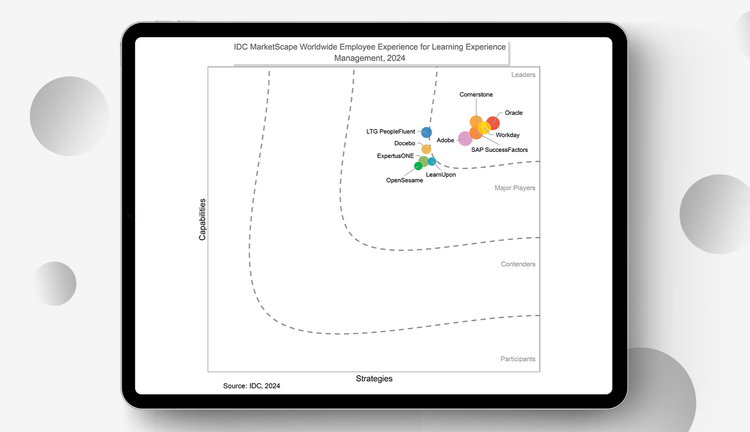
IDC Names Adobe a Leader in Learning Experience Management for Employees
Learn why IDC named Adobe a Leader in learning experience management for employee skilling. Explore current trends in learning experience management, how AI is shaping enterprise learning strategies and how leading vendors are meeting evolving enterprise needs.
Resources

5 Reasons Why Adobe Learning Manager is the Leading Customer Education Platform for Tech Enterprises
Learn how tech companies use Adobe Learning Manager to drive product adoption with engaging and personalized learning experiences.
--- #e1e1e1

Forrester Study: Driving customer loyalty and revenue-impact through learning
Explore how customer education programs enhance CX and drive engagement using Adobe Learning Manager.
--- #e1e1e1

Case Study: How Adobe Uses Learning Manager Within Their Own Ecosystem
See how Adobe uses their own Learning Manager to reach 39% employee engagement, 25% increase in partner completion rates, and 10x increase in customer demand for online courses.
--- #e1e1e1

The Great Learning Disconnect: What Your Employees Aren't Telling You
Discover how a culture of learning can enhance employee engagement, retention, and performance across generations.
--- #e1e1e1

On Demand: Building a Learning Culture to Engage Every Generation in the Workforce
Understand how to address generational differences and foster a culture of learning with modern technology.
--- #e1e1e1

On Demand: Forrester Insights on How to Take Your CX to the Next Level with Customer Education
Explore strategies to enhance customer experience and loyalty through impactful customer education.
--- #e1e1e1

On Demand: How to Design a Product-Centric Customer Education Strategy that Scales
Understand how applying product management principles can optimize customer education and drive lasting engagement.
--- #e1e1e1

On Demand: Creating a Loyal Customer Fanbase with Training that Meets Diverse Learning Needs
Discover how businesses use personalized learning to retain customers and scale customer experience efforts.
--- #e1e1e1

How a unified learning management system reduces technical debt and maximizes learning impact
Learn how a unified learning platform streamlines learning experiences, reduces technical debt, and maximizes business impact.
--- #e1e1e1

How to use customer education to accelerate customer time to value
Learn how personalized customer education drives faster product adoption and improves time to value.
--- #e1e1e1

How to Build a Successful Customer Education Program
Navigate the essentials of customer education with our step-by-step guide to creating better learning experiences.
--- #e1e1e1

Case Study: How Enlighten delivered client education at scale
See how Enlighten achieved 100% completion rates and expanded learning across 7,000+ professionals with Adobe Learning Manager.
--- #e1e1e1
Questions? We have answers.
The best LMS for tech companies is one that can support employee skilling, customer education, and partner enablement from a single platform while using AI to personalize learning at scale. Technology organizations need more than course delivery. They need a learning management system that can keep pace with rapid product innovation, evolving skills requirements, and complex global audiences.
When evaluating the best LMS for tech companies, learning leaders should look for AI-powered personalization, skills gap mapping, customer training capabilities, partner training support, multi-tenancy, analytics, and enterprise-grade security. The platform should help employees develop emerging skills, help customers achieve faster product adoption, and help partners stay certified and ready to represent the business.
Adobe Learning Manager is an AI-powered LMS designed for technology organizations. As an AI learning management system, it combines personalized learning paths, AI-driven recommendations, customer education, partner enablement, and workforce skilling within a single platform. Multi-tenant architecture enables separate learning experiences for employees, customers, and partners while maintaining centralized administration and reporting.
For technology companies looking to scale learning across the entire value chain, Adobe Learning Manager provides the flexibility, AI capabilities, and enterprise readiness required to support business growth and workforce transformation.
Customer education is the process of helping customers learn how to use a product effectively so they achieve value faster, adopt more features, and remain engaged over time. For technology companies, customer education improves product adoption, customer retention, and customer success outcomes.
For tech companies, this matters more than most. Software products are complex, and customers who don't reach proficiency quickly tend to disengage before they see real value. Customer training software delivers education at scale, personalizing content by role and tracking progress across thousands of learners. When customers understand the product deeply, they adopt more features, contact support less, and stay longer. That is why retention of customers consistently improves when a strong customer training program is in place.
Customer training software is a platform that lets tech companies deliver product education to customers through tutorials, certifications, and guided learning paths. For tech enterprises, the requirements are more specific than a generic platform can meet.
The experience should start before a customer even logs in. A non-logged-in browsing experience means customers can discover your customer training academy and see what is available before they commit to signing in, which changes how they perceive the value of your program from the first touchpoint. Headless architecture lets organizations embed customer education directly into their product, website, or customer portal, creating a fully branded learning experience without redirecting learners to a separate platform. The interface itself also matters. Tech companies set a high bar for user experience, and a platform that feels dated or difficult to navigate will see engagement drop regardless of the quality of the content.
Inside the platform, AI personalization adapts content to each learner's role, product tier, and onboarding stage, so customers are not working through a course catalog built for someone else. Blended learning support lets organizations combine self-paced learning, instructor-led training, virtual classrooms, coaching, and certifications within the same learning path. Learning in the flow of work allows customers to access training inside the product itself without switching platforms.
For the team running the program, no-code tools mean your customer education team can build and update experiences without raising a development request. Analytics connect training completion to product adoption and support ticket reduction, so the business impact of your customer training program is measurable. For enterprises operating under GDPR and SOC 2, responsible AI means knowing exactly how learner data is handled and whether it is used to train models outside your own instance. At enterprise scale, the platform also needs to support large learner volumes across multiple products, markets, and languages.
Personalized learning accelerates customer time-to-value by delivering role-specific training, recommendations, and support tailored to each customer's needs. In SaaS, time-to-value is the window between a customer signing up and the moment they get enough out of the product to want to stay. Generic training programs miss this window because they deliver the same content to every customer regardless of role, product tier, or how far along they are in their journey.
A personalized learning platform changes this by recommending content based on what each customer actually needs at their current stage. When a customer searches for help, an AI powered learning platform surfaces context-aware answers from course content rather than returning a list of vaguely related modules. When questions come up mid-course or after a session, conversational learning support draws answers from content the customer has already taken, so learning continues without interruption. Personalized learning paths map to each customer's existing skills and proficiency level, so they are always working on what moves them forward rather than covering ground they have already crossed.
The result for tech companies is that customer education programs built on AI-driven personalization consistently cut time-to-value and increase feature adoption in ways that static course catalogs cannot.
An LMS helps reduce customer churn by improving product proficiency, increasing feature adoption, and helping customers achieve value faster. Customer education programs are one of the most effective ways for technology companies to improve customer retention and long-term engagement. A customer education program addresses this directly by ensuring customers reach proficiency before they reach a decision point.
Customer training software built for retention does more than deliver courses. AI personalization ensures each customer is working through content relevant to their role and stage rather than a generic catalog that loses them before they finish. Analytics give customer success teams visibility into which accounts are falling behind on training completion, so intervention happens before disengagement becomes a decision to leave. Integrations with marketing automation tools like Marketo allow re-engagement campaigns triggered by learning behavior, reaching customers who have gone quiet before they become a churn risk.
Retention of customers consistently improves when customer training is treated as part of the ongoing journey rather than a one-time onboarding event.
A partner learning management system (partner LMS) is a platform that helps organizations train, certify, and enable external partners such as resellers, distributors, and implementation providers. Technology companies use partner learning management systems to improve partner readiness, consistency, and revenue performance. Partners are independent businesses with their own priorities, and the only leverage you have over how well they represent your product in a customer conversation is how well you have prepared them.
The need for a dedicated partner LMS comes down to audience complexity. The content that works for a partner who needs to sell the product looks nothing like the content a partner who needs to implement it requires, and a generic training platform was not designed to handle that difference. Serving every partner type from the same course catalog means building content that fits no one particularly well.
A partner learning management system solves this through multi-tenancy, giving each partner type their own branded portal with content specific to their role, tier, and region, all managed from a single admin layer. Partner enablement programs can be updated centrally and distributed instantly across the entire network, so when a product changes every partner is working from the same version of the truth.
For tech companies building global partner networks, a partner training LMS also needs to support multiple languages and custom domains for fully branded portals. Certification management should answer the question that matters most to a tech company: which partners are genuinely ready to represent your product in a customer conversation.
Multi-tenancy allows IT companies to manage every partner portal from a single admin layer, regardless of how many regions, partner tiers, or languages the program spans. Each portal runs independently with its own branding, content library, and access controls, but every update, certification change, and reporting view happens centrally.
Without multi-tenancy, growth in a partner program typically means growth in administrative overhead. Every new region or partner tier added tends to multiply operational complexity rather than sit cleanly alongside what already exists. Multi-tenancy removes that problem by keeping everything on a single platform while still giving each partner a completely separate experience.
In practice, a reseller in Germany and a systems integrator in Singapore can each have a fully branded portal in their own language, with content curated for their specific role and product line, while the team managing the program works from one interface. When a product update requires a training change, it is made once and applied across every portal rather than updated individually.
For IT companies where partner revenue is a significant portion of the business, centralized visibility means training progress and certification status across the entire partner network are always visible without manually pulling data from separate systems.
The best LMS for tech companies running partner certification programs is one that treats partner certification as a business risk question, not just a training milestone. A partner who is not genuinely prepared to represent your product in a customer conversation is a liability, and a partner learning management system built for tech companies needs to give you clear visibility into where that risk sits across your entire partner network.
Adobe Learning Manager is the LMS for partner training that tech companies use to manage this at scale. Its multi-tenancy architecture lets you run a separate certification track for each partner type, with their own branded portal and role-specific certification criteria, all managed from a single admin layer. When a product changes, certification requirements update centrally and flow through to every portal automatically.
A strong partner enablement strategy also depends on relevance. AI personalization tailors each partner's learning path to their role, tier, and existing knowledge, so channel partner enablement programs produce partners who apply their certification in practice rather than just completing it on paper.
Adobe Learning Manager connects partner training program data to the broader business picture. Integrations with Salesforce mean certification status surfaces in the CRM, so sales and channel teams always know which partners are ready to engage on a given product line. IDC named Adobe a Leader in Learning Experience Management, recognizing its AI capabilities and enterprise readiness for complex partner enablement at global scale.
IT skills training is the ongoing development of technical and professional capabilities that technology companies need their employees to have in order to stay competitive. The AI skills gap is the specific version of this challenge that tech companies are grappling with right now: the rate at which AI is changing what skills are required is outpacing the speed at which most training programs can be built and delivered.
For tech companies, this gap is not theoretical. The rate of AI-led change means the skills an engineer needed two years ago look different from what the same role requires today. Customer-facing teams are fielding questions about AI capabilities that did not exist in their onboarding training. The gap shows up differently across every function, which is why a single mandatory training module does not close it.
Closing the AI skills gap requires a personalized learning platform that can map each employee's current skills against what their role actually requires and recommend a learning path that bridges the two. Research from Lighthouse Research and Advisory found that only one in three employees say their training is fully aligned to their actual job, which means most IT skills training programs are developing the wrong skills for the wrong people.
An AI-powered learning platform addresses this by building personalized paths from internal content and integrated external sources, mapped to each employee's existing skills and proficiency level. AI coaching and role-play capabilities let technical teams practice applying new skills in realistic scenarios before they face them in the field. Because the AI skills gap keeps shifting as technology evolves, the platform also needs to surface new learning recommendations continuously rather than waiting for the next annual training cycle.
Skills gap mapping and personalized learning paths for engineers sit at the heart of any serious IT skills training program. A generic course catalog tells you what training is available. The best LMS for tech companies tells you which engineers have which skills, where the gaps are relative to what each role actually requires today, and what learning path closes those gaps most efficiently.
The foundation is AI-driven skills intelligence. The platform should be able to map each engineer's current proficiency against what their role actually requires and build a personalized learning path from internal content and integrated external sources. That path should reflect where the engineer actually is rather than where the job description says they should be.
For skills gap mapping at the team level, conversational reporting is what makes the data accessible. Learning leaders should be able to ask which teams have the biggest skill gaps and get an immediate answer rather than building a report to find out. This is what allows L&D and engineering leadership to address gaps before they affect product delivery or customer outcomes.
Adobe Learning Manager supports logical skill progression with learning paths that move from foundational to advanced concepts, with AI recommendations that update as an engineer's skills develop. AI coaching and role-play capabilities on an AI powered learning platform let engineers practice applying new skills in realistic scenarios, which is where technical knowledge becomes usable rather than just completed on paper.
Technical and engineering teams are among the hardest audiences to engage with mandatory training, which is why many technology companies use gamification to improve learner engagement and training participation. The work is demanding, the calendar is full, and a course that feels disconnected from what they are actually building gets deprioritized until a deadline forces it. Gamification in an LMS addresses this by giving engineers a reason to engage with IT skills training that goes beyond compliance.
Adobe Learning Manager's behavior-based gamification assigns points based on learner activity and engagement levels rather than just course completion. Engineers earn badges for reaching learning milestones that can be shared on professional networks and peer workspaces, while leaderboards create healthy competition within and across teams. In a professional community where credentials carry real weight, sharable badges serve as recognition that extends well beyond the training platform.
Social learning amplifies engagement further. Topic-based discussion boards let technical teams share expertise, ask questions, and build on each other's knowledge in a format that mirrors how engineers already communicate. AI-moderated content curation keeps the boards relevant and high quality without requiring manual oversight from the L&D team.
For engineering teams, the combination of milestone-based recognition, peer learning, and competitive leaderboards is what turns employee upskilling from a calendar obligation into a cultural norm.
AI can identify skills gaps across engineering teams by analyzing employee skills, proficiency levels, learning activity, certifications, and role requirements to reveal where capabilities are missing or becoming outdated. For technology companies facing rapid change in areas like AI, cloud computing, cybersecurity, and software development, this visibility helps learning leaders prioritize training investments and build future-ready teams.
Adobe Learning Manager can recommend personalized learning paths, and surface learning opportunities from both internal and external content sources. Conversational reporting makes these insights accessible by allowing learning leaders to ask natural-language questions about workforce readiness and receive immediate answers.
As an AI-powered learning platform, Adobe Learning Manager helps organizations move from reactive training programs to proactive workforce development by continuously identifying skill gaps and recommending targeted learning interventions before those gaps affect business performance.
Yes. The best LMS for tech companies serves all three audiences from a single platform, and for most tech companies this is not just a convenience but an operational necessity.
The challenge is that customer training software, partner enablement, and internal employee skilling tend to accumulate on separate platforms over time. Each additional platform multiplies administrative overhead and creates data silos that make it impossible to see how training is performing across the business as a whole.
Adobe Learning Manager is built for exactly this. Its multi-tenant architecture gives each audience their own dedicated experience with separate branding, content, and access controls, all managed from a single admin layer. The customer education team, the partner enablement manager, and the L&D leader each work within the same system but build and manage experiences specific to their audience and their goals.
AI-powered personalization works across every audience, recommending content based on role, skills, and learning history regardless of whether the learner is a customer, a partner, or an internal employee. Platform analytics give a unified view of training performance across the entire business, so learning leaders can connect training investment to outcomes across the full tech value chain rather than piecing the picture together from separate systems.
Tech companies evaluating an AI LMS face a unique challenge: they must simultaneously develop workforce skills, support AI adoption, and deliver learning at scale. They are building AI into their products, deploying it across their operations, and simultaneously trying to develop the AI skills their teams need to stay ahead. The best LMS for tech companies needs to reflect that reality rather than sit outside it.
Adobe Learning Manager helps IT companies navigate AI adoption from two directions. As an AI powered learning platform, it uses AI to improve how learning is delivered. AI-powered personalization recommends content based on each learner's role, skills, and learning history, drawing on over 50 million course data points to surface the most relevant training for every individual. The AI Assistant for Learners answers questions in context, transcribing course content and providing cited answers based on what each learner has already taken. The AI Virtual Coach enables role-based practice through dynamic, one-on-one simulations configured for specific business scenarios, so employees develop applied skills rather than theoretical knowledge.
Adobe Learning Manager also gives IT companies the content infrastructure to build AI skills programs at scale. Access to over 80,000 courses across 850 topics and 7,000 skills means learning leaders can build comprehensive AI upskilling programs for technical and non-technical teams without developing all the content in-house.
For tech companies that take AI governance seriously, learner data is protected within Adobe's enterprise cloud and never used to train models outside your own instance. Adobe Learning Manager meets GDPR, SOC 2, and ISO 27001 requirements, giving IT and security teams the assurance they need before deploying an AI powered learning platform at enterprise scale.
Migrating from a legacy LMS to an AI-powered learning platform involves transferring learning content, learner records, certifications, integrations, and reporting data while minimizing disruption to employees, customers, and partners. For technology companies, the goal is not simply to replace an existing system but to modernize learning experiences and improve business outcomes.
Many legacy learning management systems struggle to support personalized learning, skills-based development, customer education, partner enablement, and AI-driven recommendations. As learning needs become more complex, organizations often find that older platforms create administrative overhead and limit learner engagement.
Technology companies evaluating LMS migration should prioritize platforms that support AI-powered personalization, enterprise integrations, multi-tenancy, and scalable learning experiences.
Adobe Learning Manager simplifies LMS migration through support for standard learning formats, enterprise integrations, and scalable content management. Organizations can migrate existing courses, certifications, and learner histories while introducing modern capabilities such as AI-powered personalization, skills gap mapping, blended learning, and multi-tenant experiences for employees, customers, and partners.
As an AI-powered learning platform, Adobe Learning Manager helps technology companies move beyond course administration and create learning programs that improve workforce readiness, product adoption, partner performance, and learner engagement. A successful LMS migration not only preserves existing learning investments but also creates a foundation for future growth and innovation.
Personalized learning improves training outcomes by delivering the right learning experience to each learner based on their role, skills, goals, proficiency level, and learning behavior. For technology companies, where employees, customers, and partners all require different knowledge and training paths, personalized learning helps learners reach proficiency faster and stay engaged longer.
Traditional learning programs often rely on standardized course catalogs that present the same content to every learner. This approach can lead to unnecessary training, lower engagement, and slower skill development. A personalized learning platform uses AI to recommend relevant content, learning paths, certifications, and resources based on each learner's unique needs and progress.
Adobe Learning Manager is an AI-powered learning platform that delivers personalized learning at scale. AI-driven recommendations help employees build critical skills, guide customers toward faster product adoption, and ensure partners receive role-specific enablement content. Personalized learning paths continuously adapt as learner skills develop, certifications change, and new learning opportunities become available.
For technology companies navigating rapid innovation and evolving workforce requirements, personalized learning helps reduce time-to-proficiency, improve learner engagement, and ensure training investments are aligned with business goals.
Technology companies use blended learning because it combines self-paced learning, instructor-led training, virtual classrooms, coaching, and hands-on practice into a single learning experience. This approach helps learners develop both theoretical knowledge and practical skills, which is especially important for technical roles that require continuous learning and real-world application.
Technical training often involves complex concepts that cannot always be mastered through self-paced courses alone. Engineers, developers, implementation specialists, and customer-facing teams frequently benefit from a combination of on-demand content, live expert sessions, collaborative learning, and practical exercises. Blended learning allows organizations to deliver each type of learning in the format that works best.
Adobe Learning Manager supports blended learning by bringing self-paced modules, instructor-led training, virtual classrooms, assessments, certifications, and social learning experiences together within a unified platform. Learning leaders can create structured learning paths that combine multiple learning formats while tracking progress and outcomes from a single system.
For technology companies, blended learning improves knowledge retention, accelerates skill development, and creates more engaging learning experiences than relying on a single training format alone. It also provides the flexibility needed to support employees, customers, and partners across different locations, schedules, and learning preferences.
Technology companies can deliver customer and partner training in a fully branded learning experience by using a learning platform that supports custom branding, custom domains, embedded learning experiences, and flexible user interfaces. A branded learning experience helps organizations create a seamless connection between their product, website, and training programs while reinforcing trust and credibility.
When customers or partners are redirected to a generic learning portal with unfamiliar branding, the learning experience often feels disconnected from the product they are trying to learn. This can reduce engagement and make training feel like a separate activity rather than part of the overall customer journey. A fully branded customer education academy creates a consistent experience across every touchpoint.
Adobe Learning Manager enables on-brand learning through customizable learner interfaces, custom domains, headless architecture, and multi-tenant experiences. Technology companies can create customer education academies and partner training portals that reflect their brand identity while embedding learning directly into websites, applications, and digital experiences. Learners can access training without feeling like they have left the organization's ecosystem.
For technology companies focused on customer education and partner enablement, on-brand learning helps increase learner engagement, strengthen brand consistency, and create a more seamless path to product adoption and certification.
Technology companies can improve learner engagement by delivering personalized learning experiences, relevant content recommendations, social learning opportunities, gamification, and learning embedded within the flow of work. When training aligns with a learner's role, goals, and daily responsibilities, participation and knowledge retention increase significantly.
One of the biggest challenges in technology training is relevance. Engineers, product teams, customer success managers, and sales teams all have different learning needs. Generic course catalogs often result in low completion rates because learners struggle to see how the content applies to their work. Personalized learning helps solve this by recommending content based on role, skills, learning history, and proficiency level.
Adobe Learning Manager improves learner engagement through AI-powered recommendations, behavior-based gamification, social learning communities, milestone-based badges, and personalized learning paths. Learners receive relevant content recommendations and can participate in discussions, collaborate with peers, and earn recognition for learning achievements. Learning can also be embedded directly into applications and digital workflows, allowing employees, customers, and partners to access training when they need it most.
For technology companies, higher learner engagement leads to better knowledge retention, faster skill development, stronger product adoption, and improved business outcomes across workforce training, customer education, and partner enablement programs.
Fill out the form and we will contact you soon.