School’s out forever: School leaver CV examples and tips.
Learn how to write a school leaver CV to impress employers and land your first job after leaving education.




Leaving school is a life-changing moment for most people. After years of assignments, exams and rigid timetables, you’re finally free to take the next step in your life and career.
If further education isn’t for you, you can venture straight into world of work. Or you could continue studying and apply for a part-time job. Either way, both options will require one key thing – a top-notch school leaver CV.
Not sure how to write a CV? Don’t worry, that’s normal for a recent school leaver. Take a look at these examples, tips and template ideas to help you land a suitable role once school’s out.
What is a school leaver CV?
A school leaver CV documents the education and qualifications of a person of school-leaving age. In the UK, this is usually between the ages of 16 and 18. It can also mention any part-time jobs they have had or volunteering they have done alongside their studies.
Due to limited experience, a school leaver’s CV isn’t expected to be overly long or diverse – but detailing key skills, qualifications and experience can help to demonstrate abilities and competencies relevant to a future job, internship or apprenticeship.
Free school leaver CV examples.
recipe
How to write a CV for a school leaver.
A well-written school leaver CV will set you apart from other candidates, even if you have limited experience. Structure is important, and you’ll need to know which sections to focus on to impress recruiters.
Here’s how to write a CV for a school leaver:
1. Choose a simple skills-based CV format to showcase your experience.
There are different types of CV formats. As a school leaver you may find that a skills-based CV format is best for you. Also known as a functional CV, this type of CV lets you highlight the transferrable skills you’ve developed over the years.
You’ll need to format your skills as headers and provide a detailed explanation of each, including how you developed them and how they could be used in the role.
2. Add your contact details near the top.
Don’t forget to list your contact details at the top of your CV – how else will employers contact you to invite you for an interview? Contact details like your name, phone number and email address should be clear and easy to find. This will make getting to the next step in the interview process more seamless.
Do you have a website or an online portfolio? Be sure to include a link to it at the top, too.
3. Craft a short professional summary.
The professional or personal summary is where you give employers a taste of your personality with a description of your most relevant qualifications and experience in your own words.
It’s usually just two or three sentences detailing your main qualities, attributes, background and work experience – to give recruiters some context before they read the rest of your CV.
4. Outline your relevant skills.
If you opt for a skills-based CV, this section will form the main part of your document. It should be positioned right below your personal summary. Here, you’ll highlight all your relevant skills and go into further detail about how you acquired them.
Be sure to also mention how they’re transferrable to the role you’re applying for. Look at the job listing and see if you can add any of the skills being asked for.
5. Detail your education.
You’ll need to let employers know about your education and qualifications. This can be listed as bullet points, or even in a table. Begin with your most recent school and then work backwards in reverse chronological order.
For each level of education, include the following:
- Institution name
- Education level
- Start and end dates of attendance (If you're still in school, just write your expected date of completion)
- Subjects
- Achieved grades and awards.
6. Include relevant work experience.
You might not have much work experience as a school leaver, but if you’ve done any placements or voluntary work in the past, you could mention this here. You could also add any part-time work you’ve completed alongside studying or in the school holidays.
List them in chronological order and include the:
- Company name
- Job title
- Employment dates
- Main responsibilities.
7. Mention your hobbies and interests.
This section is optional, but it provides another chance for you to make you CV more personal. Mention some of your hobbies and interests and focus particularly on those that relate to the role. For example, if a role requires creativity skills, you could include any photography, art and crafts or creative writing activities you do as a hobby or an interest.
8. References.
Mention that references are available upon request. Identify a few people (usually two to three) who you could ask to be your reference in advance. This could be someone like a teacher or a work experience manager. Be sure to ask for permission in advance from the people you decide to choose.
How to make the most out of these school leaver CV examples.

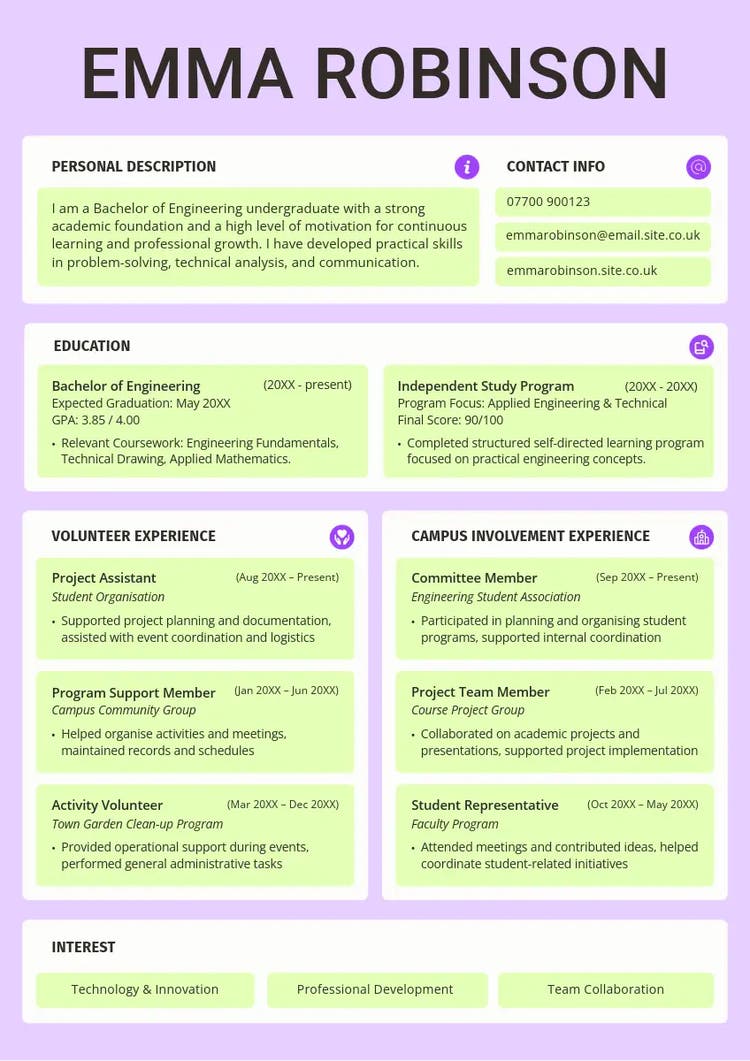
More editable CV template ideas for school leavers.
recipe
5 top tips for writing your school leaver CV.
To give you the best shot at landing your first job after school, here are five tips to help you create an impressive school leavers CV:
1. Avoid any spelling and grammar mistakes.
Spelling and grammar errors can make your CV look unprofessional. Check over your document a few times and maybe even run it through a spelling and grammar checker to ensure it’s free from any errors.
2. Be clear and concise.
CVs should be no more than two pages long, so try to keep every section as clear and concise as possible. Make sure everything you include is relevant.
3. Choose a suitable font.
Don’t go with an outlandish font unless it’s relevant to the specific job role – for example, a creative job. Simple font types like Times New Roman and Arial will help your document look clean and well structured.
4. Use set font sizes.
Aim to keep your body text between 10 and 12 point and headings between 14 and 18.
5. Get someone else to check it.
Lastly, ask someone you trust, like a teacher or family member, to give your CV a once-over to see if it could be improved in any way.