
Whether you’re a designer finalising an asset or a marketeer chasing a deadline, countless workers are putting in extra hours on a weekly basis. But how does overtime vary across industries? And are workers in certain cities doing more than others? We surveyed 1,000 UK adults to find out!
Key takeaways
- 21% of Brits are working overtime 2 days a week, 11% work 5 days, and 3% work overtime 7 days per week.
- 39% spend between 1-2 hours a week doing overtime, 16% spend 3-4 hours, and 4% work 6 hours extra.
- Overtime pressures are causing 19% of workers to look elsewhere for employment.
Eager to find out more? Let’s take a closer look at our survey results.
Overtime by industry: who’s working the longest hours?
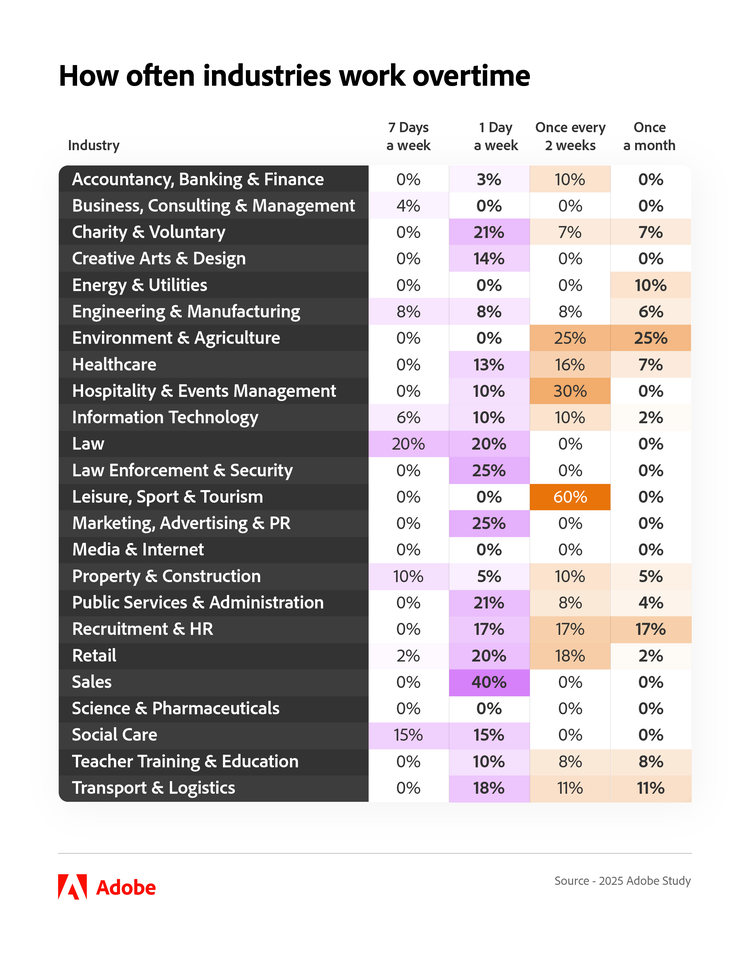
First, let’s look at how overtime varies across different industries. Those in Law top the list when it comes to working after hours, with 20% doing overtime seven days a week. Property and Construction comes in next (10%), followed by Engineering and Manufacturing (8%). Meanwhile, only 2% of those in Retail are doing this much overtime.
In the Sales sector, most people (40%) are working 1 day per week overtime, with 25% of Law Enforcement and Security, as well as Marketing, Advertising and PR also doing one day per week.
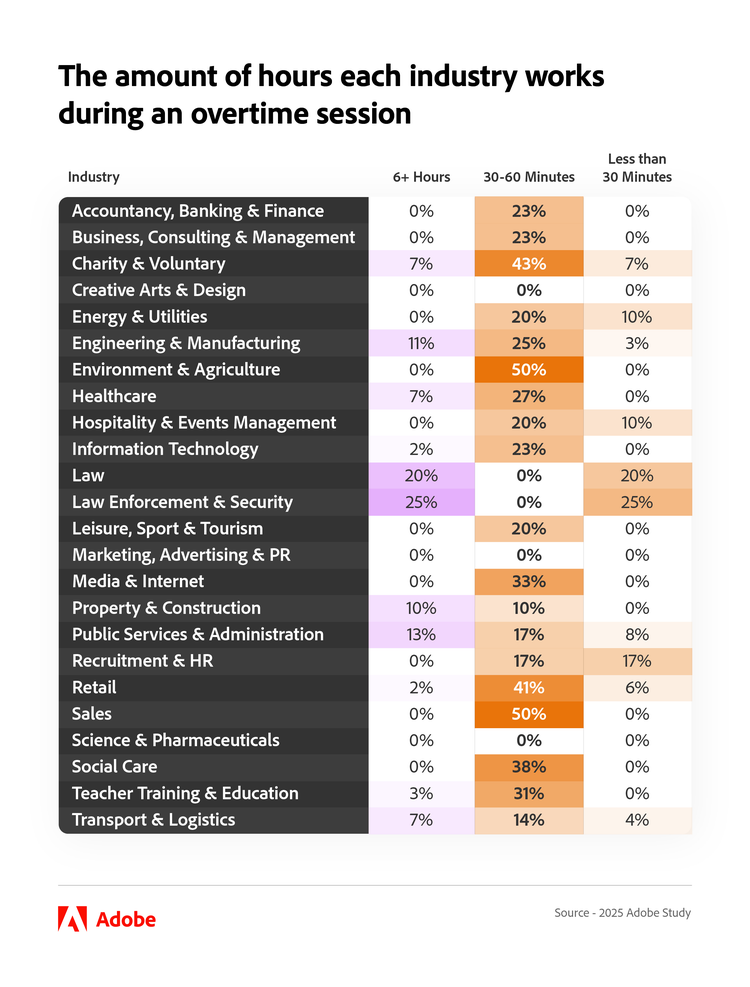
But how many extra hours are workers putting in? Well, Enforcement and Security workers top the ranking (with 25% clocking 6+ hours), followed by Law (20%), and Public services and Administration (13%). Meanwhile, in the Information Technology industry, just 2% are working 6+ hours. Environment and Manufacturing, and sales workers tend to keep overtime minimal too, with 50% logging 30-60 minutes.
How often are workers in different UK cities doing overtime?
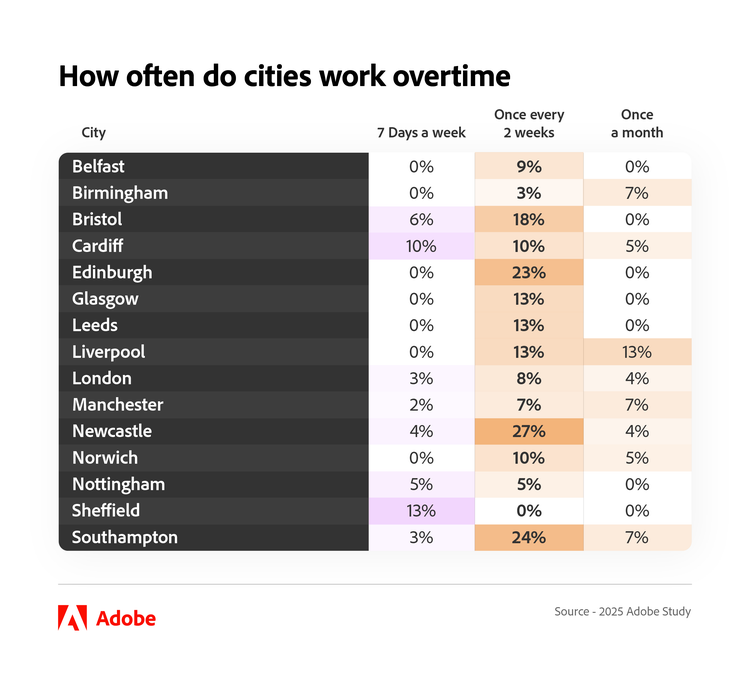
Looking at UK cities, Sheffield leads for the highest percentage of people working overtime seven days a week (13%), followed by Nottingham (5%) and Southampton (3%).
When it comes to specific hours, Cardiff tops the chart with 14% working 6+ hours, followed by Liverpool (9%), and Southampton (7%).
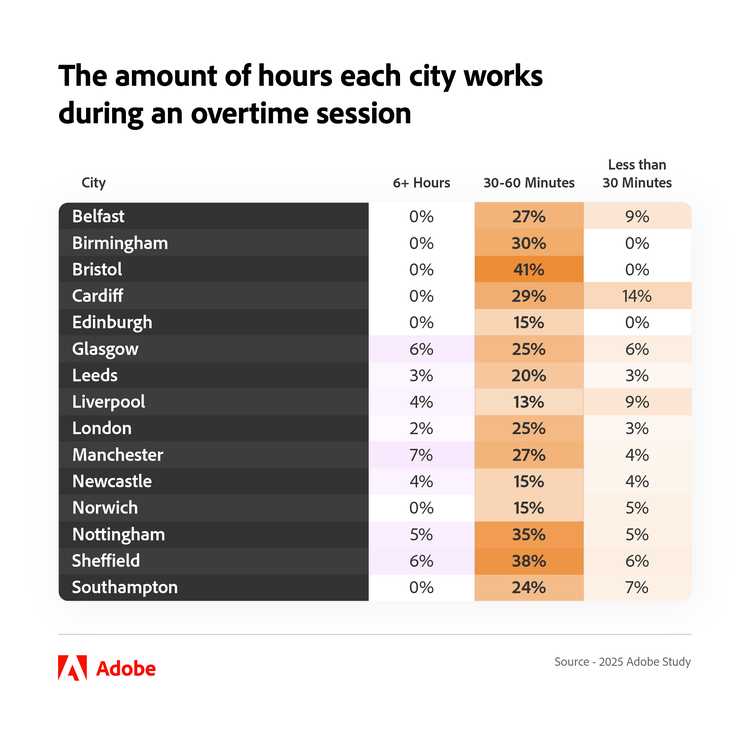
In Bristol, 41% are spending between 30-60 minutes working after hours each week, with Sheffield following closely behind at 38%. 14% of people in Cardiff are spending less than 30 minutes on overtime each session, the lowest amount of time out of all cities.
Why are people working overtime?
The main reason Brits are working after hours is due to high workloads (41%) as well as looming deadline pressures (37%). Financial motivations are clear too, with 31% working to earn extra income.
Other reasons cropped up as well, including staff shortages (25%), and feeling obliged to stay late (9%). 11% of people also cited job enjoyment as the top reason they work additional hours. Finally, 4% mentioned the issue of poor time management on their part.
When looking at specific roles, entry level staff are working the most overtime hours (with 12% working 6+), yet department heads are doing overtime the most often (with 21% working 7 days per week).
Top tips on how to work smarter
While many are putting in the work after hours to keep on top of demanding deadlines, working longer doesn’t necessarily mean working better. By leveraging smart tools and implementing better workflows, there are ways to boost productivity and get ahead:
1. Time hack
One of the best ways to stay on track is to schedule focused blocks into your day. This might involve designating time for deep work, admin tasks, and meetings to help you stay organised.
You can try working in 90-minute or two-hour focus sessions, followed by short breaks. It’s far easier to stay productive in structured bursts rather than pushing through the entire day.
2. Create work-life balance
While overtime is necessary in certain roles, it’s no secret that constant over working can lead to burnout. So, it’s crucial to establish healthy boundaries between your work and personal life.
If possible, mute notifications outside working hours and avoid checking emails when you’re out of office. You should also create a routine that helps you switch off at the end of each day. Downtime is never time wasted; your brain needs to rest to stay creative, focused, and resilient.
3. Use time-saving tools
If you’re looking to work smarter, there are various tools out there that can help you. Whether you’re building presentations, crafting social media posts, or creating stand-out images, Adobe Express is on hand to help.
And if you’re looking to connect your audience to your content, our QR code generator allows you to create custom codes that fit your brand.
Well, there you have it: our insights on the overtime landscape in the UK. While many employees are working beyond their contracted hours, balance is clearly key. Long hours can feel productive in the short term, but they can take their toll on job satisfaction and performance in the long run.
So, whether you’re in a leadership role or just starting out in your career, keep an eye out for tools to help you stay creative and efficient.
And if you’re looking for additional insights, you’ll find plenty over on the Adobe Express blog. There you can learn about content scheduling, how to use social media caption writers, and discover more tips to boost your productivity.
recipe
Methodology:
Adobe Express conducted a national survey via TLF. The survey polled 1,000 UK adults between 24.04.2025 and 01.05.2025.
The questions in the survey are displayed throughout the above content, and the data includes splits across:
- Age group: (18-24, 25-34, 35-44, 45-54, 55-64, 65+)
- City: (Belfast, Birmingham, Bristol, Cardiff, Edinburgh, Glasgow, Leeds, Liverpool, London, Manchester, Newcastle, Norwich, Nottingham, Sheffield, Southampton)
- Gender: (male, female, non-binary or alternative identity)
- Career/ Industry: (24 industries including Accountancy, banking and finance, Business, consulting and management, Charity and volunteer work, Creative arts and design, Energy and utilities, Engineering and manufacturing, Environment and agriculture, Healthcare, Hospitality and events management, Information technology, Law, Law enforcement and security, Leisure, sport and tourism, Marketing, advertising and PR, Media and internet, Property and construction, Public services and administration, Recruitment and HR, Retail, Sales, Science and pharmaceuticals, Social care, Teacher training and education, Transport and logistics).