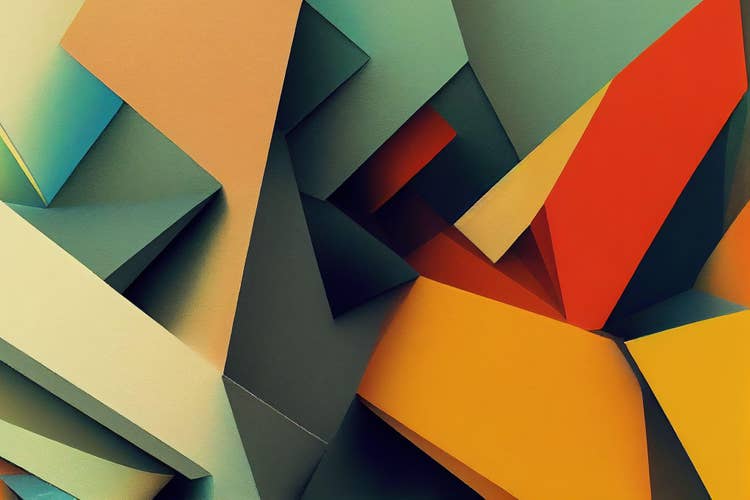
Cubism is an art movement and style you can use in many types of social media content, as well as print materials. With Adobe Express, you can quickly create original Cubism-inspired designs for just about any design. In this post, we delve into the 20th century art movement, its techniques, and some practical tips.
Why was Cubism art influential?
Cubism was an early 20th century art movement associated with abstract forms and two-dimensional shapes. Key figures include Pablo Picasso, Georges Braque, and Robert Delaunay. Rejecting the idea that art should copy nature, Cubists emphasised non-linear narratives, experimentation, and multiple perspectives.
In its first era, Analytical Cubism, subjects were painted from multiple perspectives at once, with faces appearing fractured, one eye above the other. In its second, subjects were painted in bright colours on collages, often incorporating words.
The movement then influenced other artists to join, resulting in forms known as orphic Cubism, synthetic Cubism, and tubism. After World War II, Cubism’s influence spread to other art forms like literature, music, photography, graphic and scenic design. Cubism has also had a lasting impact on digital art. Think geometrical portraits incorporating a mix of abstract facial features and textures.
What are Cubist techniques?
Cubists used geometric and abstract shapes, rather than striving to create a realistic representation of their subject matter. Many works contain tubes, cylinders of various widths and lengths, and spheres. One of the most famous Cubist works, Picasso’s “Guernica”, features a person with asymmetrical oval eyes, on a brightly lit lightbulb.
Apart from human subjects, Cubists depicted musical instruments and landscapes from multiple viewpoints at the same time. This creates a fragmented effect. Features that would appear on the front and back of a 3D representation appear clustered together in 2D space.
2D Cubist media includes collage, or papier collé (pasted paper), and oil paints on canvas. Cubists used newspaper clippings, wallpapers, and printed papers of various textures and patterns, which are re-assembled, juxtaposed, or layered on collages. On paintings on canvas, analytical Cubists used a muted colour palette (think earthy tones, and black and white), whereas synthetic Cubists explored brighter hues. 3D sculptures were made of wood, metal, or clay.
Editable Cubism art templates.
recipe
Tips for Cubism-inspired designs.
Discover Cubist templates in the Adobe Express all-in-one tool for your designs. Create Cubism-inspired designs by blending and re-interpreting Cubist techniques, whether you are creating a birthday card, business card, or Facebook post.
Digital art allows you to mix and match styles and elements from various artistic movements. Think abstract Cubist shapes inside a decorative Art Deco border and visible Impressionist-inspired brushstrokes on the background.
Here are some tips for creating Cubism-inspired designs. First, select the type of content you want to create. Adobe Express offers templates for various content types including:
- Social media content: Instagram stories, Facebook posts, or TikTok videos
- Documents: posters, brochures, and CVs
- Print media: flyers, posters, and invitations
- Marketing content: business cards, logos, ads, and presentations
Next, start creating. Choose from over 20,000 design assets in the all-in-one tool. Here is a list of assets and ideas:
- Elements. Create an original Cubist-inspired design using abstract and geometric shapes, and icons, and position them at oblique angles to each other.
- Frames. Try placing or drawing a border around a quote by a famous Cubist painter.
- Illustrations. Drag and drop an illustration of a guitar onto a muted background.
- Overlays. Layer an abstract static image over a black-and-white landscape, creating a fractured effect.
- Textures. Simulate the feel of a canvas or collage on your image, text, or background.
- Graphic groups. Customise and move the text, shapes, and icons in an abstract graphic group.
Use the search bar to find Cubist elements. Try keywords like abstract, square, Cubist, geometric shape, cube, and cylinder.
Art and design inspired by Cubism.
The Cubism movement, beginning around 1907 and ending around 1914, influenced several art movements, including Futurism, Dada, Surrealism, Abstract Expressionism, and Art Deco. Each of these movements used abstract forms and geometric shapes. Like Cubists, Dadaists and surrealists created collages incorporating visuals, words and longer texts. Art Deco is a style used in architecture, fashion and design, everyday items, and paintings.
In 2025, Cubism’s influence can be seen in digital art. Creators, whether they are solopreneurs, business owners, or individuals can create, resize, and layer simple geometric shapes in a snap. They might play with texture and image elements to create a collage effect on their Instagram posts. Or they could create an abstract background, in muted hues, for their LinkedIn banner or business card.
Build your own Cubism art designs with templates from Adobe Express.
recipe
Cubist quotes for your designs.
Use quotes when you need to add a line to a greeting card, letter to a friend, or poster for a Cubist-inspired art exhibit. Here are just a few Cubist quotes:
Quotes by Cubists
- Painting is just another way of keeping a diary – Pablo Picasso
- It took me my whole life to learn to draw like a child. – Pablo Picasso
- Everything you can imagine is real. – Pablo Picasso
- Reality only reveals itself when it is illuminated by a ray of poetry – Georges Braque
- In art there is only one thing that counts: the bit that cannot be explained. – Georges Braque
Quotes about Cubism
- Maybe Cubism started this way. Memory re-arranging a face. – Mary Rakow
- Cubism is ... a picture for its own sake. – Max Jacob
Use a frame or border around a quote to make it stand out. Or layer it on a Cubist-inspired background, incorporating abstract and geometric shapes onto a quote poster.
Whether you are sending a card to a recent art graduate, or adding a quote to an Instagram caption, you can customise it with text and design elements in Adobe Express.