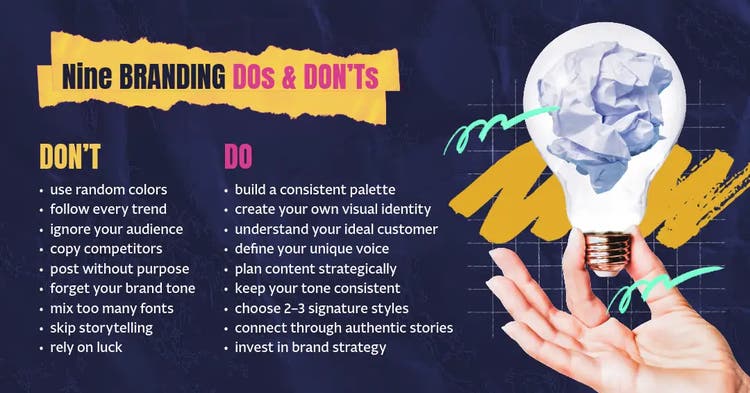




Brand guidelines: What to include with style guide examples.

Discover brand guidelines examples and tips to help you build out your own brand style guide.

Start designing with Adobe Express

Brand guidelines: What to include with style guide examples
Get started for free. Access 100K+ free templates, 1M+ assets for social media, video and other content, custom Adobe fonts, and more.
Get Adobe Express Free
Learn more
linear-gradient(90deg, #C0C9FF 0%, #ACCFFD 100%)
Get started for free. Access 100K+ free templates, 1M+ assets for social media, video and other content, custom Adobe fonts, and more.
Get Adobe Express Free
Learn more
linear-gradient(90deg, #C0C9FF 0%, #ACCFFD 100%)
Easy all-in-one editor
One-click edits from any device
Fast creation with generative AI
Thousands of professionally designed templates
toc-title
Jump to this section:
toc-aria-label
table of contents links
content-1
What are brand guidelines?
content-1-short
content-2
Why are brand guidelines so important?
content-2-short
content-3
What to include in your own brand guidelines.
content-3-short
content-4
Editable brand guideline examples.
content-4-short
content-5
How to create your brand guidelines in 5 steps.
content-5-short

All successful brands start somewhere. From concept to marketing, your brand should build a strong identity that resonates with consumers. That’s where brand guidelines come in. This set of rules outlines how to use written and visual elements in your content for public perception.

Our guide will explore what brand guidelines are, their benefits, and what to include in your own brand guidelines document. Develop comprehensive style guides and get each member of your team up to speed with logo and font templates from Adobe Express.

What are brand guidelines?

Brand guidelines, or brand style guides, are a set of clearly defined standards and rules that summarise your brand’s identity. Think of it as a handbook filled with all the key details about your brand – including how it should look, sound and be viewed by consumers.

Brand guidelines encompass your brand’s values, unique selling points (USPs), mission statement, vision and more. This helps to create a consistent message and feel across your entire business – from your products and packaging to your website and social channels.

recipe

topics=brand,branding AND guidelines,depop,brand guidelines&tasks=cover-page,media-kit&language=en-US&license=free&orderBy=-createDate&limit=4&collection=default

Why are brand guidelines so important?

Brand guidelines ensure that everyone is on the same page when it comes to your brand’s identity – both internally and externally. This results in strong, unique branding that customers are more likely to trust.

A brand guidelines document can also:

What to include in your brand guidelines.

All brand guidelines should act as a comprehensive rulebook for establishing your brand. This ensures that it’s represented consistently across all channels and touchpoints. Here are some of the most common elements to include.

Your brand’s values, vision and mission.

Your values, mission statement and vision shape the backbone of your brand. So, it’s only right these are clearly outlined at the start of your style guide to make sure everyone is on the same page. Think about your brand’s principles, purpose and aspirations and build a solid foundation for your brand identity guidelines.

Logos with approved variations.

Your brand guidelines document should explain how to correctly use your company logo, including formats, colour variations and placements. Provide an example of your logo on a plain background versus a patterned one, or social media channels versus the website.

Colour palette.

Brand guidelines should also focus on colour palette for consistency and brand recognition. This includes swatches and colour codes with the relevant CMYK, HEX and RGB codes for accuracy. It’s especially crucial for team members designing for print and digital.

Fonts and typography.

Fonts and typography are a huge part of your brand guidelines. You’ll need to identify which fonts you’re going to use, the text alignment, spacing considerations, sizing and more. Whatever your typography design, it should be standard to your brand.

Key images and icons.

Image guidelines ensure that your brand carries a consistent photographic or illustrative style throughout. Include aspirations and best practice examples in a variety of contexts that have performed well for your brand in the past. You can also include examples of what images to not include.

Tone of voice.

Tone of voice is crucial for your brand guidelines as it strongly impacts the way consumers connect and associate with your brand. Reinforce your brand’s core values and provide a house style guide of your visual tone, including content marketing, slogan use and email etiquette.

Editable brand guideline examples.

recipe

topics=brand,branding AND guidelines,guideline&tasks=presentation&language=en-US&license=free&orderBy=+createDate&limit=4&collection=default

How to create your own brand guidelines in 5 steps.

Ready to create your own brand guidelines? Whether you’re creating this golden rulebook for a new company or rebranding an existing one, you’ll need a clear picture of what your brand represents. Design your brand style guide with the following steps.

Picture, Picture
Establish your brand identity.
Arguably the most important step, your brand identity is what will inform your brand guidelines document. Outline your company’s mission, values, vision, character and voice. What sets you apart? How do you want to be perceived? These attributes will allow you to curate your brand’s image and positioning.
Design a mood board.
Hone in on your brand identity with a mood board. This will allow you to gather your best branding visuals and assets in one place. It can act as a source of inspiration and brainstorming. Work with colour, texture, style, image, text and more to tell a visual story about your brand.
Develop key brand elements.
Consider the use of brand elements for visual and written communication across different channels. Information such as logos, typography, illustrations, icons and colour should all be established here, as well as grids and white space. These specifications will provide clarity when creating on-brand content and keep everyone aligned.
Share with your team.
Once you’ve confirmed your brand guidelines, they should be communicated to employees and relevant stakeholders. Compile your brand guidelines into a PDF document or a presentation and announce the new changes in an official launch. You may also create a brand identity toolkit to share across the company. This can include the brand style guide, visual assets and how to use them.
Adapt to growth and change.
Your brand guidelines are a reflection of your brand. When your brand grows, so does your brand style guide. These should be revisited periodically, especially if there’s a shift in focus, a change in products or services, or an expansion into new markets. Keep your brand guidelines updated and current for consistency.

You might also like...

View all