
Creator-led brands — businesses founded and promoted by content creators, influencers, or celebrities — are gaining ground in the retail world. More than half of US consumers now buy from these brands, attracted by their authenticity, trust, and personal connection.
A new Adobe survey of 1,000 shoppers explores how younger generations are driving this trend across industries like beauty, fashion, and food. From Fenty Beauty to MrBeast Burger, discover how these brands are redefining shopping habits for the future.
Key takeaways
56% of consumers purchase from creator-led brands, with Gen Z (66%) and millennials (61%) leading the trend.
The most popular creator-lead brands in 2025 are Fenty Beauty and Savage X Fenty, both from Rihanna.
13% of shoppers now trust creator-led brands more than traditional ones.
Gen Z spends $104 monthly on creator-led brands.
70% of consumers believe creator-led brands deliver products that match their hype, and 40% plan to continue purchasing from these brands.
style
long-form, long-form-blog, xxl-spacing-top
The top creator-led brands of 2025
From apparel to beverages, trending creator brands are capturing wallets and attention, especially among younger US consumers.
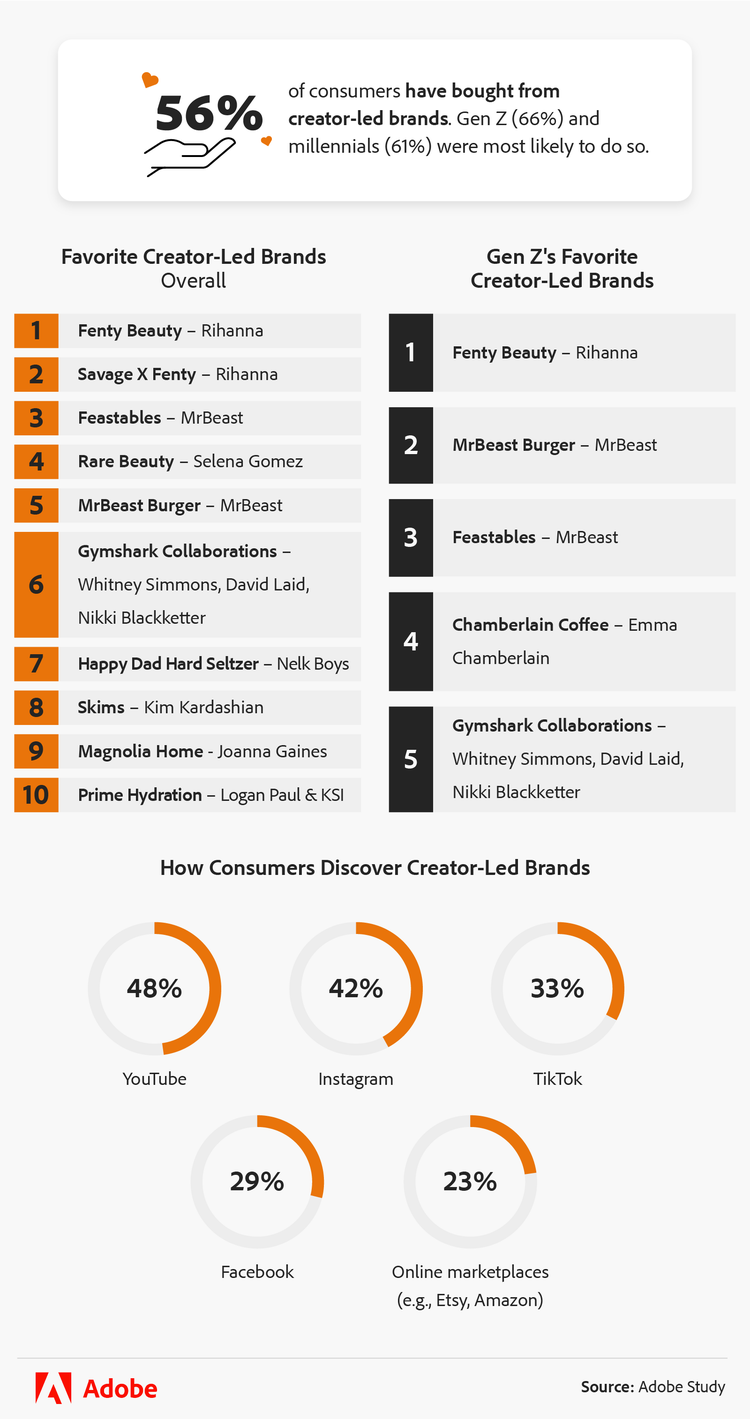
More than half of consumers (56%) have purchased products from a creator-led brand, with Gen Z (66%) and millennials (61%) leading the trend. Shoppers are most often discovering these brands online, with YouTube (48%), Instagram (42%), and TikTok (33%) being the top three platforms. This reflects a strong link between platform discovery and purchasing behavior, as video-driven platforms like YouTube and TikTok are also where these creators build the most trust and engagement.
Rihanna's Fenty Beauty and Savage X Fenty were the most popular creator brands overall. Fenty Beauty was also Gen Z's top choice, followed by MrBeast Burger, Feastables, and Chamberlain Coffee.
style
long-form, l-spacing, long-form-blog
Why consumers prefer creator-led brands
What's driving consumers away from traditional brands? It comes down to trust and connection, and creator brands are winning on both fronts.
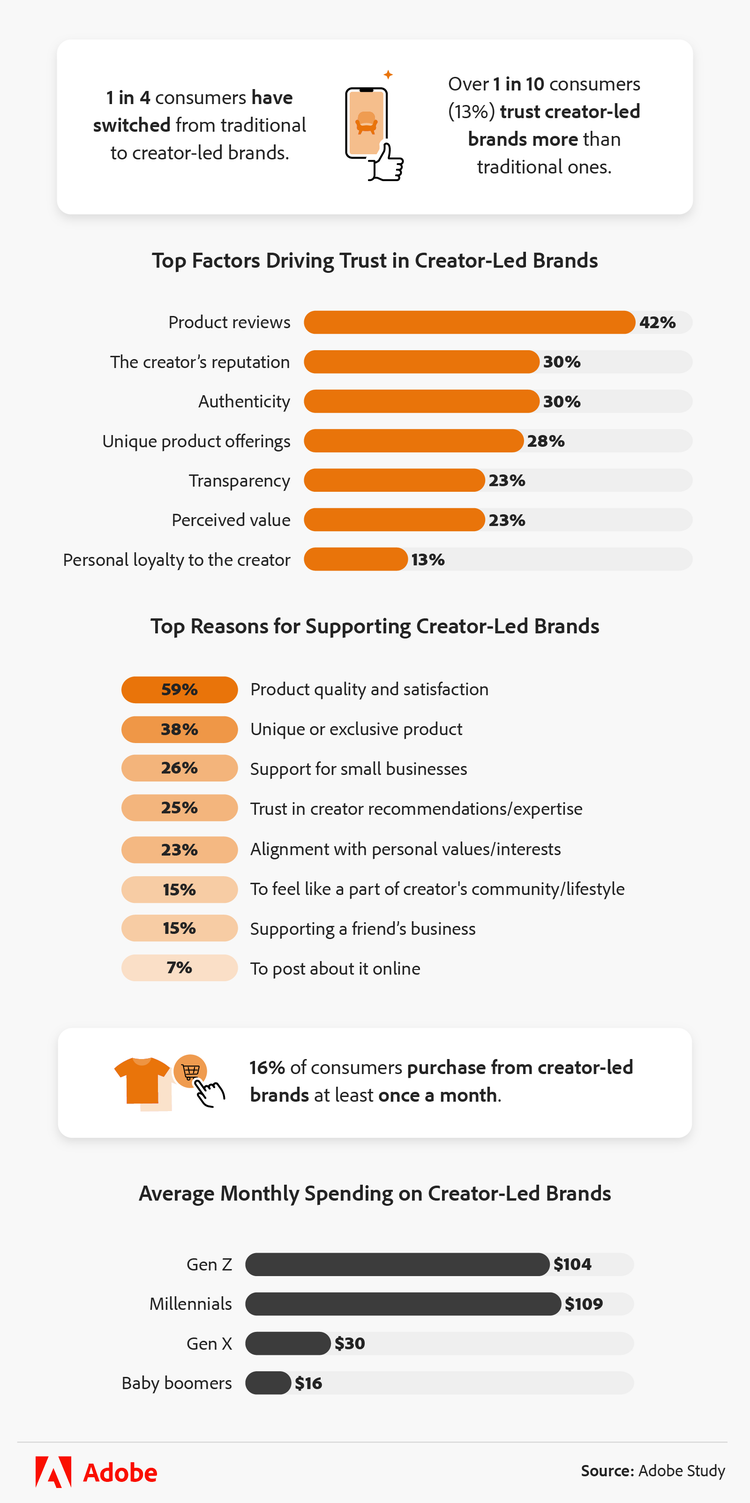
While 13% of consumers now prefer creator-led brands over traditional ones, the real story is in the shift: One in four have switched their loyalty from traditional to creator brands. The top decision drivers? Product reviews (42%), creator reputation (30%), and authenticity (30%). This suggests that consumers now value transparent storytelling and peer-like relatability as much as — if not more than — conventional marketing tactics.
The generational spending gap is stark: Millennials spent an estimated $109 a month on creator-led brands, with Gen Z close behind at $104. Gen X averaged only $30 monthly, and baby boomers spent just $16.
style
long-form, l-spacing, long-form-blog
Are creator-led brands delivering?
Some creator brands aren't just riding on fame — they're delivering on their promises. The customer satisfaction numbers prove it.
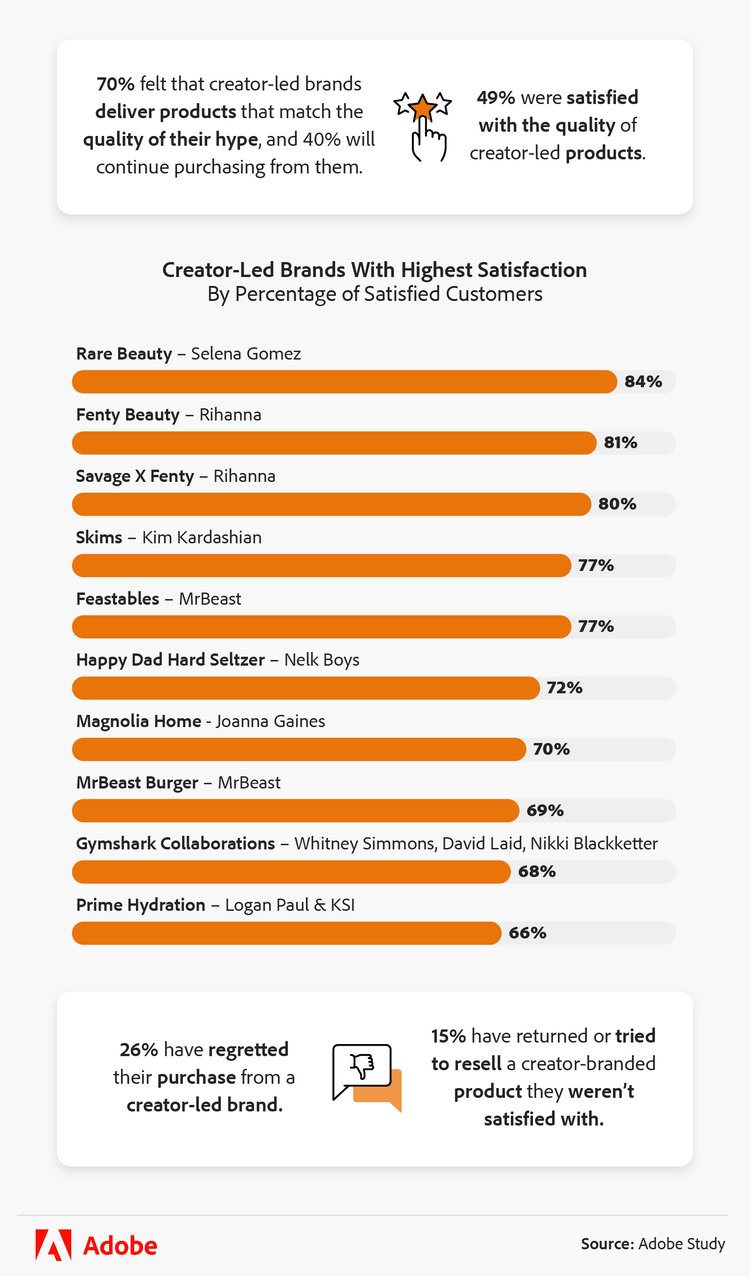
A strong majority of consumers (70%) felt that creator-led brands delivered products that matched their hype, and 40% plan to continue purchasing from these brands. Rare Beauty by Selena Gomez topped the most popular creator brands with an impressive 84% consumer satisfaction, while Fenty Beauty (81%) and Savage X Fenty (80%) were close behind.
style
long-form, l-spacing, long-form-blog
The new retail playbook
Creator-led brands are more than a passing trend — they reflect shifting consumer values where trust, authenticity, and personal connection take center stage. As younger generations continue driving this shift, traditional brands may need to rethink their strategies to stay relevant. As creator-led brands mature, their ability to consistently deliver on quality and values is setting a new benchmark for long-term consumer trust and retention. The success of creator-led brands highlights an important lesson: people trust people, and that trust can redefine long-term brand loyalty.
Methodology
Adobe surveyed 1,000 people in the US to explore preferences and spending on creator-led brands. Of the respondents, 16% were Gen Z, 52% were millennials, 25% were Gen X, and 8% were baby boomers.
Fair use statement
Sharing of these findings for noncommercial purposes is permitted with a link to this page.
You can control how Adobe websites use cookies and similar technologies by making choices below. But note that if you disable cookies and similar technologies entirely, Adobe websites may not function properly.
Cookies are small text files stored by your web browser when you use websites. There are also other technologies that can be used for similar purposes like HTML5 Local Storage and local shared objects, web beacons, and embedded scripts. These technologies help us do things like remembering you and your preferences when you return to our sites, measure how you use the website, conduct market research, and gather information about the ads you see and interact with.
You can make choices in the menu below about what cookies and other technologies you want us to use on Adobe sites when you visit them from this browser. You can always change those choices later by clicking on the Cookie Preferences link at the bottom of the page.
If enabled:
We can improve your experience by tailoring the site and the content to things we think might be of interest
We can better keep track of your preferences — like what language you prefer to use
We will better understand your likely interests so we can provide you more relevant Adobe ads and content on non-Adobe websites and in non-Adobe apps
It will help us improve the performance of our website and those of our partners who use the Adobe Experience Cloud
If disabled:
We won’t be able to remember you from session to session so the experience may not be tailored to your interests
You’ll still have access to the content of the site but certain features that depend on cookies may not function
You’ll still see ads, they just may not be as relevant to you
General information
You can control how Adobe websites use cookies and similar technologies by making choices below. But note that if you disable cookies and similar technologies entirely, Adobe websites may not function properly.
Cookies are small text files stored by your web browser when you use websites. There are also other technologies that can be used for similar purposes like HTML5 Local Storage, web beacons, and embedded scripts. These technologies help us do things like remembering you and your preferences when you return to our sites, measure how you use the website, conduct market research, and gather information about the ads you see and interact with.
You can make choices in the menu below about what cookies and other technologies you want us to use on Adobe sites when you visit them from this browser. You can always change those choices later by clicking on the Cookie Preferences link at the bottom of the page.
If enabled:
We can improve your experience by tailoring the site and the content to things we think might be of interest
We can better keep track of your preferences — like what language you prefer to use
We will better understand your likely interests so we can provide you more relevant Adobe ads and content on non-Adobe websites and in non-Adobe apps
It will help us improve the performance of our website and those of our partners who use the Adobe Experience Cloud
If disabled:
We won’t be able to remember you from session to session so the experience may not be tailored to your interests
We’ll still count your use of our site and services
You’ll still have access to the content of the site but certain features that depend on cookies may not function
You’ll still see ads, they just may not be as relevant to you
Operate the site and core servicesOperate site and measure engagement
Always active
These cookies are required, and they are used to enable the site and related services core functionality. Without them the site could not operate, so they cannot be disabled.
These cookies enable the site and related services’ core functionality and collect statistics about user engagement, such as counting active use to help us understand trends. These cookies cannot be disabled.
Measure performance
These cookies are used to analyze site usage to measure and improve performance. Without them Adobe cannot know what content is most valued and how often unique visitors return to the site, making it hard to improve information we offer to you.
These cookies are used to analyze site usage to measure and improve performance. Without them Adobe cannot know what content is most valued, making it hard to improve information we offer to you.
Extend functionality
These cookies are used to enhance the functionality of Adobe sites such as remembering your settings and preferences to deliver a personalized experience; for example, your username, your repeated visits, preferred language, your country, or any other saved preference.
Personalize advertising
These cookies are used to enable Adobe and our partners to serve ads more relevant to your interests. Without them you will still see ads, but they might not be as relevant to you.