What happens the moment a customer opens a package can be just as powerful as the product inside. To find out how packaging design shapes trust, loyalty, and word of mouth for online brands, Adobe Express surveyed 703 online consumers and 300 small business owners selling physical products across a wide range of categories.
Most sellers are underinvesting in packaging without realizing it. When packaging makes the right impression, every shipment becomes a chance to build loyalty, earn referrals, and turn a one-time buyer into a repeat customer.
Key takeaways
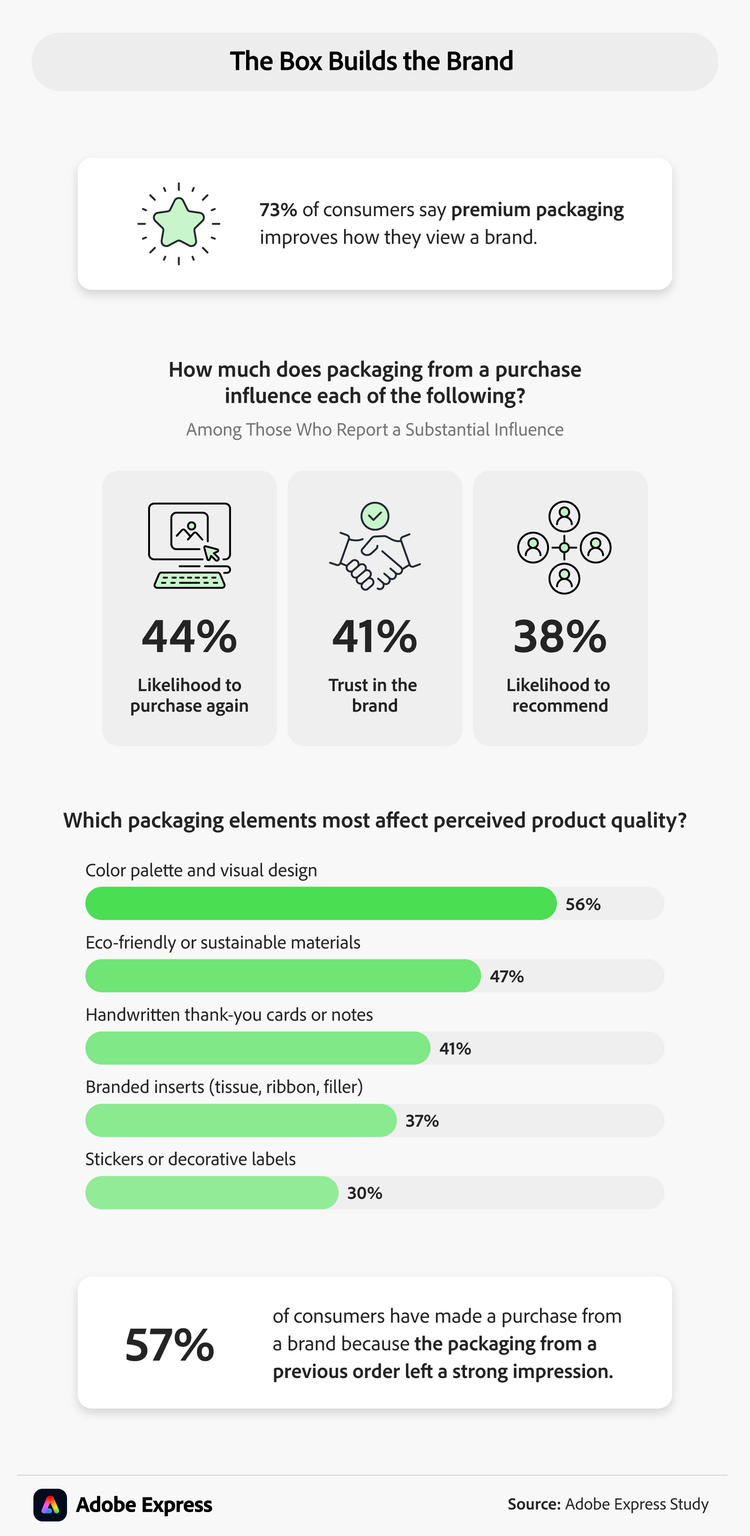
- 73% of consumers say premium packaging improves their perception of a brand.
- 57% of consumers who had a memorable packaging experience went on to make another purchase from that brand.
- 47% of consumers say eco-friendly or sustainable materials affect their perception of product quality.
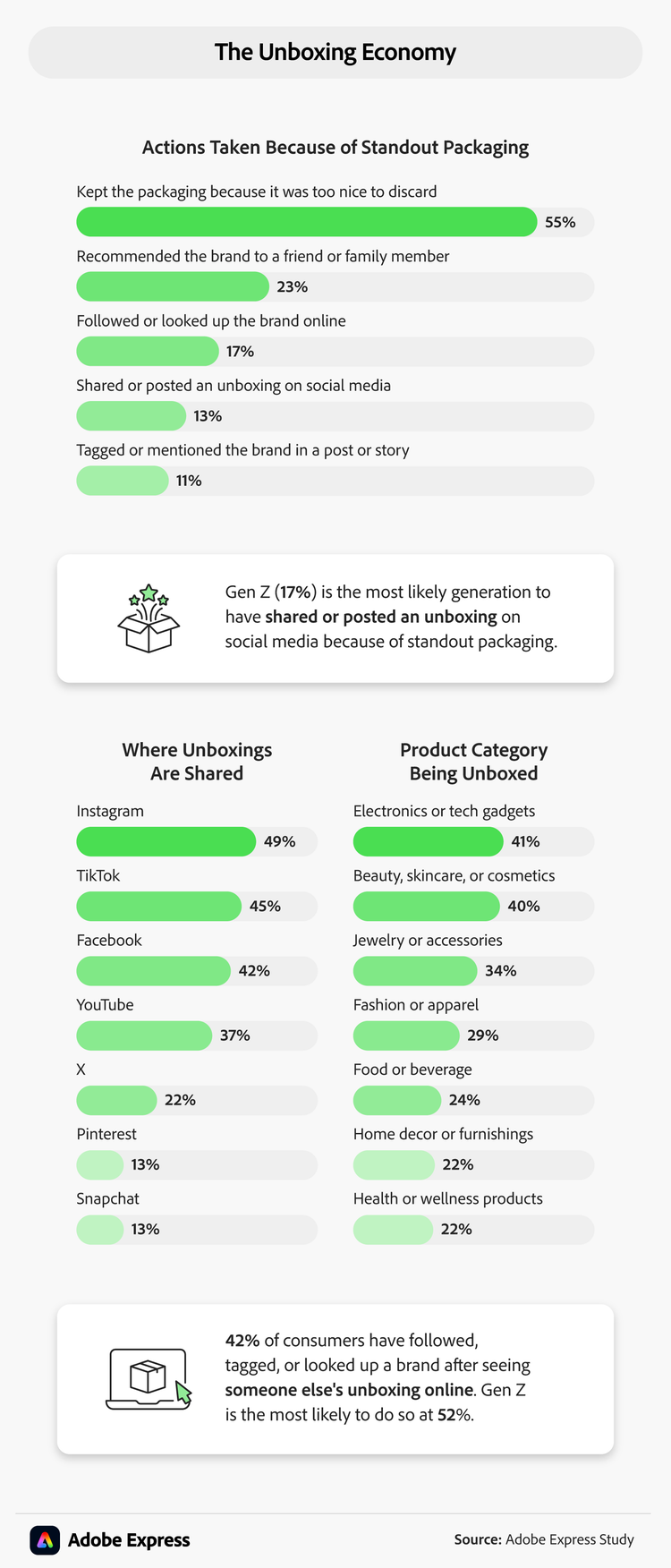
- 42% of consumers have followed, tagged, or searched for a brand after seeing someone else's unboxing online.
- 55% of consumers have kept packaging because it was too nice to throw away.
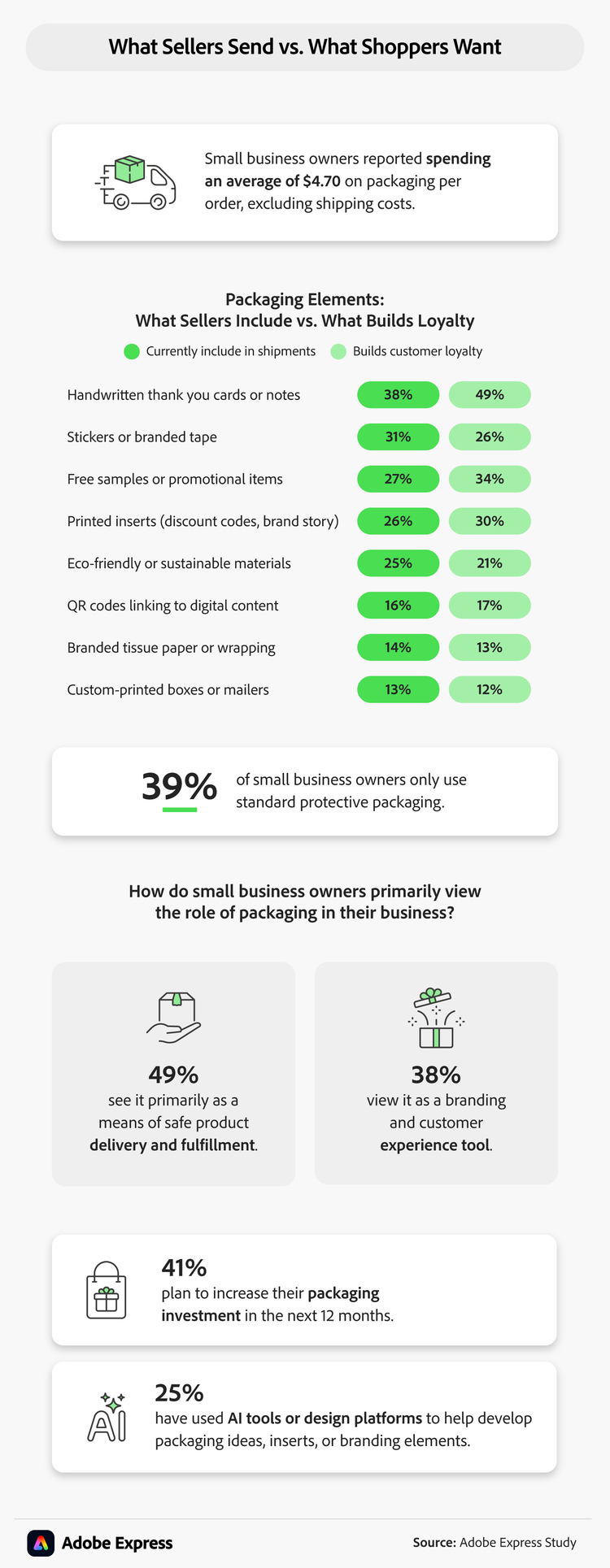
- 49% of small business owners say handwritten thank you cards are the most effective packaging tactic for earning loyalty, but 62% are missing this opportunity by not including them.
The trust factor: How packaging shapes brand perception
Packaging can affect how customers feel about your brand before they even use your product. Long before a review is written or a return is requested, the box, bag, or wrap you choose is already sending signals about who you are as a brand.
Premium packaging resonated strongly with survey respondents. A full 73% of consumers said it improved their view of the brand. The effect was especially high among Gen Z (80%), followed by millennials (73%), Gen X (68%), and baby boomers (65%).
That perception lift translated directly into purchasing behavior: 57% of consumers said they had made a purchase from a brand specifically because the packaging from a previous order left a strong impression. That number was highest among Gen Z (61%) and millennials (60%), with Gen X and baby boomers each at 49%.
Another 44% of consumers said packaging significantly influences whether they'd buy from a brand again, while 41% said it affects their trust in a brand, and 38% said it plays a role in whether they'd recommend a brand. However, there are limits to how far packaging can go. Consumers said packaging starts to feel less genuine and more gimmicky when it:
- Noticeably adds to the cost of the product (55%)
- Creates unnecessary waste or uses non-recyclable materials (54%)
- Appears more expensive than the product itself (50%)
- Prioritizes aesthetics rather than the customer experience (40%)
The most effective packaging feels intentional, not performative.
The unboxing effect: Emotions, sharing, and staying power
Opening a thoughtfully packaged order can feel less like receiving a shipment and more like unwrapping a gift. That moment of discovery triggers real emotional responses, and often prompts consumers to share, save, or even forgive.
The reach of packaging frequently extends beyond the people who receive it. After seeing someone else's unboxing online, 42% of consumers followed, tagged, or searched for that brand. That makes packaging one of the few marketing channels that works even when you're not the one doing the marketing. Every order a customer shares increases your brand's organic reach.
The most common emotion consumers reported when receiving packaging that stood out was delight or pleasant surprise (53%). Close behind were feeling like they were receiving a gift (45%), excitement (44%), and feeling valued as a customer (42%). Another 30% said they felt anticipation, and 13% reported a stronger sense of connection to the brand. More than half of consumers (55%) have kept packaging because it was too nice to throw away.
A well-packaged order can also build a cushion of goodwill, softening an otherwise frustrating experience. Roughly a quarter of consumers (26%) said premium packaging makes them more forgiving of a shipping delay, and 21% said it makes them more forgiving of a higher price.
What small business owners are investing in and what's working
Small business owners are investing in packaging, though spend and strategy vary significantly by product category. They also shared what they believe helps to build customer loyalty.
The gaps between what sellers include and what actually builds loyalty reveal real missed opportunities. Handwritten thank you cards are rated the most effective tactic for earning customer loyalty by 49% of small business owners, yet 62% still don't include them.
Free samples and printed inserts tell a similar story. Only 27% and 26% of sellers currently include them, yet 34% and 30% of sellers say they build loyalty.
Most small business owners (85%) believe their packaging meets or exceeds customer expectations. But with only 39% currently including anything beyond standard protective packaging, there's a real opportunity for brands looking to differentiate and stand out. Another 29% had already taken steps in this direction, redesigning their packaging specifically to create a more memorable unboxing experience or one worth sharing on social media.
Of those who had tried or considered various packaging elements, branded tissue paper (27%) and custom-printed boxes (26%) were most commonly flagged as not worth the cost. Sellers may want to weigh ROI carefully before investing in those specific touches.
The average cost of packaging varied across product categories as follows:
- Subscription boxes ($8.20)
- Beauty and personal care ($6.40)
- Health and wellness ($5.86)
- Home goods and decor ($5.58)
- Apparel and fashion ($4.77)
- Jewelry and accessories ($4.56)
- Electronics and tech ($3.76)
- Food and beverage ($3.45)
- Toys and hobbies ($3.44)
Overall, 68% said they track trust, repeat purchases, and recommendations as separate packaging outcomes. In other words, they measure each result separately, so they can see exactly how packaging builds trust, drives repeat sales, and encourages consumer recommendations.
Tools to help you create packaging that connects
Great packaging starts with a clear, consistent brand identity, and Adobe Express has tools to help you build it without prior experience:
- Brand kits: Store your brand's colors, fonts, and logos in one place so every label, insert, and mailer looks cohesive. Consistency is one of the fastest ways to build the kind of trust that brings customers back.
- Printed products: Design and order business cards, stickers, and flyers that double as packaging inserts, giving every shipment a built-in loyalty touchpoint.
- Logo maker: Create a polished logo to anchor your packaging and make your brand recognizable enough to search for after an unboxing.
- Flyer maker: Design printed inserts, discount cards, or brand story cards that give customers a reason to return and something worth sharing.
The box is just the beginning
What this survey makes clear is that packaging does more than protect a product. It's a marketing and discovery channel that affects how customers feel about your brand, whether they come back, and whether they tell someone else about you. When 42% of consumers have searched for or followed a brand after seeing an unboxing online, every shipment becomes an opportunity to reach an audience beyond the person opening the box.
The good news is that some of the most effective touches don't require a big budget. A handwritten note or a thoughtful insert can make your brand more memorable, more shareable, and more likely to earn a second purchase.
Methodology
Adobe Express surveyed 703 online consumers and 300 small business owners who sell physical products online. The objective of this study was to explore how packaging design, presentation, and personal touches influence consumer perception, trust, loyalty, and willingness to recommend or repurchase from online brands.
Consumer respondents were distributed across generations: Gen Z (20%), millennials (49%), Gen X (23%), and baby boomers (8%). Small business owner respondents were distributed across generations as well, including Gen Z (25%), millennials (50%), Gen X (20%), and baby boomers (5%).
We surveyed businesses across a range of product categories, including electronics and tech, apparel and fashion, home goods and decor, health and wellness, beauty and personal care, toys and hobbies, jewelry and accessories, and food and beverage. The survey was conducted using SurveyMonkey in March 2026. All percentages are rounded to the nearest whole number.
Fair use statement
The data and findings presented in this article are available for noncommercial use only. If you choose to share or reference this content, please include a link back to this page with proper attribution to Adobe Express.