

.
Get your designs printed and delivered to your door - plus, enjoy 50% off your order until January 15th (See terms).
Redeem now

Branding

How consumers really feel about AI chat

More consumers are getting comfortable with AI chat, but they still want to know who (or what) they're talking to.

Adobe Express logo

Adobe Express

December 19, 2025

Woman speaking into her smartphone using a voice assistant

AI chat has come a long way from clunky voice bots and misunderstood queries. Today, consumers are embracing smarter, faster conversations with virtual assistants, especially when it saves time. But just how comfortable are people with AI-powered chats, and where do they draw the line between helpful and too robotic?

To explore the current relationship between humans and conversational AI, Adobe Express surveyed 1,005 consumers in the US who had recently made an in-store or online purchase. The study examined how people interact with AI across various industries, the situations in which they trust it, and the extent to which they rely on it, from asking simple questions to completing purchases.

Key takeaways

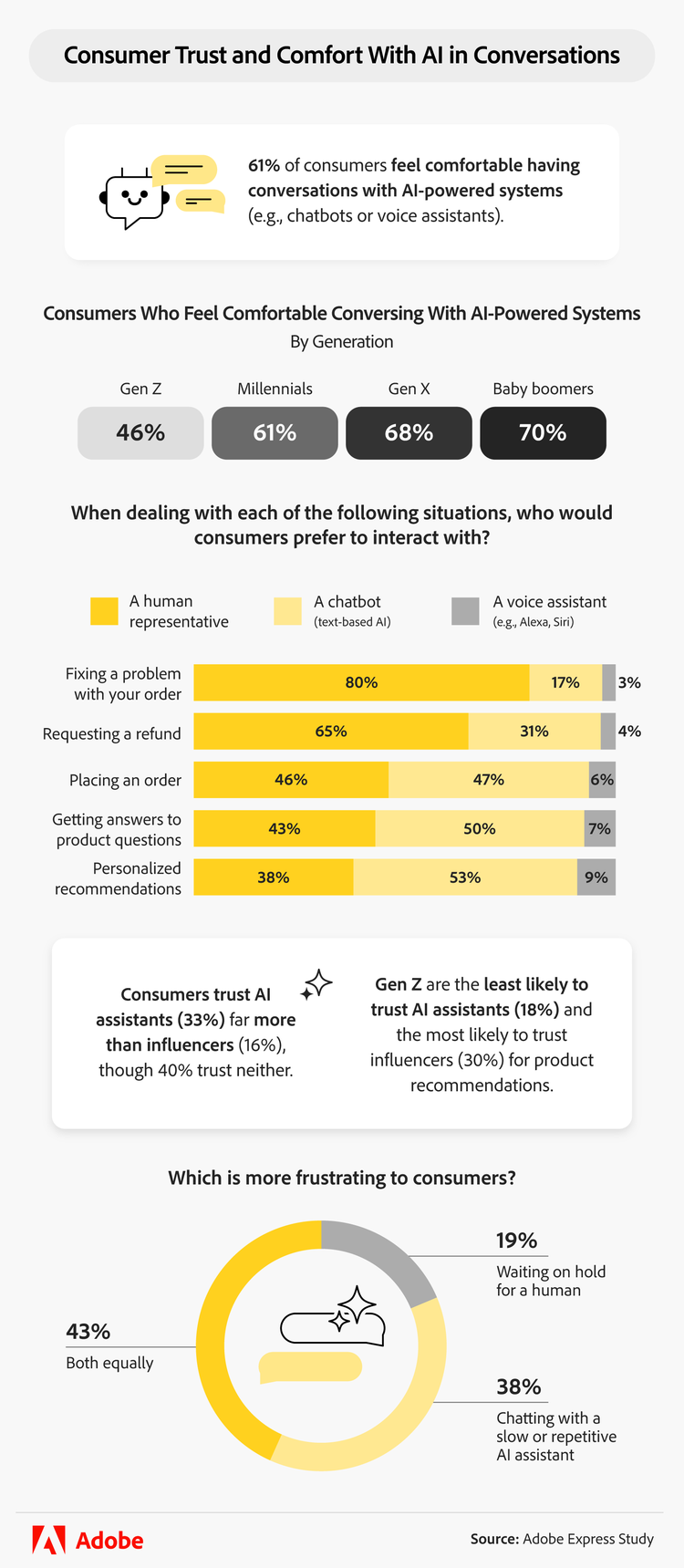
  • Nearly two-thirds of consumers (61%) now feel comfortable engaging in conversations with AI-powered systems, but Gen Z (46%) is the least comfortable with this approach.
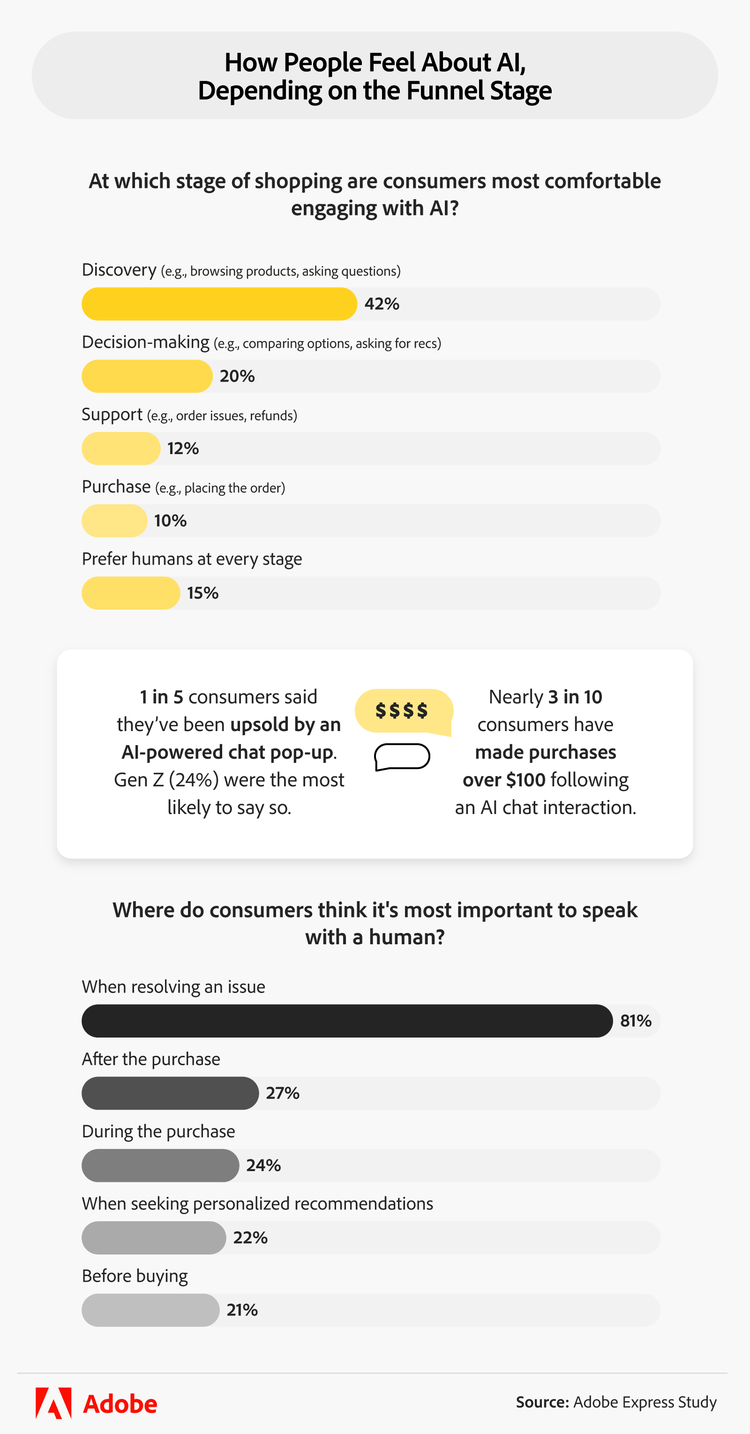
  • Nearly three in ten consumers have made purchases of over $100 after an AI chat interaction.
  • One in five consumers said an AI-powered chat pop-up has successfully upsold them, with Gen Z (24%) being the most likely to be persuaded.
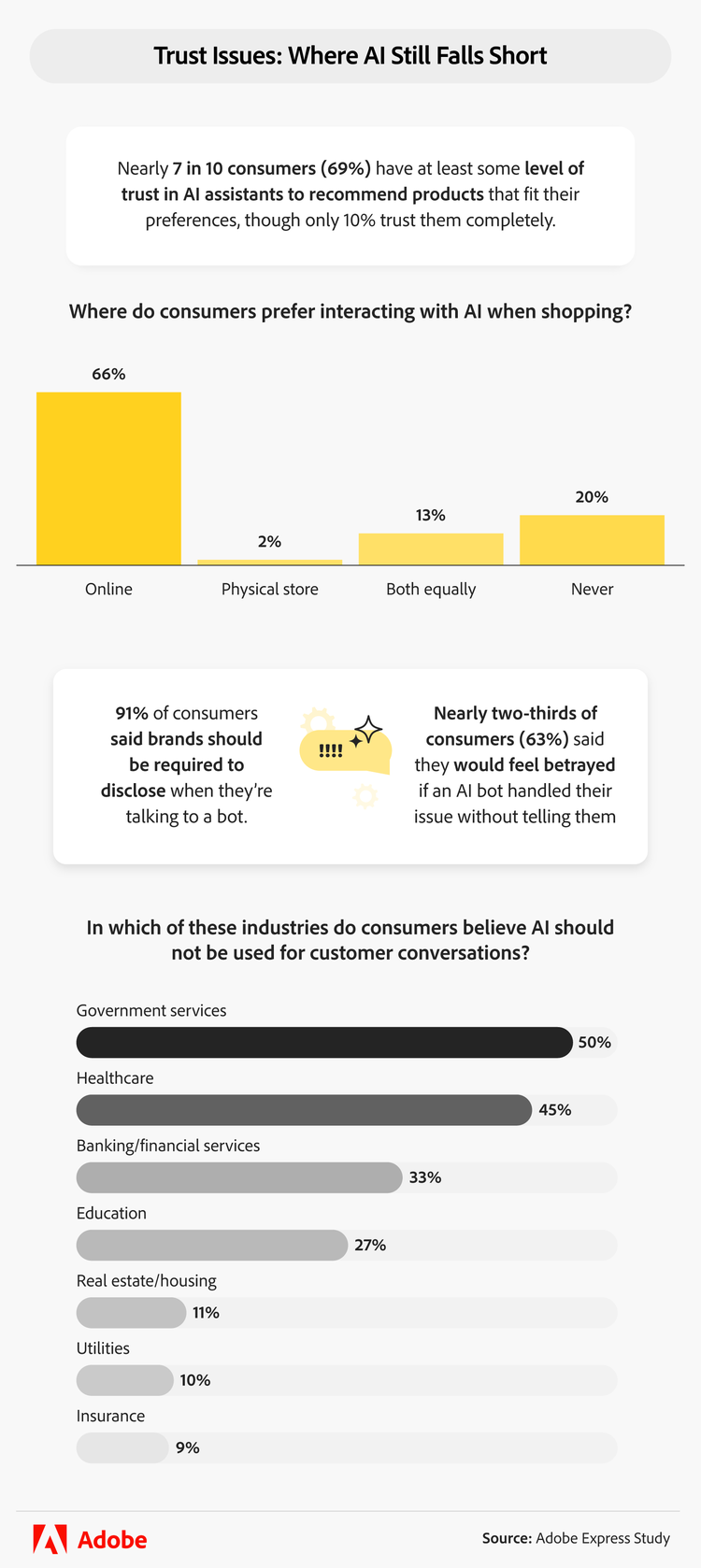
  • 91% of consumers believe brands should be required to disclose when they're interacting with a bot.
Who consumers want to talk to: AI or humans

Today's customer service is a mix of live agents, chatbots, and voice assistants. But who do people really want on the other end of the conversation?

Infographic showing consumer comfort levels with AI conversations by generation

Consumer comfort with AI conversations is generally high, with 61% of respondents saying they feel at ease chatting with bots. Still, not everyone is on board. Only 46% of Gen Z reported feeling comfortable talking to AI, making them the least trusting generation.

Consumers felt most comfortable using conversational AI for retail and e-commerce purchases (34%). The food and beverage industry ranked second at 25%, followed by entertainment and media (23%), tech and electronics (16%), travel and hospitality (8%), and education (7%).

Across all customer service situations, human interactions remain consumers' top preference, at 49%. Chatbots followed at 41%, and voice assistants lagged (11%). During a service interaction, 56% of consumers said speed and empathy matter equally. Another 29% prioritized speed alone, while only 15% said empathy is most important.

When returning an item, 60% of people wanted a human helper, but 36% were open to using a chatbot. Few (6%) would prefer a voice assistant for help with returns. For complaints, 63% preferred talking to a human, while 32% said they'd use a chatbot. Only 5% would want to deal with a voice assistant when voicing complaints.

One interesting behavior emerged: 43% of consumers admitted to pretending to be satisfied during a chatbot conversation just to end it faster. Gen Z was the most likely to do this (50%).

Where AI fits in the customer journey

On top of answering questions, AI-powered tools are influencing purchasing decisions.

Infographic showing when consumers prefer AI versus humans during the shopping process

A quarter of consumers have made a purchase after engaging with a chatbot or voice assistant. And for nearly three in ten, those purchases were over $100. One in five consumers reported being successfully upsold by an AI-powered chat pop-up. Gen Z leads the way again, with 24% saying they've made a larger purchase thanks to AI-provided suggestions.

Why trust and transparency still hold AI back

Even as AI gets smarter, trust remains a key barrier to adoption. Consumers want clear communication, not just quick answers.

Infographic showing where consumers prefer interacting with AI and industries where AI shouldn’t be used

Nearly 7 in 10 consumers (69%) said they trust AI at least somewhat to recommend products that suit their preferences. However, only 10% trust it completely. Most would prefer to interact with AI tools online (66%) rather than in a store (2%), but some (13%) were okay with either option.

Transparency is non-negotiable for most users: 91% believe brands should be required to disclose when they're interacting with a bot. Failing to do so can backfire. Overall, 63% of consumers said they would feel betrayed if a company used AI to handle their issue without telling them. Baby boomers (71%) and Gen Z (70%) were the most likely to agree.
These findings highlight a clear opportunity for brands. Consumers are open to AI, but they expect it to be helpful, transparent, and human-aware. That same balance applies beyond chatbots and customer service, especially when brands use AI to communicate with their audiences.

Use AI to communicate faster, clearer, and better

Creating clear, engaging content for your brand doesn't have to take hours or require design experience. Adobe Express uses built-in AI features to help you move faster, stay creative, and keep your message on point. Try our:

  • AI Assistant (beta): Prompt, create, and edit anything. Make quick edits and refine every layer, all while keeping the parts you love intact. Describe what you need and get quick content ideas, templates, and design help all in one place.
  • Text effect generator: Make your words stand out with creative styles and smart suggestions.
  • Template generator: Get quick layout ideas tailored to your needs, then customize with your own content, colors, and images.

Winning with AI starts with transparency

Conversational AI is becoming a regular part of customer experiences, especially in retail and service-based industries. While most people are open to chatting with bots, they still expect brands to be transparent and respectful about it. Even as comfort with AI grows, human connection still matters. Brands that use AI to enhance speed, support, and satisfaction have a real opportunity to build stronger, more trusted customer relationships.

Methodology

Adobe Express surveyed 1,005 consumers in the US to examine their attitudes toward using AI-powered tools such as chatbots and voice assistants. All respondents had shopped either online or in-store within the past three months. The sample included Gen Z (18%), millennials (51%), Gen X (22%), and baby boomers (9%). Data was collected in November 2025. The survey was conducted via SurveyMonkey, and all responses are self-reported.

Fair use statement

If you'd like to share insights from this article, you're welcome to do so for noncommercial purposes. Please include a link back to Adobe Express for proper attribution.

Try Adobe Express for free now