
Pinterest has become more than just a place to save ideas. People now go on the platform to search and shop. A surprising number are starting their searches on Pinterest instead of Google, and businesses are leveraging it, too. Many say it drives more engagement than other platforms. So, what's making Pinterest such a powerful search tool? This study breaks it down.
Key takeaways
39% of consumers use Pinterest as a search engine.
36% of consumers start their searches on Pinterest instead of Google, with Gen Z being the most likely (39%).
24% of business owners use Pinterest, and nearly a quarter plan to increase their ad spending on the platform this year.
Is Pinterest the future of e-commerce? 80% of businesses believe it outperforms other search platforms in driving engagement.
style
long-form, long-form-blog, xxl-spacing-top
Pinterest is attracting a younger audience
Pinterest is becoming a go-to platform for search and discovery, especially among younger users and women.
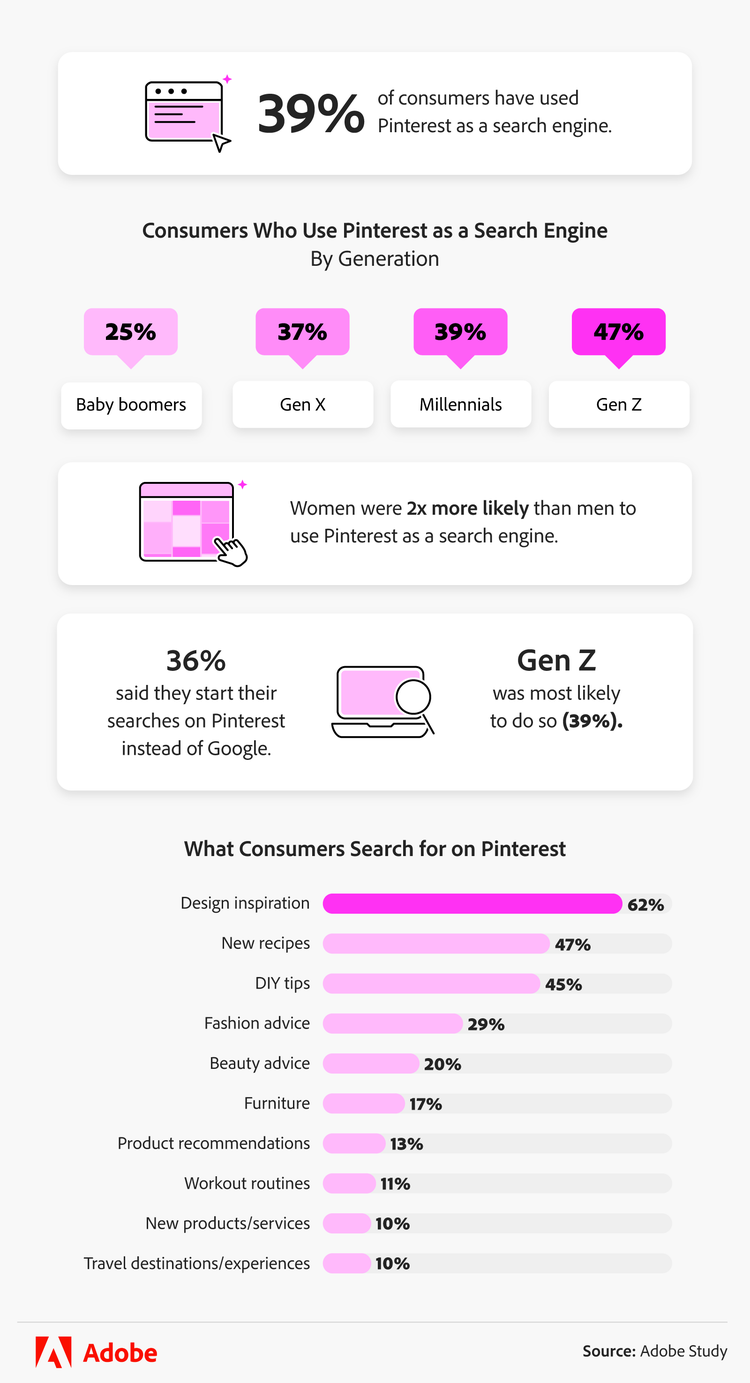
About two in five consumers (39%) have used Pinterest as a search engine. Gen Z used it the most for this purpose (47%), and women were twice as likely as men to do so. Surprisingly, over a third of consumers (36%) said they start their searches on Pinterest instead of Google, with Gen Z again being the most likely (39%).
Most often, consumers have used Pinterest to find design inspiration, new recipes, and DIY tips. But it's not just about gathering ideas. More than one in 10 (13%) said they search Pinterest for product recommendations, and 10% use it to learn about new products or services.
style
long-form, long-form-blog, l-spacing
Why consumers rely on Pinterest
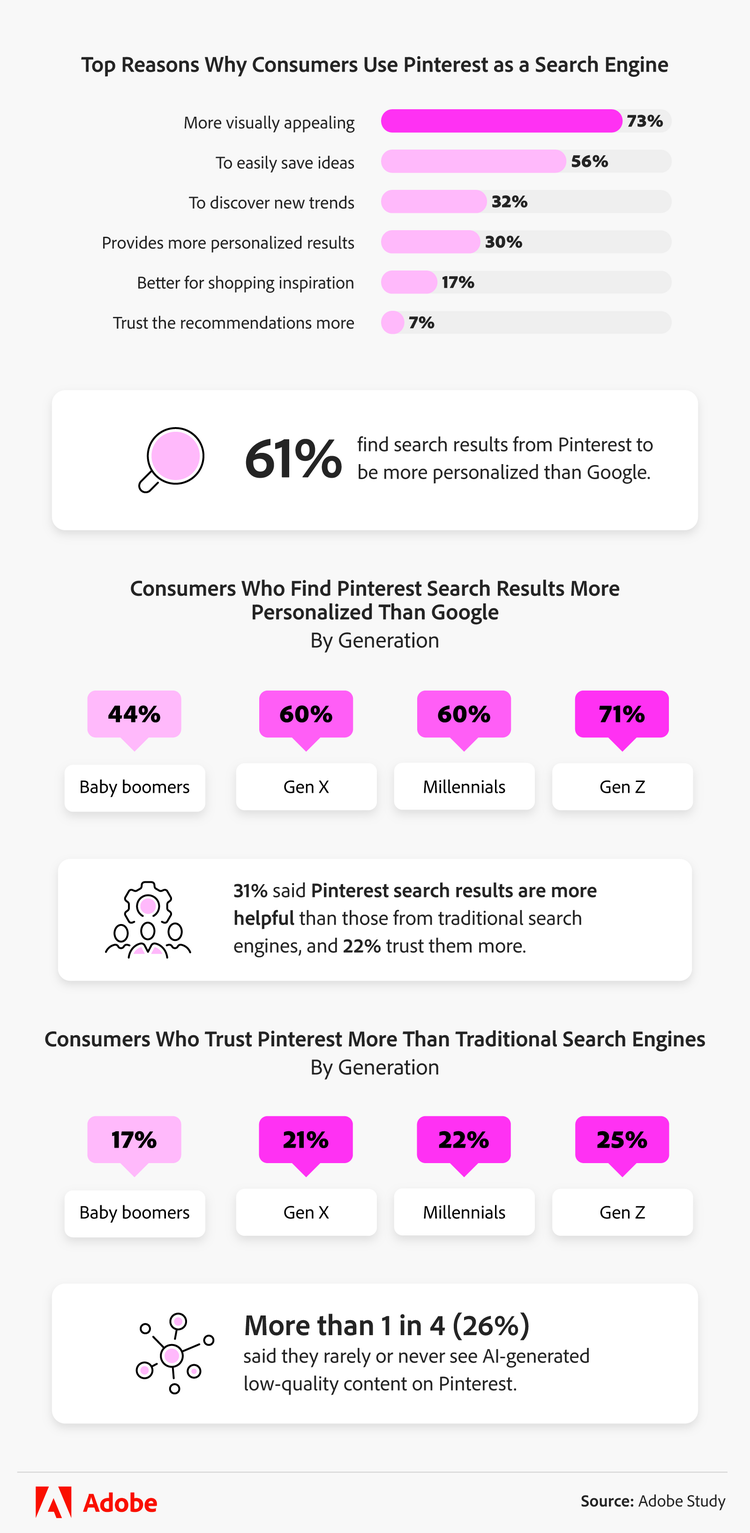
People who use Pinterest as a search engine have clear reasons for choosing it over more traditional options. Consumers are drawn to its visual format, personalized results, and more.
Pinterest's biggest appeal is its visually engaging search results, cited by 73% of users. Consumers also appreciate how easy it is to save ideas (56%) and discover new trends (32%).
More than half (61%) said Pinterest's search results feel more tailored to them than Google's, especially Gen Z (71%). Over one in five said they trust Pinterest results more than traditional search engines. Gen Z expressed this belief the most (25%).
Search quality is another key factor, with 26% of users saying they rarely or never encounter low-quality AI-generated content in Pinterest search results.
style
long-form, long-form-blog, l-spacing
How business owners use Pinterest
Business owners are turning to Pinterest to grow their brands, with many saying it drives more traffic and engagement than other platforms. However, keeping up with best SEO practices and content creation remains a challenge.
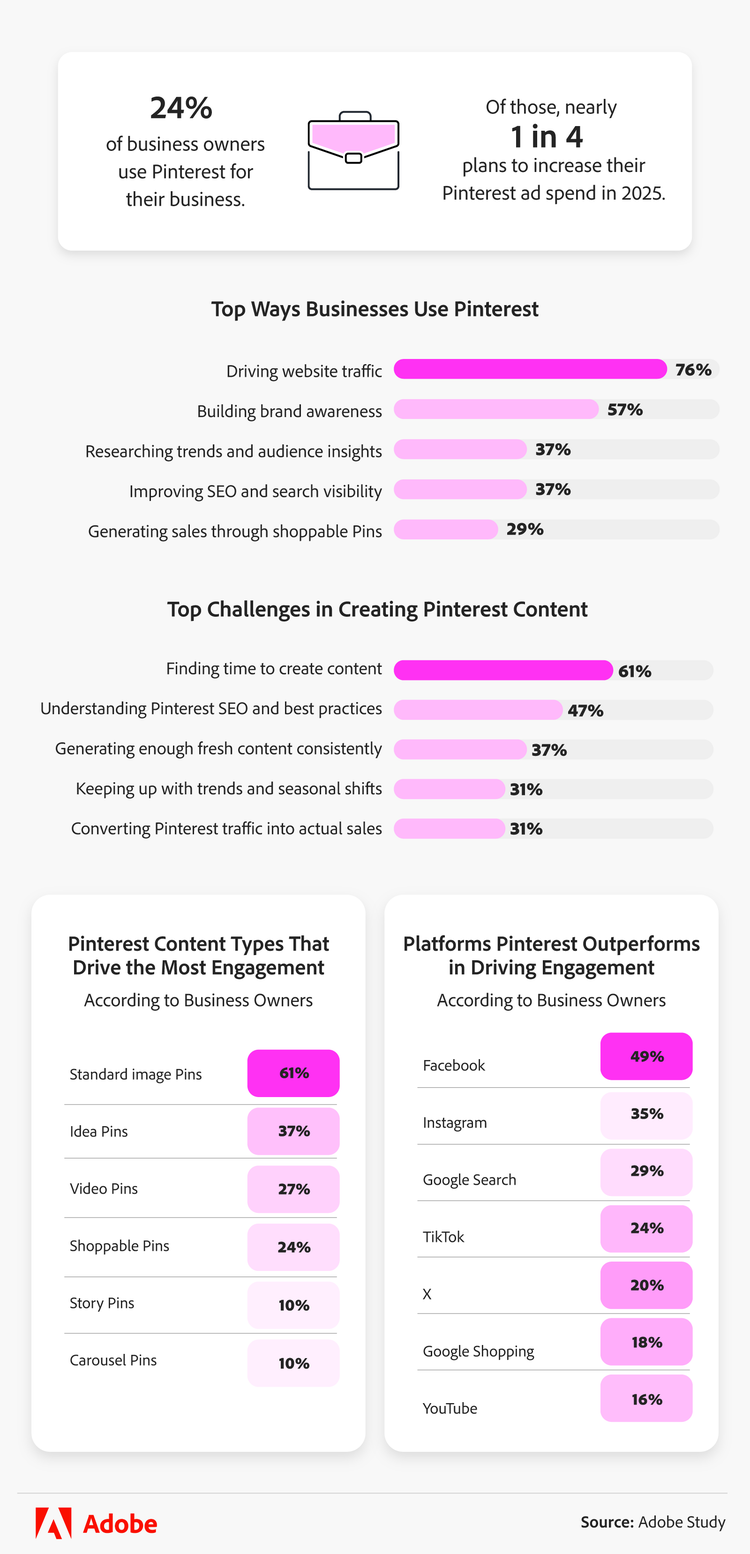
About a quarter of business owners have turned to Pinterest as a marketing tool. Among those leveraging the platform, 76% said they use it to drive website traffic, while 57% focus on building brand awareness. The most engaging content types were standard image Pins (61%), followed by idea Pins (37%) and video Pins (27%).
Pinterest also stood out for engagement, with 80% of businesses that use it saying it outperforms other platforms in keeping consumers interested and interacting with their content. Specifically, businesses found it more effective than Facebook (49%), Instagram (35%), and Google Search (29%) for driving actions like saves, clicks, and shares.
Despite its benefits, business owners faced challenges with marketing on the platform. The top problem was finding the time to create Pinterest content (61%). Other common hurdles included understanding SEO and best practices (47%) and producing enough fresh content (37%) to stay competitive.
style
long-form, long-form-blog, l-spacing
Pinterest is changing how people search
Pinterest isn't just for inspiration anymore. It has become a trusted search tool for consumers, and businesses are benefiting from it. With its visual and personalized results, many users prefer Pinterest over traditional search engines. For small business owners, investing in Pinterest content could be a smart move to reach new audiences and drive more traffic.
Methodology
Adobe surveyed 800 consumers and 200 business owners on March 12, 2025, to understand how people use Pinterest as a search engine. Of the respondents, 16% were Gen Z, 51% were millennials, 25% were Gen X, and 9% were baby boomers. The gender breakdown was 51% male, 48% female, and 1% non-binary. Only responses from those who use Pinterest in this way were included. All survey data is self-reported.
Fair use statement
You are welcome to share this content for noncommercial purposes, but a link to our page is required.
You can control how Adobe websites use cookies and similar technologies by making choices below. But note that if you disable cookies and similar technologies entirely, Adobe websites may not function properly.
Cookies are small text files stored by your web browser when you use websites. There are also other technologies that can be used for similar purposes like HTML5 Local Storage and local shared objects, web beacons, and embedded scripts. These technologies help us do things like remembering you and your preferences when you return to our sites, measure how you use the website, conduct market research, and gather information about the ads you see and interact with.
You can make choices in the menu below about what cookies and other technologies you want us to use on Adobe sites when you visit them from this browser. You can always change those choices later by clicking on the Cookie Preferences link at the bottom of the page.
If enabled:
We can improve your experience by tailoring the site and the content to things we think might be of interest
We can better keep track of your preferences — like what language you prefer to use
We will better understand your likely interests so we can provide you more relevant Adobe ads and content on non-Adobe websites and in non-Adobe apps
It will help us improve the performance of our website and those of our partners who use the Adobe Experience Cloud
If disabled:
We won’t be able to remember you from session to session so the experience may not be tailored to your interests
You’ll still have access to the content of the site but certain features that depend on cookies may not function
You’ll still see ads, they just may not be as relevant to you
General information
You can control how Adobe websites use cookies and similar technologies by making choices below. But note that if you disable cookies and similar technologies entirely, Adobe websites may not function properly.
Cookies are small text files stored by your web browser when you use websites. There are also other technologies that can be used for similar purposes like HTML5 Local Storage, web beacons, and embedded scripts. These technologies help us do things like remembering you and your preferences when you return to our sites, measure how you use the website, conduct market research, and gather information about the ads you see and interact with.
You can make choices in the menu below about what cookies and other technologies you want us to use on Adobe sites when you visit them from this browser. You can always change those choices later by clicking on the Cookie Preferences link at the bottom of the page.
If enabled:
We can improve your experience by tailoring the site and the content to things we think might be of interest
We can better keep track of your preferences — like what language you prefer to use
We will better understand your likely interests so we can provide you more relevant Adobe ads and content on non-Adobe websites and in non-Adobe apps
It will help us improve the performance of our website and those of our partners who use the Adobe Experience Cloud
If disabled:
We won’t be able to remember you from session to session so the experience may not be tailored to your interests
We’ll still count your use of our site and services
You’ll still have access to the content of the site but certain features that depend on cookies may not function
You’ll still see ads, they just may not be as relevant to you
Operate the site and core servicesOperate site and measure engagement
Always active
These cookies are required, and they are used to enable the site and related services core functionality. Without them the site could not operate, so they cannot be disabled.
These cookies enable the site and related services’ core functionality and collect statistics about user engagement, such as counting active use to help us understand trends. These cookies cannot be disabled.
Measure performance
These cookies are used to analyze site usage to measure and improve performance. Without them Adobe cannot know what content is most valued and how often unique visitors return to the site, making it hard to improve information we offer to you.
These cookies are used to analyze site usage to measure and improve performance. Without them Adobe cannot know what content is most valued, making it hard to improve information we offer to you.
Extend functionality
These cookies are used to enhance the functionality of Adobe sites such as remembering your settings and preferences to deliver a personalized experience; for example, your username, your repeated visits, preferred language, your country, or any other saved preference.
Personalize advertising
These cookies are used to enable Adobe and our partners to serve ads more relevant to your interests. Without them you will still see ads, but they might not be as relevant to you.